Principles of Lean Production (Edexcel IGCSE Business)
Introduction to lean production
Spec point —
5.2.2· Principles of lean production
-
Lean production involves the minimisation of the resources used in production
- Less time is required as the production process is organised in the most efficient way
- Fewer materials are used as there is a focus on waste reduction
- Less labour is used as lean production is typically capital intensive
- The space required for production is reduced as a result of just in time stock management
- A small number of trusted suppliers work closely with the business
-
The use of lean production is likely to lead to a competitive advantage
- Lower unit costs are achieved due to minimal wastage so prices may be lower than those offered by competitors
- High quality output is likely as a result of supplier reliability and carefully managed production processes
- The result should be increased profit margins
-
Lean production uses strategies such as Just in Time stock control and Kaizen
Just-in-time (JIT) stock management
Spec point —
5.2.2· Principles of lean production: • just-in-time (JIT) definition, +'s & -'s"
Just-in-time (JIT) stock management
-
Just-in-time (JIT) stock management is a process in which raw materials are not stored onsite but ordered as required and delivered by suppliers 'just in time' for production
-
Careful coordination is required to ensure that raw materials and components are delivered by suppliers at the moment that they are to be used
- Close relationships with suppliers need to be developed
- Suppliers may need to be in close proximity
-
Just-in-time is particularly useful for businesses that operate in dynamic markets
-
Products may need frequent design changes that require different components
- Holding large amounts of stock risks wastage through obsolescence
-
Where significant competition exists lean production can ensure a high level of quality to achieve a competitive advantage
-
Advantages and disadvantages of just-in-time stock management
| Advantages | Disadvantages |
|---|---|
| - Stockholding costs including storage costs are minimised - Close working relationships are developed with a small number of trusted suppliers - Cash flow is improved as money is not tied up in stock - Unused storage space is available for productive use | - Bulk buying economies of scale *are not generally possible - The ability to respond to unexpected increases in demand is reduced - Administrative costs related to frequent ordering are increased - Unreliable suppliers (e.g. late or poor quality deliveries) can quickly halt production |
Kaizen
Spec point —
5.2.2· Principles of lean production: • Kaizen definition, +'s & -'s"
Kaizen
-
Kaizen involves taking continuous steps to improve productivity through the elimination of all types of waste in the production process
- Changes are small and ongoing rather than significant one-off’s
- They are constantly reviewed to ensure that they achieve the desired positive impact on productivity and always focused on meeting customers' needs
-
Kaizen requires a long-term cultural and management commitment to change
- All workers must be actively involved in making improvements, not just management
- Ongoing training and development is vital
The impact of Kaizen on productivity over time
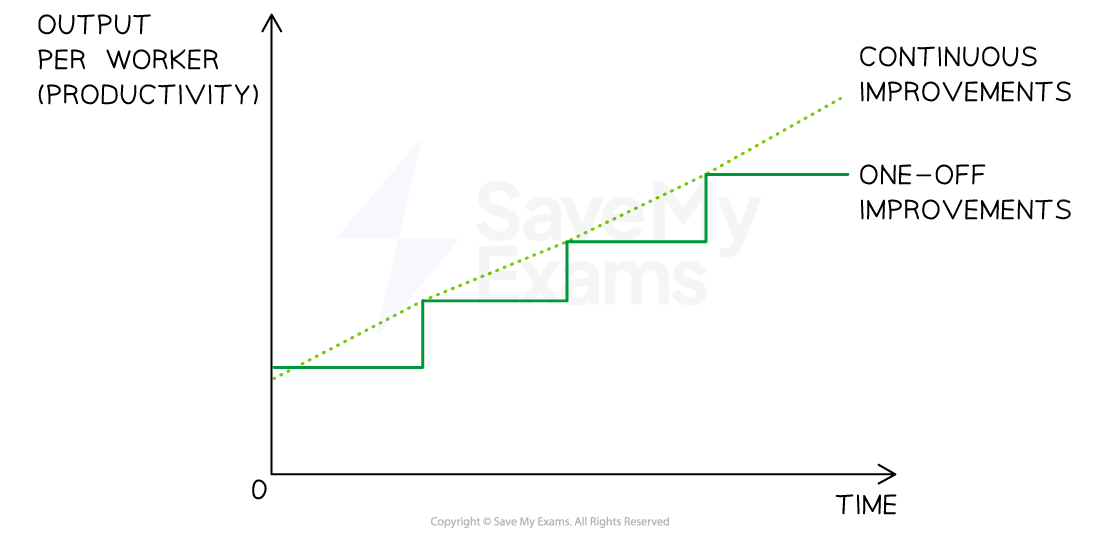
Kaizen versus one-off improvements
-
Elements of Kaizen commonly include
-
Zero defects in manufacturing
-
High levels of automation
-
High levels of cooperation between workers and management
- Employees are likely to work in teams and be empowered to work creatively
-
-
Staff training and computer inventory management systems may also reduce wastage as fewer errors are likely to be made
Exam Hint In the exam, you could be asked to justify whether a business should improve efficiency by adopting just-in-time or kaizen. A great evaluation point is that, in most cases, the two elements of lean production are adopted together.
The importance of using resources effectively
Spec point —
5.2.2· Principles of lean production: • the importance of using resources effectively. definition, +'s & -'s"
The importance of using resources effectively
-
Lean production is focused on the effective use of resources and, in particular, the elimination of waste throughout the business
- Waste refers to anything that prevents a business from being efficient
- Seven key types of waste are minimised in lean production
The seven wastes
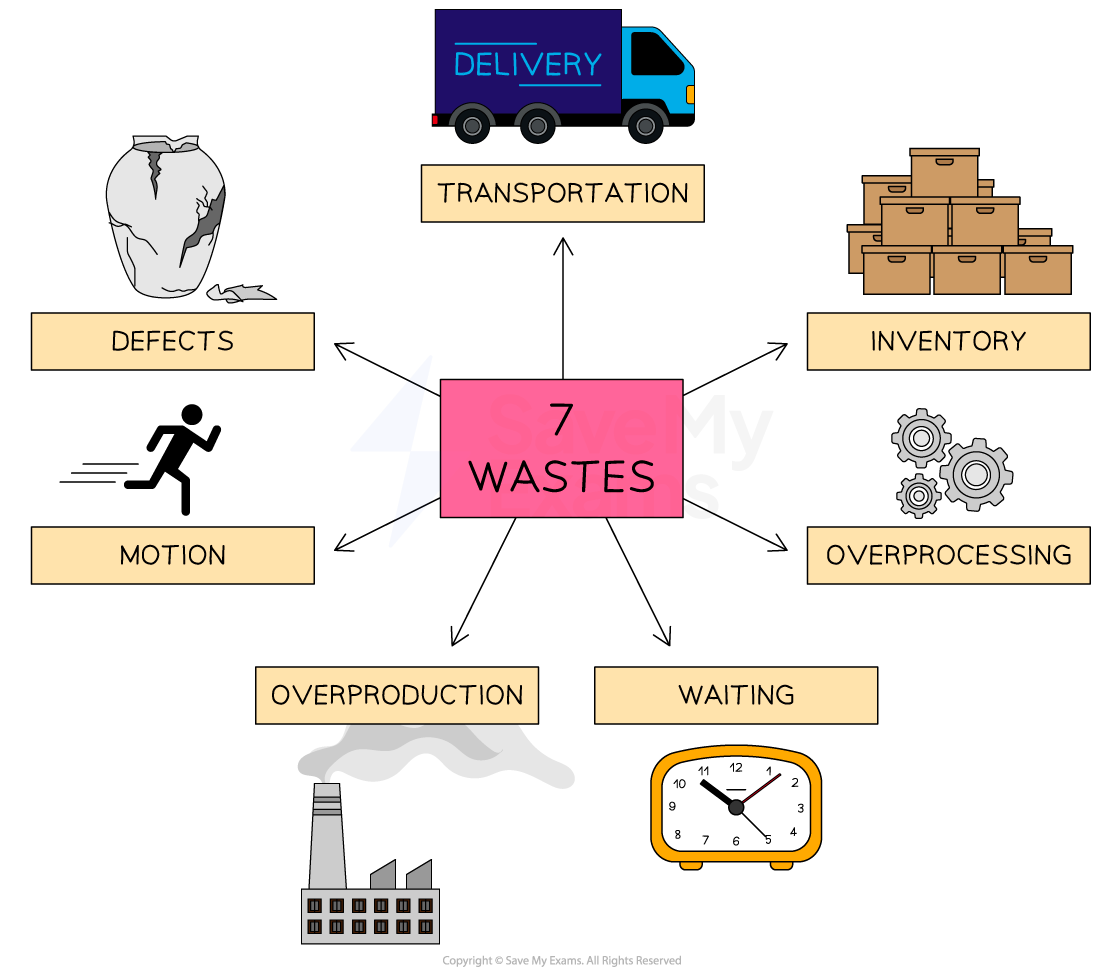
Lean production involves the reduction of all types of waste
- Transportation: Unnecessary movement of materials or products
- Inventory: Excess raw materials, work-in-progress, or finished goods
- Motion: Unnecessary movement of people or equipment
- Waiting: Delays or idle time in the production process
- Overproduction: Producing more than what is required by the customer
- Overprocessing: Using more resources than necessary to produce a product
- Defects: Products or services that do not meet customer requirements
Benefits of reducing waste
| Benefit | Explanation |
|---|---|
| Competiveness | - Minimal levels of waste reduces costs, allowing a business to lower prices to gain market share from more expensive rivals |
| Lower costs | - Lower spending on reworking defective products, storage space and moving stock or finished goods can lead to greater profits - This can be retained for future use or distributed to shareholders as dividends |
| Better customer service | - Customers are likely to be satisfied with higher quality and short lead times associated with lean production, leading to increased customer loyalty |
| Environmental benefits | - Business reputation may improve as a result of using fewer resources such as energy and making better use of others, for example recycling |
Was this revision note helpful?
Build on this topic