Other Forms of Business Organisation (Edexcel IGCSE Business)
Franchises
Spec point —
1.2.3· Franchisor, franchisee; advantages + disadvantages; examples
-
Franchising is a business format in which an individual (franchisee) buys the rights to operate a business model, use its branding and software tools and receive support from a larger company (franchisor). The franchisee will pay both an initial lump sum plus ongoing royalty fees
-
The franchisee is usually the owner of a private limited company
- The business is operated under the franchisor's established system and training, marketing support and ongoing assistance are provided
- Examples of well-known franchises include Domino's Pizza, KFC and Burger King
A selection of fast food franchises
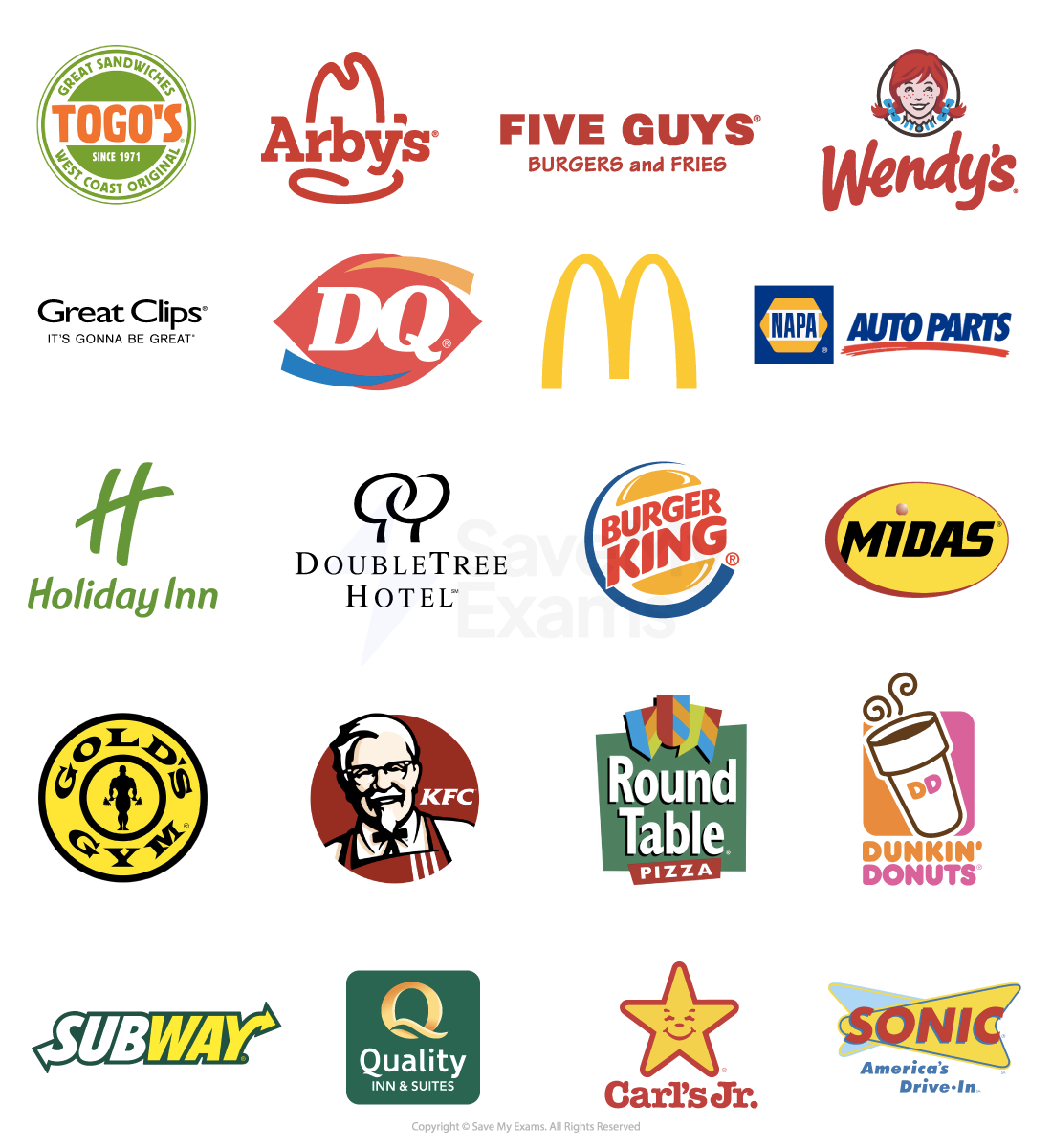
Some of the many well-known brands sold as franchise opportunities
-
A franchise is not a form of business ownership; it is an alternative to starting a brand new business from scratch
- In most cases, franchisors require businesses to operate as private limited companies as this form of ownership is considered to be more stable than sole traders or partnerships
Advantages and disadvantages of owning a franchise
| Advantages | Disadvantages |
|---|---|
| - A recognised brand name which is promoted centrally by the franchisor - E.g. Dominos sponsored 'The Simpsons' for many years - Product **training, **such as how to consistently make good pizzas, is provided to ensure the quality and consistency of the brand - Equipment and supplies are provided by the franchisor so that the product will be the same regardless of where it was purchased - Franchisees buy an exclusive area or market to sell to - The franchisor will not create any more franchises in that area, limiting competition - Advice, training, use of software systems and problem solving are ongoing and the franchisor may also provide services such as loans and insurance | - A fixed sum must be paid at the start of the franchise for the right to use the business name and resources - Regular royalties must also be paid which vary according to the level of sales, often around 5 - 10 % of sales turnover - The franchisor may sell materials or equipment to the franchisee at** inflated prices** - If the franchisee does not produce the good/service to the required standard set by the franchisor the right to run the franchise can be removed from them - Franchisees have little say about how the business is run and lack freedom to introduce new products or change selling prices |
Social Enterprises
Spec point —
1.2.3· Definition, objectives, +'s & -'s
-
A social enterprise is a business that has the primary purpose of creating social or environmental impacts, in addition to generating profits
-
Social enterprises can take different forms
- Cooperatives have a social mission. They are owned and controlled by workers or customers and their members have the right to elect directors and share profits
- Charities raise money, provide help and raise awareness of social, ethical, environmental or developmental issues #### Objectives of social enterprises
| Social | Environmental | Ethical | Financial |
|---|---|---|---|
| - Provide jobs and support for disadvantaged groups in society, such as the disabled or homeless | - Protect the natural world, animals and their habitats, and reduce the impacts of pollution or overdevelopment | - Operate the business in a responsible way by treating stakeholders including employees and suppliers fairly | - Make a profit to invest back into the social enterprise to expand the social work that it performs |
Case Study
- Butterfly Books is a social enterprise that publishes children’s educational books in the UK
- Their aim is to 'work to educate, inspire and entertain children, aiming to change future generations by reducing gender bias in job roles'
- A recent book entitled 'My Mummy is an Engineer' challenges gender stereotypes

Advantages and disadvantages of social enterprises
| Advantages | Disadvantages |
|---|---|
| - Social enterprises often have a good reputation which can attract highly-qualified employees and encourage customer loyalty - For-profit rivals may be encouraged to improve their business practices to better compete with social enterprises - Deserving causes receive much-needed financial support | - Social enterprises may face media scrutiny so must ensure they behave responsibly at all times - Profits (surpluses) available for reinvestment are limited as they are shared with members or good causes - Decision-making is often slow as many stakeholders need to be consulted |
Multinationals
Spec point —
1.5.2· Definition, +'s & -'s, impact on stakeholders
-
A multinational company (MNC) is a business that is registered in one country but has manufacturing operations/outlets in different countries
- E.g. Starbucks headquarters are in Washington, USA but they have 32,000 stores in 80 countries
-
Factors such as globalisation and deregulation have contributed to the growth of MNC’s
-
MNC’s choose locations based on factors such as cost advantages and access to markets
- E.g. Nike originates from the USA but 50% of their manufacturing takes place in China, Vietnam and Indonesia due to the lower production costs in these countries
Exam Hint Explain questions are worth three marks and require a clear point with a two-step development.
- A good way to structure answers to these questions is X (the point) leads to Y and results in Z.
- Explain questions do not need you to use a business context.
Was this revision note helpful?
Build on this topic