The Use of Data in Market Research (Edexcel IGCSE Business)
Quantitative and qualitative market research
Spec point —
4.1.3· The use of data in market research: • qualitative and quantitative data
Quantitative and qualitative market research
-
Market research data can be quantitative or qualitative
- Both forms are useful and any data analysis should ideally include a combination of the two
-
Quantitative data is based on numbers and could include financial reports (e.g. sales, costs), market data (e.g. markets share) or summaries of data gained from primary research (e.g. on a scale of 1-10 rate our customer service)
-
Qualitative data gathers descriptions or explanations based on conversations, discussions, impressions, and emotional feelings and is usually gathered through primary research
Limitations of quantitative and qualitative research data
| Limitations of quantitative data | Limitations of qualitative data |
|---|---|
| - Numerical data may be out-of-date, especially in dynamic markets - Data analysis and interpretation is a complex skill that is likely to be lacking in smaller businesses - Looking at a small amount of data and then extrapolating results can provide wrong assumptions on which to base decisions - Numerical data does not provide reasons for outcomes e.g. data may reveal sales volumes are falling, but not the reason for the decline | - Bias may mean that analysts can interpret responses in a particular way - Respondents may lack awareness or language skills to explain preferences accurately - Respondents in focus groups may be influenced by the responses of others, or not provide accurate information - Qualitative data is difficult to present in graphs and charts so may not be easily understood |
Exam Hint Make sure that you can define both of these key terms and identify examples of quantitative and qualitative research data.
Social media and market research
Spec point —
4.1.3· The use of data in market research:
- the role of social media in collecting market research data
Social media and market research
- Traditionally, primary research has been relatively difficult and expensive for businesses to gather
- The rise of social media platforms such as Facebook, Twitter, Instagram and TikTok has provided businesses with incredible market research opportunities (and some threats too!)
Benefits of using social media to collect market research data
| Benefit | Explanation |
|---|---|
| Speed | - The speed of communication between businesses and customers can be almost instantaneous, e.g. by using online polls, thousands of responses can potentially be received in several hours |
| Cost | - The cost of gathering this information can be very low e.g. Online polls take a few minutes to set up and software automatically gathers and analyses the results |
| Relationships | - Social media helps businesses to generate an interactive relationship with their customers which helps to strengthen brand loyalty |
| Feedback | - Customers are also able to feedback quickly on products - or to express innovative ideas about how they want the products to be changed - This feedback may help the firm to develop extension strategies in their product life cycle |
The reliability of market research data
Spec point —
4.1.3· The use of data in market research: • the importance of the reliability of market research data.
The reliability of market research data
-
Gathering and analysing reliable data is critical to a business
- It supports decision-making and reduces risk
- It helps businesses to set realistic objectives and manage performance
-
The reliability and accuracy of market research depend upon a range of factors
Factors affecting the reliability of market research data
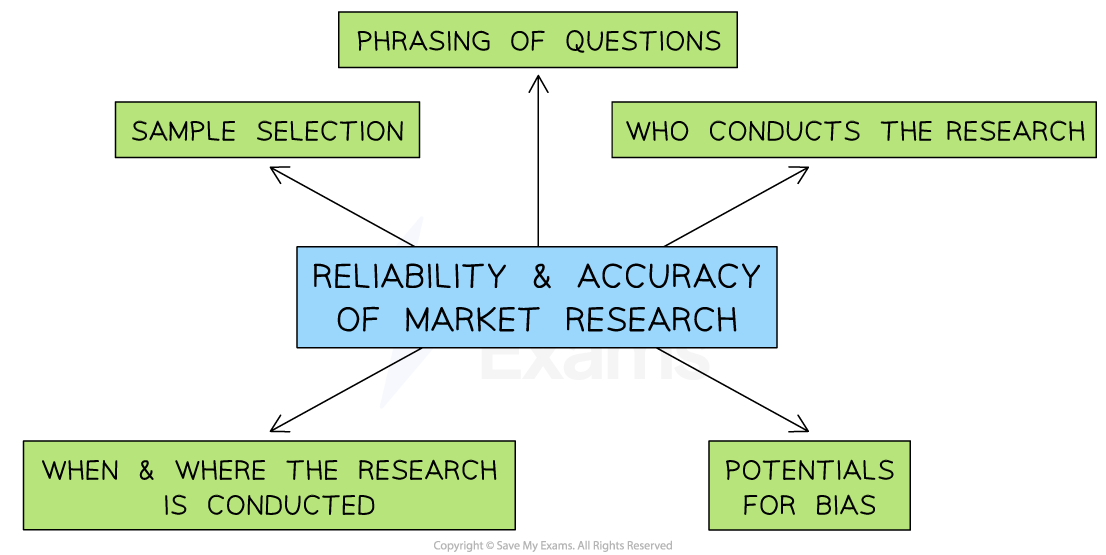
The reliability and accuracy of market research data depend on factors including the time and place of research, who carries out and take part in the research, the potential for bias and how questions are phrased
-
How questions are phrased in questionnaires or other tools used to conduct surveys
- E.g. Market researchers should avoid leading questions
-
How carefully the sample is selected
- Including its size,types of respondent chosen and how closely these reflect the intended target market
-
Who conducts the research?
- Do researchers have the experience, research skills to conduct research effectively?
- Is the source primary or secondary?
-
Potential for Bias when conducting research or analysing results
- Presenting results in a particularly positive or negative way can impact decisions made
- Personal preferences should be avoided
-
When and where the research is conducted
- Customer tastes, fashions, economic conditions and technology change, giving data a relatively short period of usefulness
- Customers in different geographic areas can have very different opinions
Was this revision note helpful?
Build on this topic