The Roles & Responsibilities of Employees (Edexcel IGCSE Business)
Roles and responsibilities
Spec point —
2.5.2· Roles and responsibilities of employees in terms of compliance and accountability: • span of control • chain of command
Roles and responsibilities
- The organisational structure of a business determines the roles, responsibilities and relationships between individuals in an organisation
Business roles
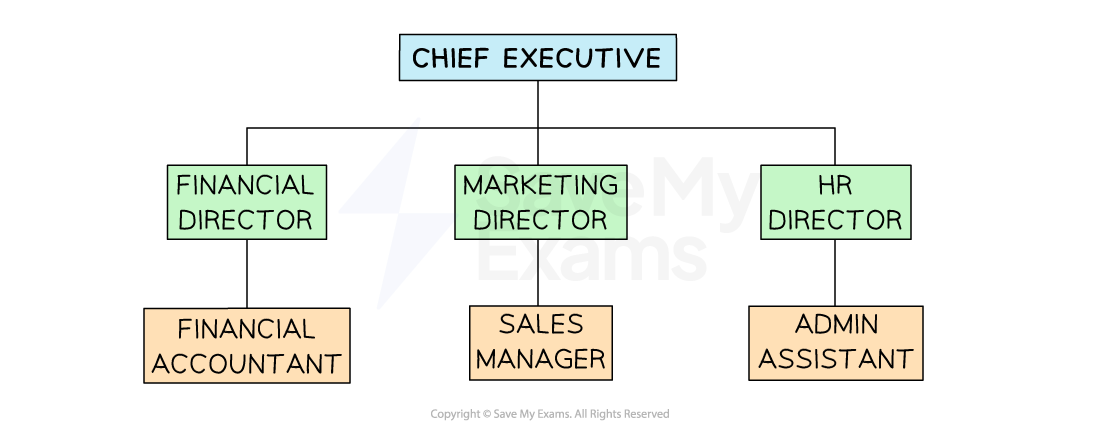
*Larger firms are usually arranged into functional departments such as finance and marketing, which are led by directors who carry the final responsibility for the work of everyone in the department *
The role of directors
-
Larger businesses often have a board of directors who make key strategic business decisions such as
- Implementing new corporate policies
- Investment of retained profit and share capital
- Growth objectives
-
The board normally consists of a senior employee from each department, officers (such as treasurer or secretary) and the owner or chief executive officer (CEO) of a business
The role of managers
- Managers have many responsibilities in the business and help it to operate effectively on a day-to-day basis
- Types of managers include senior and functional managers, line managers and supervisors
Roles and responsibilities of managers
| Role | Responsibilities |
|---|---|
| Senior manager | - Plan to achieve the business’ overall goals - Set long-term plans and targets for the business - Contribute to strategic decisions |
| Functional manager | - Work to achieve the short and long-term targets set by the directors and senior managers - Responsible for running a function within the business, e.g. marketing or finance - Make operational decisions - Use employees and other resources in the best possible ways |
| Supervisor/team leader | - Help managers achieve their targets by reporting any problems and passing on instructions - Take simple decisions such as allocating jobs among different employees |
The role of operational and support staff
-
Operational staff complete tasks to which they are directed by their manager(s)
- E.g. In a department store operational staff include customer service representatives, sales assistants and security staff
-
Support staff assist with the non-core operations of a business
- E.g. In a bank support staff may include cleaners, IT technicians and human resources assistants
Delegation
Spec point —
2.5.2· Roles and responsibilities of employees in terms of compliance and accountability: • delegation.
Delegation
-
Delegation is a process where responsibility for specific tasks is given to subordinates by managers
- Delegation usually involves transferring authority from manager to subordinate
- E.g. the Human Resources Director of a large company delegates authority for recruitment and training to the Recruitment and Training Manager
-
Delegation is particularly important in businesses with a flat organisational structure, where managers have wide spans of control
The advantages of delegation
| Advantages for managers | Advantages for workers |
|---|---|
| - Allows managers to concentrate on important tasks - Managers do not have the time to do complete every task themselves | - Delegation allows workers to feel empowered in decision making - This can motivate as staff are trusted to perform a job well |
| - Helps managers to measure the performance of their staff as they can judge how well subordinates carry out these tasks | - Provides a form of training as workers learn on the job thus increasing job opportunities to progress within the organisation |
| - Can help to reduce errors if managers delegate - Workers may be skilled in certain areas and have sufficient time to complete the task to a higher standard | - Makes employees work more interesting and rewarding - This could reduce absenteeism and labour turnover |
-
Despite its advantages, some managers are reluctant to delegate as they lose some control over decision-making
- Managers may need support to be able to balance trust and control to delegate appropriate tasks
- Autocratic leaders may not be willing to give authority to others
- Some managers may feel threatened by highly skilled subordinates seeking promotion
Exam Hint In the exam you could be asked to analyse delegation as a way to motivate workers. Remember, whilst some may see having more authority as a non-financial incentive, some workers may be anxious about taking on extra responsibility or lack the appropriate skills.
Was this revision note helpful?
Build on this topic