Pricing Strategies (Edexcel IGCSE Business)
Exam board Pearson Edexcel · IGCSEUpdated 2025-06-23
Common pricing strategies
Spec point —
4.3.2· the main pricing strategies and when they might be applied: • cost plus • penetration • competition • skimming • promotional.
Common pricing strategies
-
A pricing strategy is the approach businesses use to determine what prices they should charge customers for their products
-
Choosing the right pricing strategy is essential for a business to be profitable, competitive and successful in the long run
- Price can play a significant role in the market positioning of the brand and help a firm compete with rivals
The main pricing strategies
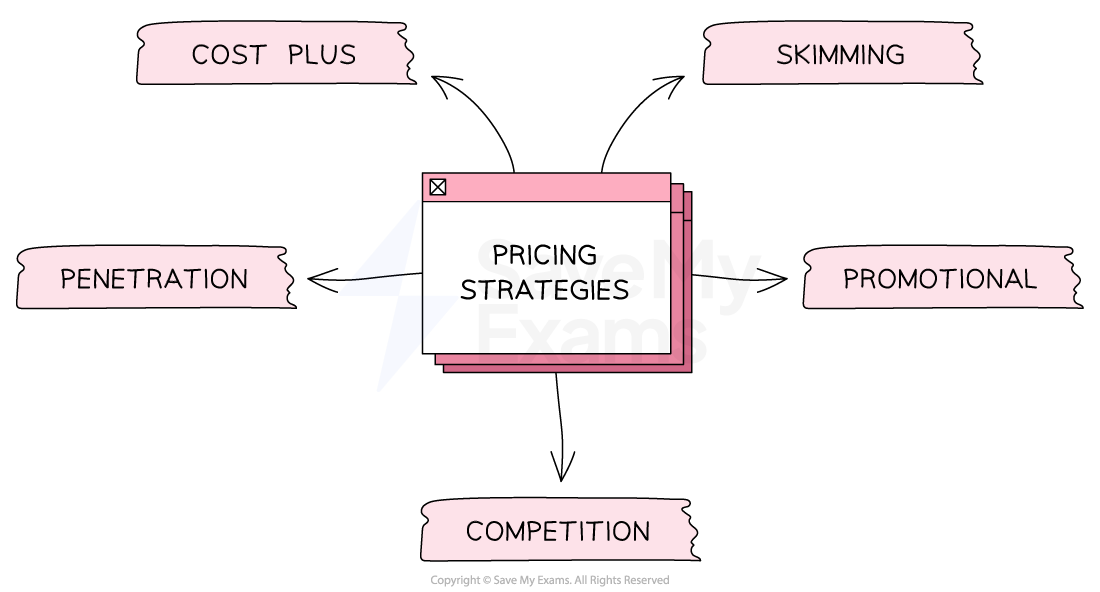
Businesses can choose from a range of pricing strategies to suit the products they sell and the customers at which they are aimed
Different types of pricing strategies
| Pricing strategy | Explanation | Advantages | Disadvantages |
|---|---|---|---|
| Cost plus | - The business calculates the cost of production and then adds a markup to determine the final price - The markup covers the cost of production **plus the business's desired profit margin - This pricing strategy is commonly used by manufacturers that produce standardised goods e.g. washing machines | - A** simple **and quick methods of calculating a price for a product - It ensures that a profit is made on each item sold | - It does not consider the** needs of the market ** - The pricing approach of competitors is ignored |
| Skimming | - The business sets a high price for a new product when it is first introduced to the market - The business will then gradually lower the price to ensure sales continue - Skimming should not be confused with premium pricing, where a permanently high price gives customers an impression of high quality and luxury | - This is effective when an established brand is introducing a new product and there is a high demand for it e.g successive models of Apple's Macbook Air - The high price helps the business to recover its development and marketing costs quickly | - Less useful for new brands as it requires significant customer trust - Loyal customers may become **tired of paying high prices **for new product versions and look to see what competitors offer |
| Penetration | - The business sets a** low price for a new product/service** when it is first introduced - This helps to quickly capture market share and attract price-sensitive customers e.g. many new perfumes launch using penetration pricing - Once they have enough customers, the business will start to raise the price | - Customers are attracted to buy the product at a low price leading to high sales volume and market share - Competitors unable to match or beat the low price are forced out the market leading to less competition | - Customers may perceive that the product is of** low quality if the product is sold at a low price - Selling at a low price limits the amount of profit made |
| Competition | - The business sets its prices based on its competitors' prices | - This is effective when a business is in a highly competitive market and wants to maintain its market share | - The business must continually monitor its competitors' prices and adjust its prices accordingly to remain competitive |
| Promotional pricing | - This pricing strategy takes into account the customer's emotions, and compulsive behaviours in responding to price promotions - E.g. a business may have a Bogof offer - buy one get one free | - Generates high volumes of sales for a limited period - Can be a useful tool to catch the attention of customers | - Profit margins are likely to be lower during price promotions - Customers may be unwilling to pay a higher price once a price promotion comes to an end |
Exam Hint In the exam, you could be asked to choose between two pricing strategies for a business and justify which would be most appropriate. You should consider factors such as
- The nature of the product - E.g. Is it a necessity or a luxury?
- Competitors' prices - especially if competition is fierce
- Stage in the product life cycle - E.g. Newly-launched products may be suited to promotional pricing to attract customers
- What is hoped to be achieved - E.g. High profits may be achieved through price skimming, whilst penetration pricing is more appropriate to gain market share
Was this revision note helpful?
Build on this topic