Gas Exchange in Plants (Edexcel IGCSE Biology)
Diffusion in Gas Exchange
Spec point —
2.40B· understand the role of diffusion in gas exchange
- Particles in a liquid and gas are in constant motion
- Diffusion is the movement of particles from a region of higher concentration to a region of lower concentration, down a concentration gradient
- Diffusion is important in living organisms. Substances that may move into and out of cells by diffusion include the molecules oxygen (O₂) and carbon dioxide (CO₂)
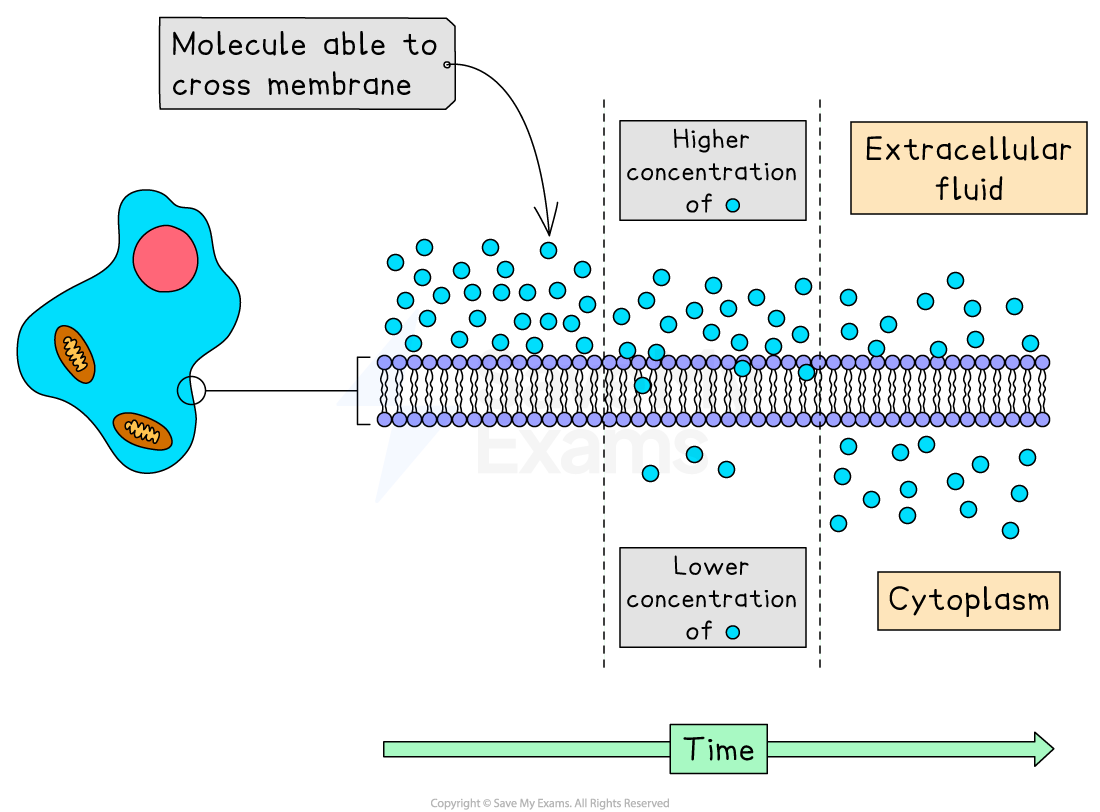
If there is a higher concentration of a substance outside of the cell compared to the inside (or vice versa), then diffusion occurs
Diffusion in organisms
- Gas exchange refers to the exchange of the gases oxygen (O₂) and carbon dioxide (CO₂) between a cell/organism and its environment
- Single-celled organisms, such as amoeba, can exchange gases sufficiently by simple diffusion through the cell membrane
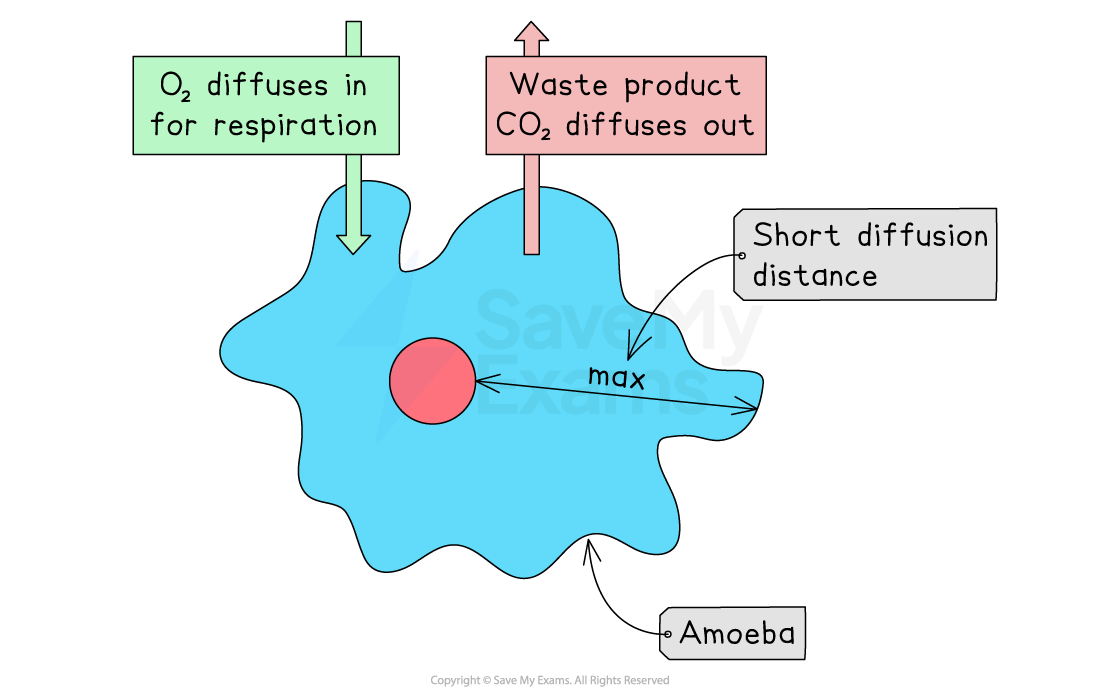
Gas exchange in single-celled organisms (such as amoeba) occurs by diffusion
-
Multicellular organisms (such as plants and animals), however, have exchange surfaces and organ systems that maximise the exchange of materials
-
Gills are the gas exchange organ in fish, lungs are the gas exchange organ in humans and leaves and roots are the gas exchange organ in plants
-
These organs increase the efficiency of exchange in several ways by:
- Having a large surface area, providing more surface area relative to volume to allow sufficient diffusion
- A short diffusion distance for substances to move across. This short distance is created because the barrier that separates two regions is as thin as possible
- In addition, animals have gas exchange surfaces that are well-ventilated to maintain steep concentration gradients
-
Gas Exchange: Photosynthesis & Respiration
Spec point —
2.41B· understand gas exchange (of carbon dioxide and oxygen) in relation to respiration and photosynthesis
- The processes of respiration and photosynthesis in cells both rely on the exchange of the gases oxygen and carbon dioxide
Gas exchange during respiration
-
Plant cells, like all living cells, require energy for cellular processes. Energy is released when respiration occurs. Respiration occurs in plant cells all the time - both during the day and at night
- In the daytime, if conditions are sufficient then photosynthesis will also occur in plants cells with chloroplasts
- During the night when there is no light no photosynthesis occurs, but respiration will still be occurring
-
Aerobic respiration requires oxygen and produces carbon dioxide
-
At night, when no photosynthesis is occurring:
-
Oxygen diffuses down a concentration gradient from a higher concentration outside the leaf to a lower concentration inside the leaf
- The cells in the leaf use oxygen in aerobic respiration so the concentration will remain low inside the respiring cells
-
Carbon dioxide diffuses down a concentration gradient from a higher concentration inside the leaf to a lower concentration outside the leaf
-
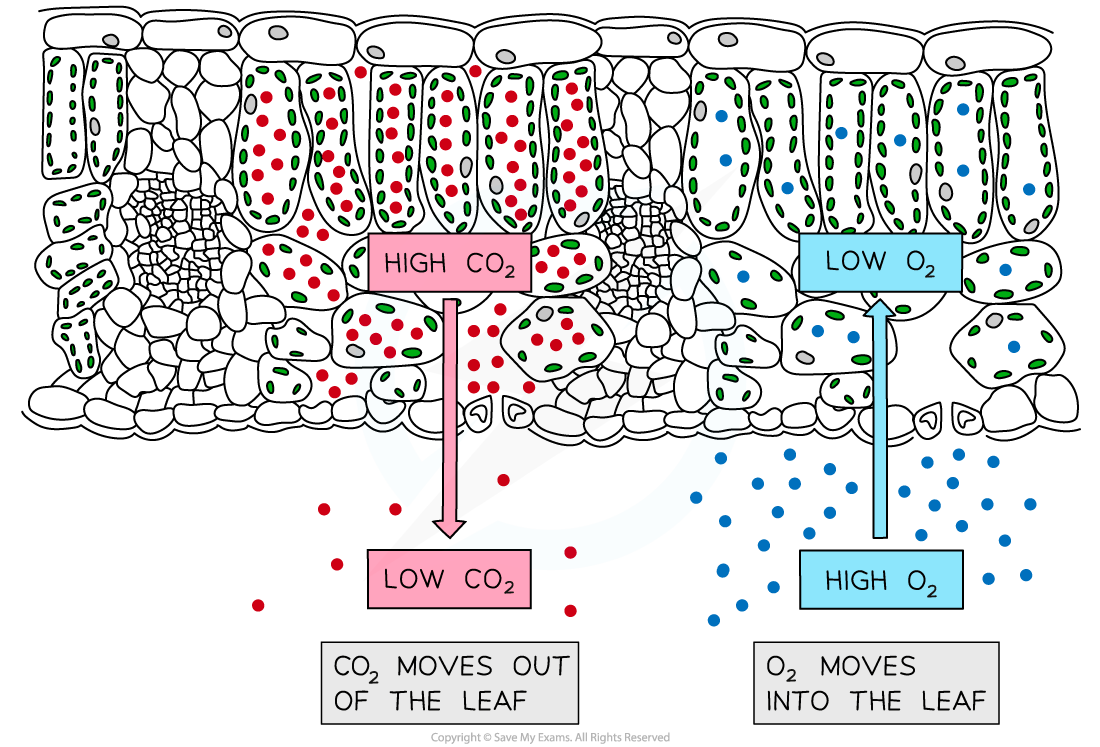
At night, when no photosynthesis is occurring, oxygen diffuses into the leaf and carbon dioxide diffuses out of the leaf. This is an example of gas exchange.
Gas exchange during photosynthesis
-
Plant cells with chloroplasts can photosynthesise when there is enough sunlight
-
Photosynthesis requires carbon dioxide and releases oxygen
-
Carbon dioxide diffuses down a concentration gradient from a region of higher concentration outside the leaf to a region of lower concentration inside the leaf
- Cells with chloroplasts use carbon dioxide in photosynthesis so the concentration of carbon dioxide inside the photosynthesising cells is lower than outside
-
Oxygen diffuses down a concentration gradient from a high concentration (inside the leaf) to a low concentration (outside the leaf)
- Note - some of the oxygen released in photosynthesis will be used in respiration!
-
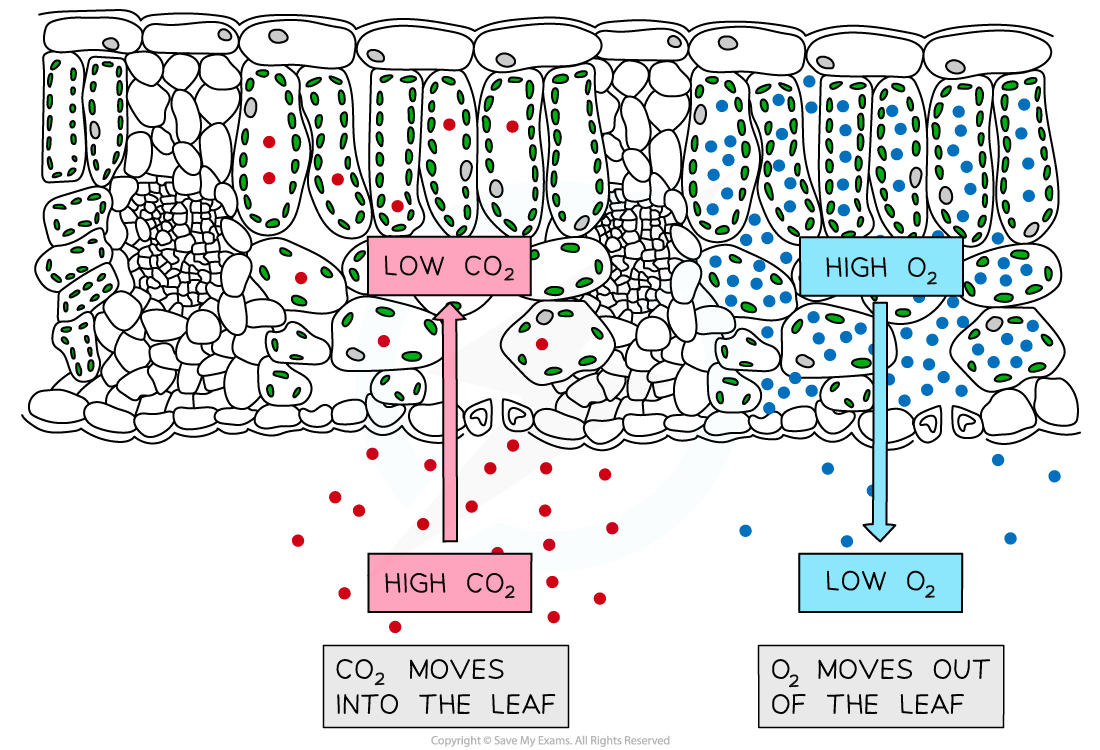
When photosynthesis occurs, carbon dioxide diffuses into the leaf and oxygen diffuses out of the leaf.
Was this revision note helpful?
Build on this topic