Practical: Energy Content of a Food Sample (Edexcel IGCSE Biology)
Spec point —
2.33B· practical: investigate the energy content in a food sample
Practical: Energy Content of a Food Sample
We can investigate the energy content of food in a simple calorimetry experiment
Apparatus
- Boiling tube
- Boiling tube holder
- Bunsen burner
- Mounted needle
- Measuring cylinder
- Balance/scales
- Thermometer
- Water
- Food samples
Method
-
Use the measuring cylinder to measure out 25 cm3 of water and pour it into the boiling tube
-
Record the starting temperature of the water using the thermometer
-
Record the mass of the food sample
-
Set fire to the sample of food using the bunsen burner and hold the sample 2 cm from the boiling tube until it has completely burned
-
Record the final temperature of the water
-
Repeat the process with different food samples
- E.g. popcorn, nuts, crisps
Investigating the energy content of food samples diagram
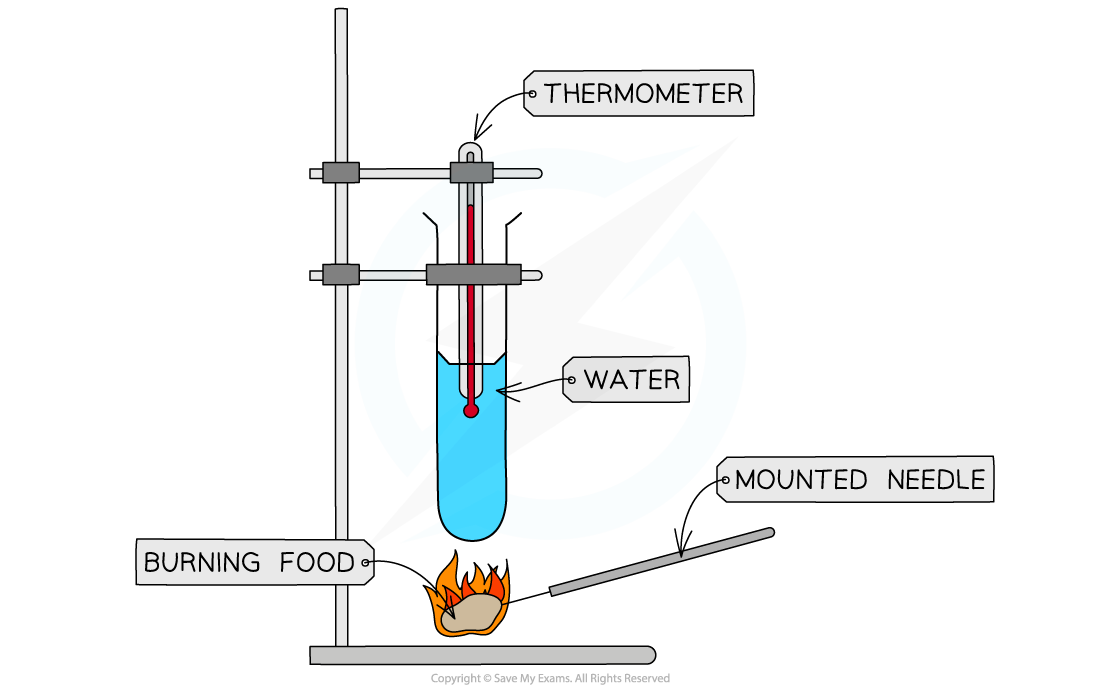
Different food samples can be burned in a simple calorimetry experiment to compare the energy contents of the samples
Results
- The larger the increase in water temperature, the more energy is stored in the sample
- We can calculate the energy in each food sample using the following equation:
- 4.2 kJ is the specific heat capacity of water, meaning that it is the energy required to raise 1 kg of water by 1 °C
- 1 cm3 of water has a mass of 1 g
The energy content of food samples table
| Food sample | Mass of water / g | Mass of food / g | Initial water temperature / °C | Final water temperature / °C | Change in water temperature / °C | Energy transferred per gram of food (J/g) |
|---|---|---|---|---|---|---|
| Popcorn | 25 | 8.5 | 20.5 | 31.2 | 10.7 | 132.2 |
| Walnut | 25 | 8.1 | 20.4 | 34.1 | 13.7 | 177.6 |
Limitations
-
Incomplete burning of the food sample
- Some food may not burn completely, so not all of the energy of the food is released
- Solution: relight the food sample until it no longer lights up
-
Heat energy loss to the surroundings
- Some of the energy from the burning food escapes into the air instead of heating the water
- This can make the calculated energy values lower than the true values
-
Ways to reduce heat loss:
-
Simple improvements:
- Keep the boiling tube close to the burning food (but safely)
- Use a piece of aluminium foil around the tube to reduce heat loss
-
An alternative is to use a calorimeter:
- A calorimeter is a piece of equipment that captures almost all of the heat released when food burns
- Instead of burning food in open air to heat water in a boiling tube, the food is burned inside the calorimeter
- This reduces heat lost to the surroundings and transfers more of the food’s energy to the water. As a result, the calculated energy content (from measuring the temperature change in the water) is more accurate and closer to the true energy stored in the food
-
Was this revision note helpful?
Build on this topic