Structure of Biological Molecules (Edexcel IGCSE Biology)
Chemical Elements
Spec point —
2.7· identify the chemical elements present in carbohydrates, proteins and lipids (fats and oils)
- Most of the molecules in living organisms fall into three categories: carbohydrates, proteins and lipids(fats and oils)
- These all contain carbon and so are described as organic molecules
| Molecule | Chemical elements |
|---|---|
| Carbohydrate | Carbon (C), oxygen (O) and hydrogen (H) |
| Protein | All contain carbon (C), oxygen (O), hydrogen (H) and nitrogen (N) Some contain small amounts of other elements such as sulfur (S) |
| Lipid | Carbon (C), oxygen (O) and hydrogen (H) |
Structure of Carbohydrates, Proteins & Lipids
Spec point —
2.8· describe the structure of carbohydrates, proteins and lipids as large molecules made up from smaller basic units: starch and glycogen from simple sugars, protein from amino acids, and lipid from fatty acids and glycerol
Carbohydrates
-
Carbohydrates contain the elements carbon, hydrogen and oxygen
-
Carbohydrates can be small, simple sugars or more complex larger molecules
-
A monosaccharide is a simple sugar e.g. **glucose **(C6H12O6)
-
A disaccharide is made when two monosaccharides join together, e.g.** maltose** is formed from two glucose molecules joined together
-
A large polysaccharide is formed when lots of monosaccharides join together
- Starch, glycogen or cellulose are all formed when lots of simple glucose molecules join together
- Polysaccharides are insoluble and therefore useful as storage molecules
-
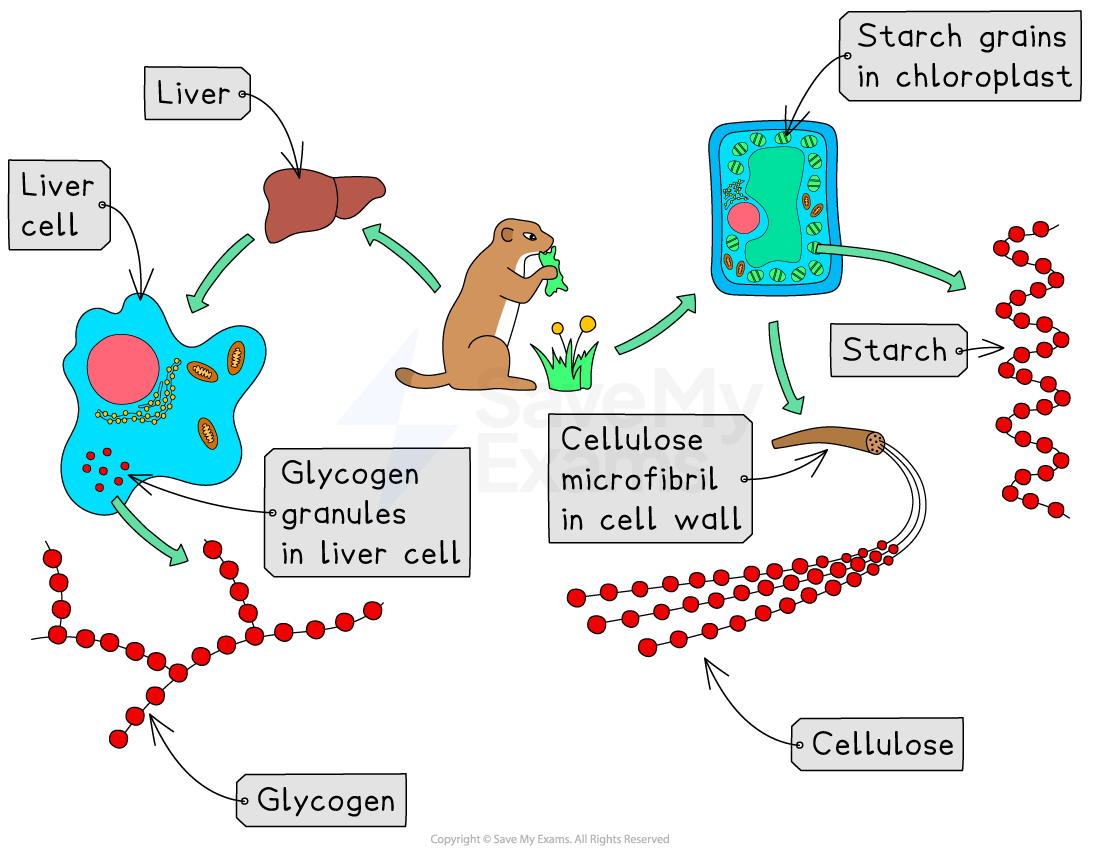
Glycogen, cellulose and starch are all made from glucose molecules. Glycogen is also found in animal muscle cells.
Exam Hint You don't need to know the terms monosaccharide, disaccharide and polysaccharide for your exam, but you do need to know that starch and glycogen are large molecules formed from many glucose molecules (a simple sugar) joined together.
There is also a difference in how plants and animals store glucose: plants store glucose as starch molecules, whereas animals store glucose as glycogen molecules. Take care not to confuse the two!
Lipids
- Lipids, like carbohydrates and proteins, are large molecules made up of smaller basic units: glycerol and fatty acids
- Lipids may be solid at room temperature (solid lipids are also known as fats) or liquid at room temperature (liquid lipids are also known as oils )
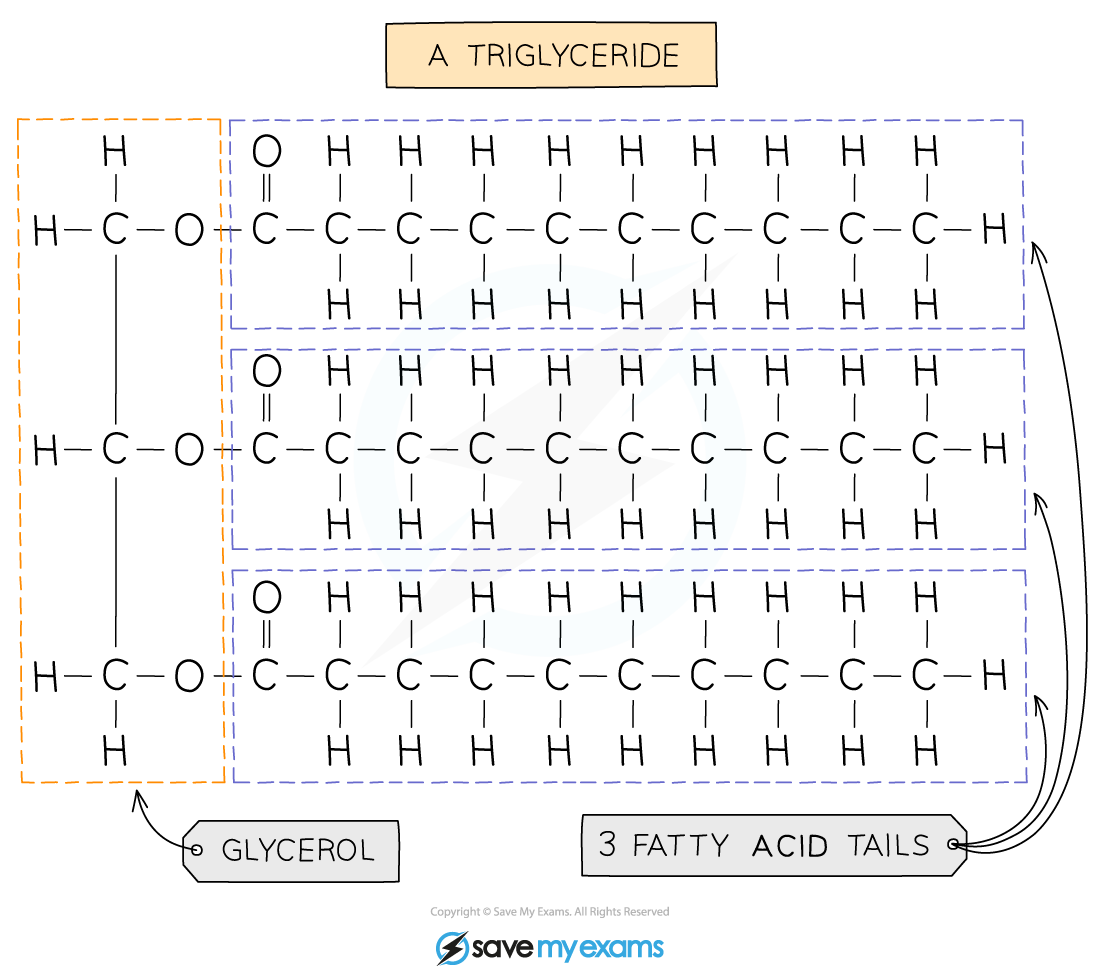
One type of lipid found in the human body is a triglyceride; like all lipids it is formed from the smaller units glycerol and fatty acids joined together.
Exam Hint You don't need to know the structure of a triglyceride, just that lipids are large molecules formed from the smaller units glycerol and fatty acids, and that lipids contain the chemical elements carbon (C), hydrogen (H) and oxygen (O).
Proteins
-
Proteins, like carbohydrates and lipids are large molecules formed from smaller molecules called amino acids
-
When amino acids are joined together a protein is formed
-
Amino acids can be arranged in any order, resulting in hundreds of thousands of different proteins
- Each protein has a specific amino acid sequence which gives the overall protein molecule a particular shape; and the shape of a protein determines its function
- Examples of proteins include enzymes, haemoglobin and keratin (a protein found in hair)
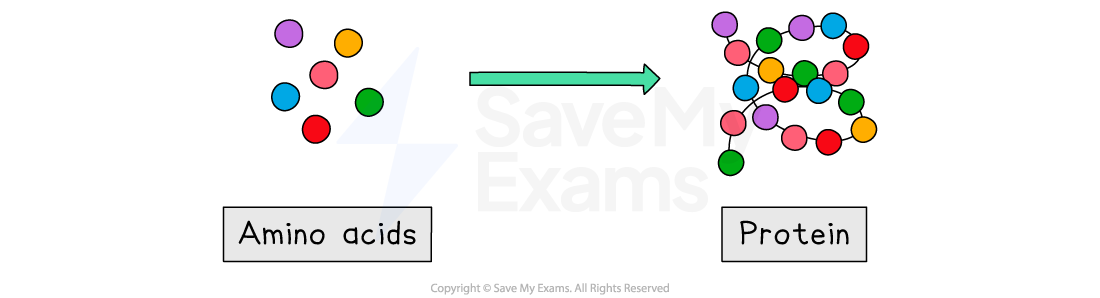
Amino acids join together to form proteins
Exam Hint You must be able to recall the chemical elements found in the three biological molecules on this page, as well as what the smaller units are for each molecule. This knowledge links to a later topic in the course - the role of enzymes in human digestion - as all large biological molecules need to be broken down into their smaller units (by enzymes) so that they can be absorbed into the bloodstream.
Was this revision note helpful?
Build on this topic