Trade Receivables Ledger Control Account (Edexcel IGCSE Accounting)
Spec point —
IGCSE_ACCOUNTING:S3.151
Trade receivables ledger control account
What is a trade receivables ledger control account?
-
A trade receivables ledger control account is an account that summarises all the transactions for trade receivables
- It is not part of the double entry system
Where do I find the information to complete a trade receivables ledger control account?
-
The books of original entry are used to find the totals
-
The sales day book is used to find the total value of credit sales
-
The sales returns day book is used to find the total value of returned goods
-
The cash book is used to find the total values for:
- Money received from credit customers
- **Money refunded **to credit customers
- Cash discounts allowed to credit customers
- Dishonoured cheques received** from credit customers
-
The** journal is used to find the total values for:
- Interest charged to credit customers on overdue accounts
- Contra entries against the purchases ledger
- Irrecoverable debts written off
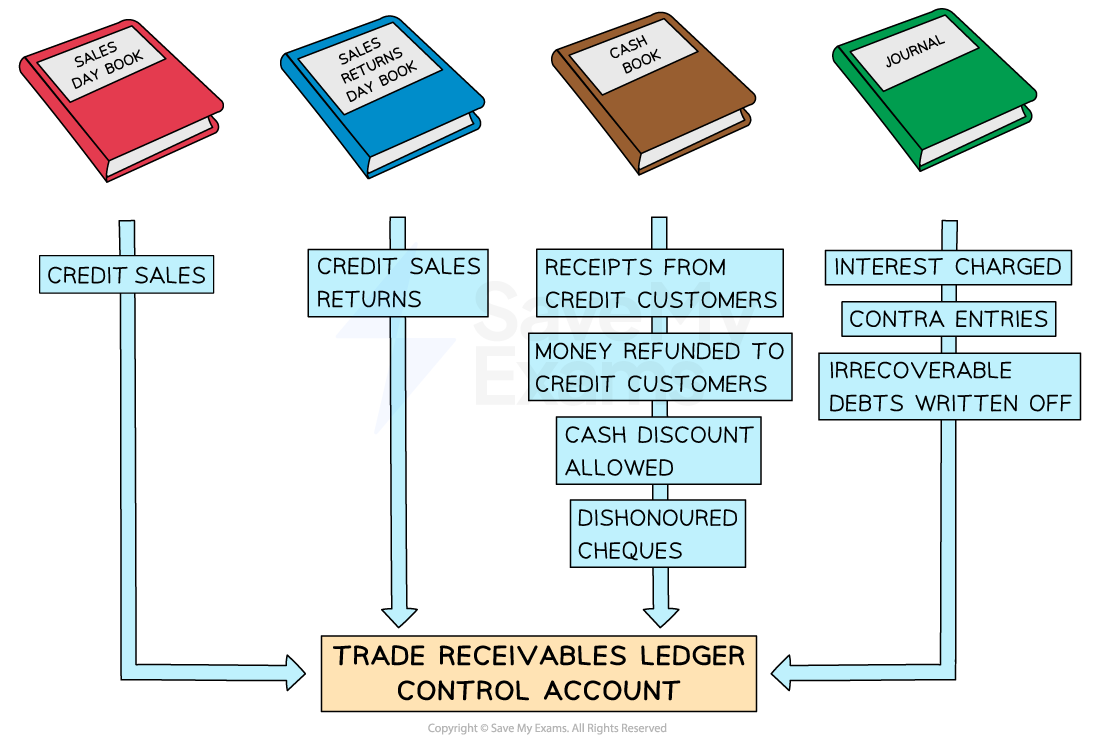
Exam Hint The ledger accounts are not used when preparing control accounts. The information is taken from the books of original entry.
Why might there be a credit balance in a trade receivables ledger control account?
-
A trade receivables account will usually have a debit balance
- This indicates that the credit customer owes the business money
-
However, a trade receivables account could have a credit balance
- This indicates that the credit customer is owed money
-
Credit balances can occur when:
-
Credit customers pay in advance of buying goods
-
Credit customers make an overpayment
-
The business owes refunds to credit customers
- The customers have paid for goods and then returned them
-
-
Debit and credit balances are totalled separately in the trade receivables ledger control account
- This means there could be two opening balances and two closing balances
What is the layout of a trade receivables ledger control account?
-
The layout looks very similar to the layout of a trade receivables ledger account
-
The main differences are:
- There could be two opening balances
- There could be two closing balances
-
Use the name of the book of original entry as the detail
- Put more information in brackets
| Entries on the debit side: | Entries on the credit side: |
|---|---|
| - Opening balance - Credit customers who owe money - Sales day book - Credit sales only - Journal - Interest - Cash book - Dishonoured cheques from credit customers | - Opening balance - Credit customers who are owed money - Sales returns day book - Credit sales only - Cash book - Bank - Bank transfers from credit customers - Cash - Cash received from credit customers - Discount allowed - Journal - Irrecoverable debts - Contra entries |
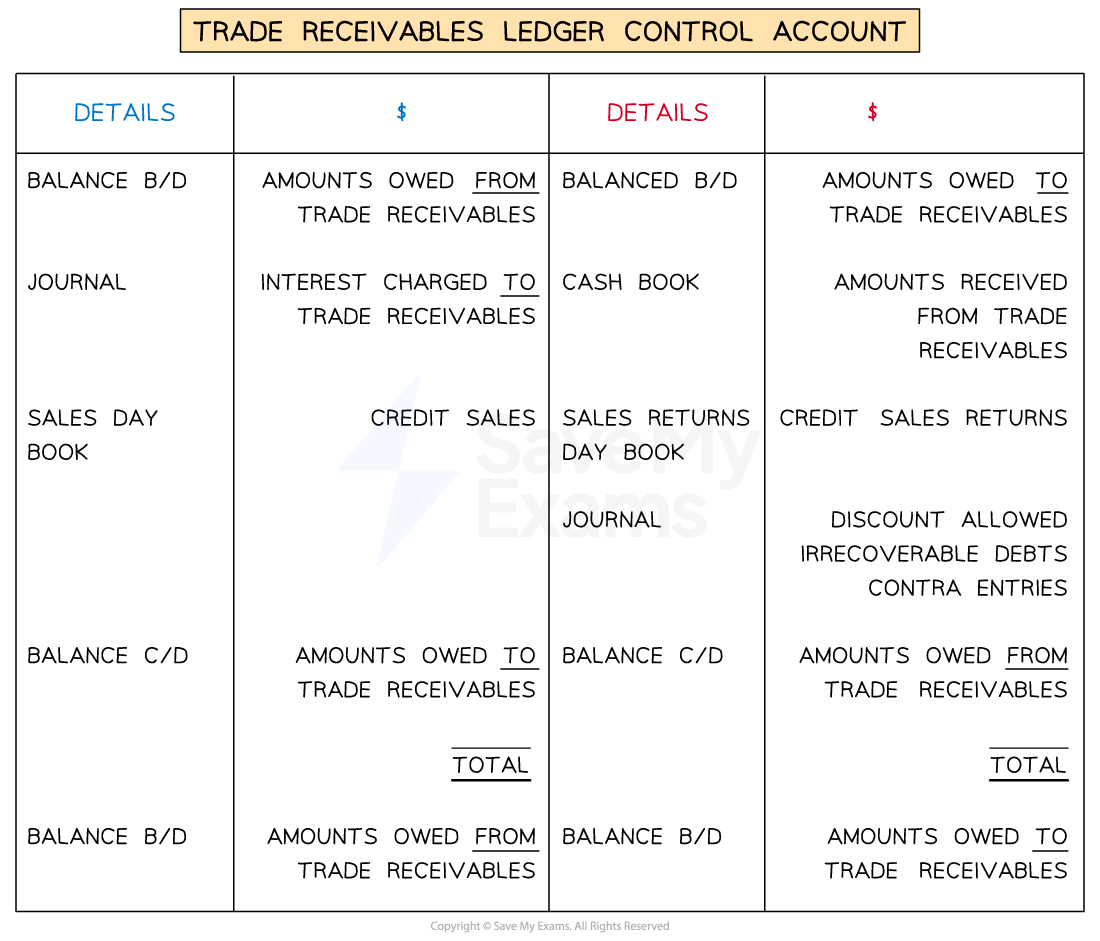
Layout of a trade receivables ledger control account
Exam Hint Remember that cash sales are not recorded in the receivables ledger. Only enter cash received from credit customers when the cash is used to make a payment towards an invoice.
Worked Example Kimi maintains a full set of account records. She provides the following information for February 2024.
$ On 1 February 2024 Trade receivables ledger control account debit balance b/d 12 780 Trade receivables ledger control account credit balance b/d 150 Totals for February 2024 Credit sales 25 470 Cash sales 5 780 Credit sales returns 7 000 Cheques received by credit customers 18 450 Cash received by credit customers 1 400 Discount allowed 3 290 Interest charged to credit customers 860 Contra purchases ledger 1 050 Irrecoverable debts written off 870 At 29 February, the total amount that Kimi owed to her credit customers was $460.
Prepare the trade receivables ledger control account for February 2024. Balance the account and bring down the balances on 1 March 2024.
Answer
Ignore the cash sales, as they do not affect the receivables ledger accounts.
Enter the balances and totals on the correct sides of the account.
Transactions which increase the amount owed to the business appear on the debit side.
Credit sales
Interest
Transactions which reduce the amount owed to the business appear on the credit side.
Receipts from credit customers using cash or bank transfers
Sales returns
Discount allowed
Irrecoverable debts
Contra entries
On 1 March 2024, there will be a credit balance of $460; therefore, there will need to be a balance c/d on the debit side on 29 February 2024.
Final answer: Kimi Trade Receivables Ledger Control Account
Final answer: Date Final answer: Details Final answer: $** Final answer: Date Final answer: Details Final answer: $ Final answer: 2024
Final answer: Feb 1Final answer:** **
Final answer: Balance b/dFinal answer: 12 780 Final answer: 2024
Final answer: Feb 1Final answer: Balance b/d Final answer: 150 Final answer: 29 Final answer: Sales day book Final answer: 25 470 Final answer: 29 Final answer: Sales returns day book Final answer: 7 000 Final answer: 29 Final answer: Journal (interest) Final answer: 860 Final answer: 29 Final answer: Cash book (bank) Final answer: 18 450 Final answer: 29 Final answer: Balance c/d Final answer: 460 Final answer: 29 Final answer: Cash book (cash) Final answer: 1 400 Final answer: 29 Final answer: Cash book (discount allowed) Final answer: 3 290 Final answer: 29 Final answer: Journal (contra) Final answer: 1 050 Final answer: 29 Final answer: Journal (irrecoverable debts) Final answer: 870 Final answer:** Final answer: 29 Final answer: Balance c/d Final answer: 7 360 Final answer: 39 570 Final answer: 39 570 Final answer: Mar 1 Final answer: Balance b/d Final answer: 7 360 Final answer: Mar 1 Final answer: Balance b/d Final answer: 460
Was this revision note helpful?
Build on this topic