Core Practical 9: Investigating Impulse (Edexcel IAL Physics)
Spec point —
82
Core Practical 9: Investigating Impulse
Aims of the Experiment
-
To determine the change in momentum of a trolley due to a force acting on it
- This is known as the impulse
Variables
-
Independent variable = accelerating mass, m
-
Dependent variable = time taken to pass between two light gates, t
-
Control variables
- Overall mass of the system (trolley + accelerating masses)
- Tilt angle of the ramp
- Trolley and ramp used
- Size of interrupter card
Equipment List
| Apparatus | Purpose |
|---|---|
| Dynamics trolley | Momentum change of the trolley is being investigated |
| Ramp, slightly tilted | For the trolley to travel down |
| Bench pulley | To pull trolley using the suspended masses |
| String | To connect the suspended mass and the trolley over the pulley |
| 5 slotted masses (10 g) and hanger | To create the force to accelerate the trolley |
| Light gates and computer or datalogger | To measure the time taken and velocity of the trolley passing through it |
| Balance | To measure the masses |
| Interrupt card | For the data logger to detect the motion of the trolley |
-
Resolution of measuring equipment
- Balance = 0.01 g
Method
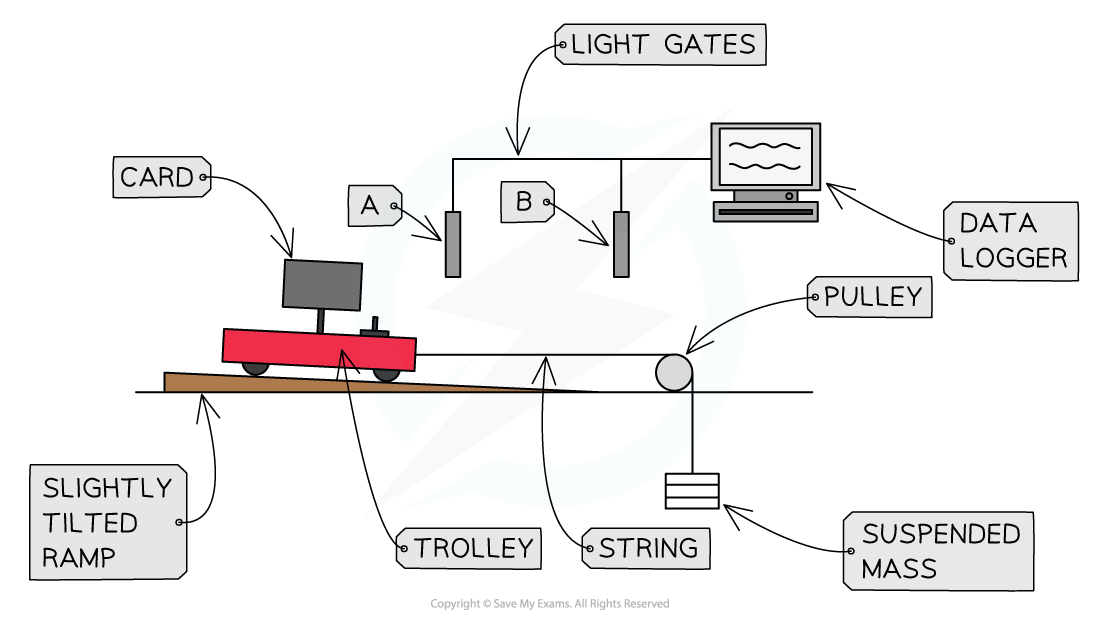
-
Measure the total mass, M, of the trolley and the five 10 g masses using the balance
-
Set up the equipment:
-
Secure the bench pulley to one end of the runway allowing one end to project over the end of the bench
-
Tilt the ramp slightly
- This is to compensate for friction
-
Place the mass hanger (without the masses on them) on the floor and move the trolley backwards until the string becomes tight, with the mass on the floor
-
Place the light gates at either end of the ramp
- There should be enough space on the ramp to allow the trolley to clear the light gate at the bottom before hitting the pulley
- Set the start position for the experiment
- Move the trolley further backwards until the mass hanger is closer to the pulley (it will fall to the floor as the trolley moves on the runway)
- Put the five 10 g masses on the trolley so that they will not slide off
-
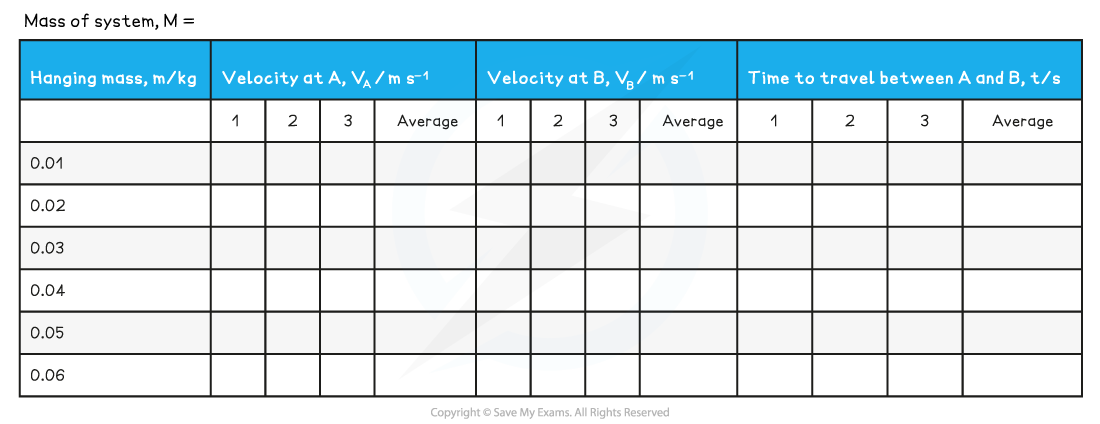
Record the total hanging mass, m in the results table
-
Release the trolley and start the timing software
- The computer will record the velocity through each gate, and the the time taken for the trolley to travel between them
- Record the values in the results table
-
Repeat the readings and calculate the mean time and velocity for this value of m
-
Move one 10 g mass from the trolley to the hanger and repeat steps 4 and 5
- Repeat this process, moving one 10 g mass at a time
- The last reading is when all of the masses are on the hanger
Table of Results:
Analysing the Results
- The momentum of the trolley can be represented by two equations:
(equation 1)
-
Where:
- Δp = change in momentum (kg m s−1)
- M = mass of the system (kg)
- vB = velocity at light-gate B
- vA = velocity at light-gate A
(equation 2)
-
Where:
- m = mass on the hanger (kg)
- g = acceleration due to gravity, (9.81 m s−1)
- t = time taken between light-gates A and B
-
Combing equations 1 and 2 gives:
- This can be rearranged to give:
-
This is in the form of y = mx + c, where:
- y = mt
- x = (vB − vA)
- m =
- c = 0
-
Therefore, a graph can be plotted of mt against (vB − vA)
- This should be a straight line graph to prove the relationship
- The gradient should be equal to
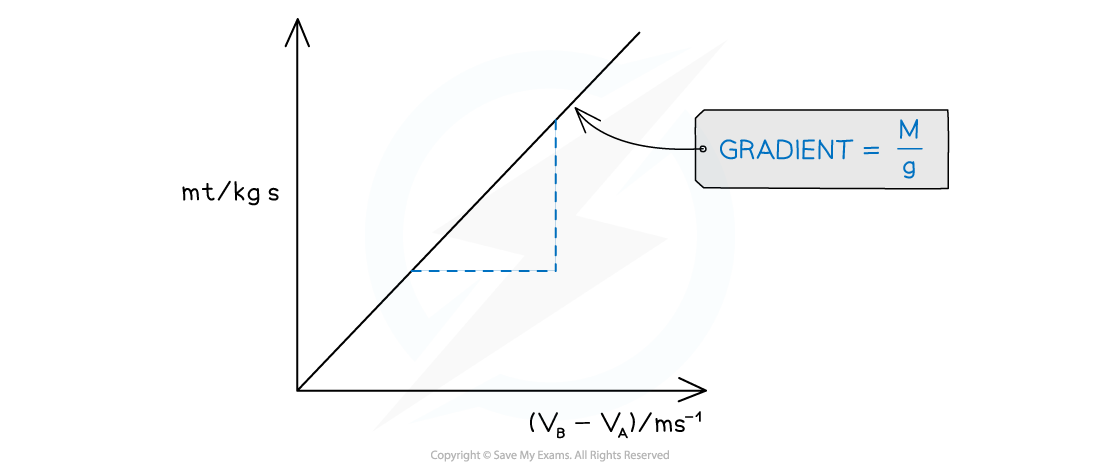
A straight line with gradient M/g confirms the relationship between the variables
Evaluating the Experiment
Systematic errors:
-
The interrupt card may be a different width to that recorded in the data logger
- Measure it three times and calculate an average value
-
The interrupt card may not be of sufficient height to trigger the light gate
- Move the light gates down, or use a taller card
-
Mass of the system, M,* *may not be measured correctly
- Measure it three times and calculate an average value
-
The overall mass, M, of the system may not be kept constant
- Ensure each hanging mass, m, which is removed is transferred to the trolley so the overall mass of the system (trolley + hanging masses) stays the same
Random errors:
-
The trolley may not travel in a straight line
- Discard this result
-
The trolley may hit one of the light gates when passing through
- Discard this result
Safety Considerations
- Stand well away from the masses in case they fall onto the floor
- Place a crash mat or any soft surface, such as a small cushion, under the masses to break their fall
- Keep liquids away from the data logger and other electronic equipment
- Make sure no other objects are obstructing the motion of the trolley throughout the experiment
Exam Hint This practical can be completed with one light gate, where a card of known length, L is passed through a light gate. The time is recorded and v is found using . The overall time is taken from the trolley at rest and the stop watch is started when the trolley is released.
A graph is then plotted as above, but with v not (vB − vA) on the x-axis as initial velocity is 0.
Was this revision note helpful?
Build on this topic