Measuring Refractive Index (Edexcel IAL Physics)
Exam board Pearson Edexcel · IALUpdated 2026-07-02
Spec point —
48
Measuring Refractive Index
Aim of the Experiment
- To investigate the refraction of light through a perspex block
Equipment
- Ray Box - to provide a narrow beam of light to refract through the perspex box
- Protractor - to measure the light beam angles
- Sheet of paper - to mark with lines for angle measurement
- Pencil - to make perpendicular line and angle lines on paper
- Ruler - to draw straight lines on the paper
- Perspex block - to refract the light beam
Variables
-
Dependent variable = angle of refraction , r
-
Control variables:
- Use of the same perspex block
- Width of the light beam
- Same frequency / wavelength of the light
Method
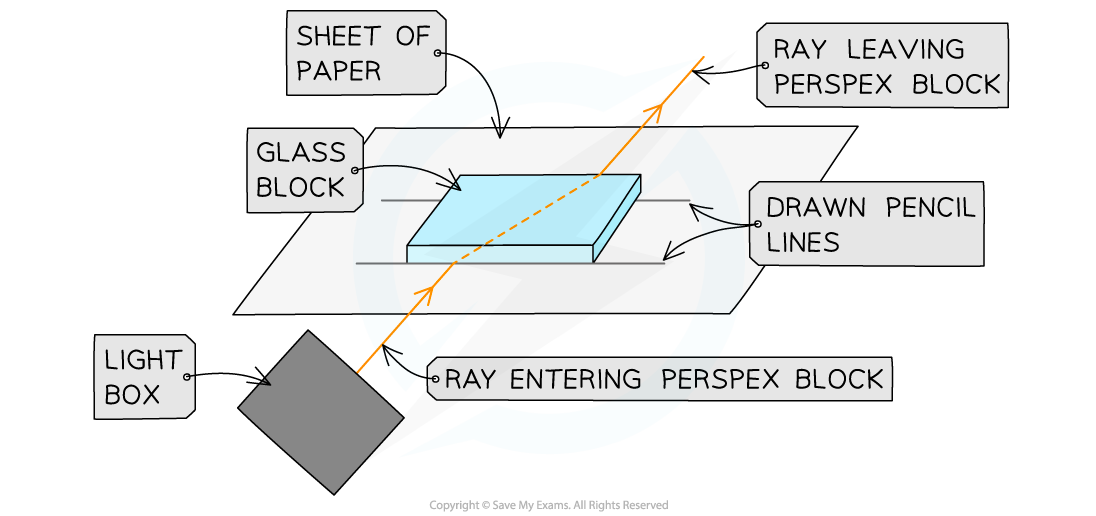
Apparatus to investigate refraction
- Place the perspex block on a sheet of paper, and draw around it using a pencil
- Switch on the ray box and direct a beam of light at the side face of the block
- Mark on the paper with a small 'x':
- A point on the ray close to the ray box
- The point where the ray enters the block
- The point where the ray exits the block
- A point on the exit light ray which is a distance of about 5 cm away from the block
- Draw a dashed line normal(at right angles) to the outline of the block
- Remove the block and join the points marked 'x' with three straight lines
- Replace the block within its outline and repeat the above process for a ray striking the block at different angles of incidence
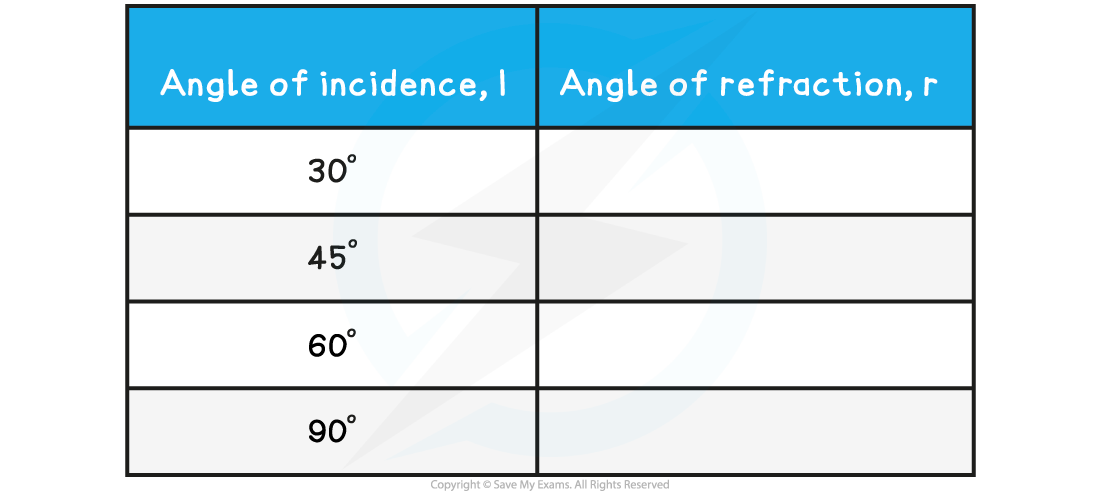
- An example of the data collection table is shown below:
Analysis of Results
- i and r are always measured from the normal
- For light rays entering perspex block, the light ray refracts towards the central line:
i > r
- For light rays exiting the perspex block, the light ray refracts away from the central line:
i < r
- When the angle of incidence is 90° to the perspex block, the light ray does not refract, it passes straight through the block:
i = r
- If the experiment was carried out correctly, the angles should follow the pattern, as shown below:
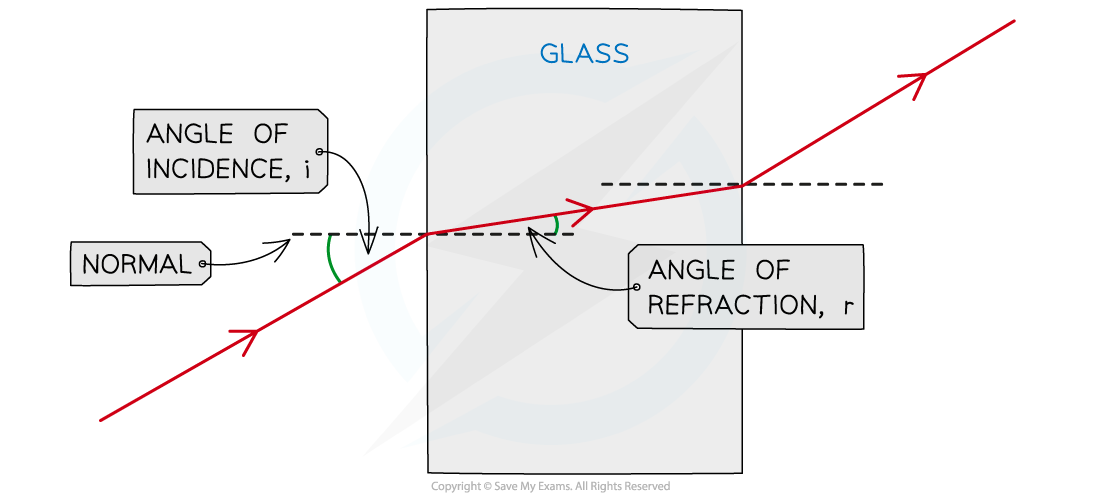
How to measure the angle of incidence and angle of refraction
Safety Considerations
-
The ray box light gets hot and could burn if touched
- Run burns under cold running water for at least five minutes
-
Looking directly into the light may damage the eyes
- Avoid looking directly at the light
- Stand behind the ray box during the experiment
-
Keep all liquids away from the electrical equipment and paper
-
Take care using the perspex
- Damage to the perspex block can affect the outcome of the experiment
Exam Hint In your examination you could be asked about the method for this experiment or given a set of results and asked how accurate they are or how they can be improved.
Was this revision note helpful?