Equations for Nuclear Physics (Edexcel IAL Physics)
Activity & The Decay Constant
Spec point —
142
-
Since radioactive decay is spontaneous and random, it is useful to consider the average number of nuclei which are expected to decay per unit time
- This is known as the average decay rate
-
As a result, each radioactive element can be assigned a decay constant
-
The decay constant λ is defined as: The probability, per second, that a given nucleus will decay
-
When a sample is highly radioactive, this means the number of decays per unit time is very high
- This suggests it has a high level of activity
-
Activity, or the number of decays per unit time can be calculated using:
-
Where:
- A = activity of the sample (Bq)
- ΔN = number of decayed nuclei
- Δt = time interval (s)
- λ = decay constant (s-1)
- N = number of nuclei remaining in a sample
-
The activity of a sample is measured in Becquerels (Bq)
- An activity of 1 Bq is equal to one decay per second, or 1 s-1
-
This equation shows:
- The greater the decay constant, the greater the activity of the sample
- The activity depends on the number of undecayed nuclei remaining in the sample
- The minus sign indicates that the number of nuclei remaining decreases with time - however, for calculations it can be omitted
Worked Example Americium-241 is an artificially produced radioactive element that emits α-particles. A sample of americium-241 of mass 5.1 μg is found to have an activity of 5.9 × 10⁵ Bq.
(a) Determine the number of nuclei in the sample of americium-241.
(b) Determine the decay constant of americium-241.
Answer:
Part (a)
Step 1: Write down the known quantities
- Mass = 5.1 μg = 5.1 × 10⁻⁶ g
- Molecular mass of americium = 241
- NA = Avogadro constant
Step 2: Write down the equation relating number of nuclei, mass and molecular mass
Step 3: Calculate the number of nuclei
Part (b)
Step 1: Write the equation for activity
Activity, A = λN
Step 2: Rearrange for decay constant λ and calculate the answer
Exponential Decay
Spec point —
142
-
In radioactive decay, the number of nuclei falls very rapidly, without ever reaching zero
- Such a model is known as exponential decay
-
The graph of number of undecayed nuclei and time has a very distinctive shape
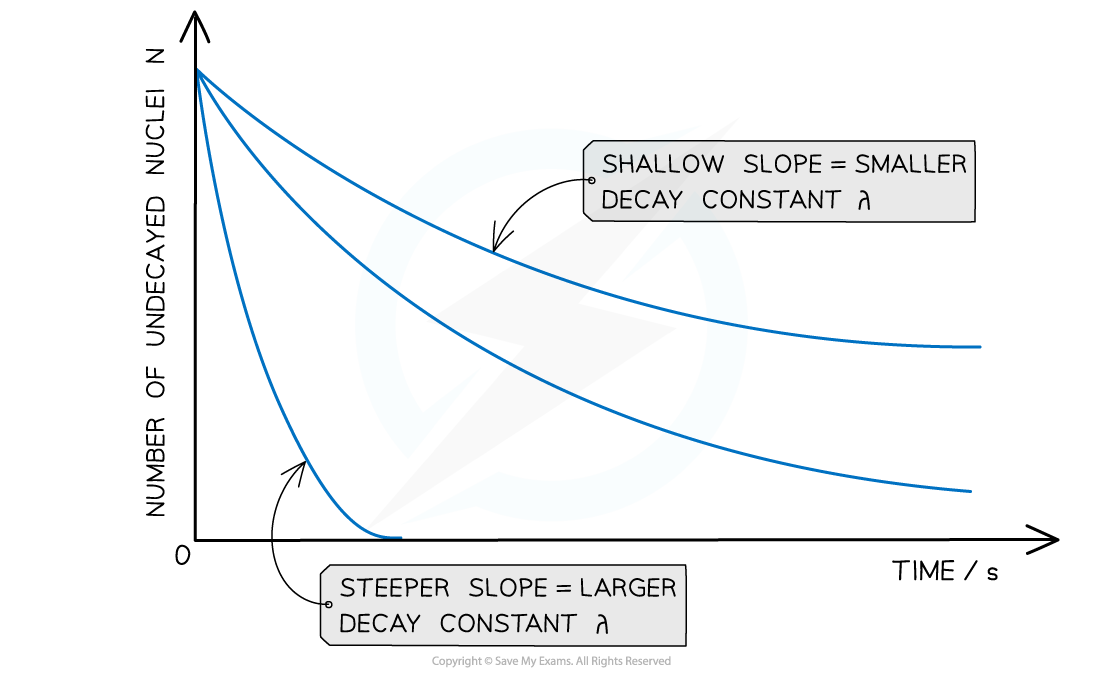
Radioactive decay follows an exponential pattern. The graph shows three different isotopes each with a different rate of decay
Radioactive Decay Equation
- The number of undecayed nuclei N can be represented in exponential form by the equation:
N = N0e–λt
-
Where:
- N0 = the initial number of undecayed nuclei (when t = 0)
- λ = decay constant (s-1)
- t = time interval (s)
The exponential function e
-
The symbol e represents the exponential constant
- It is approximately equal to e = 2.718
-
On a calculator it is shown by the button ex
-
The inverse function of ex is ln(y), known as the natural logarithmic function
- This is because, if ex = y, then x = ln(y)
Worked Example Strontium-90 decays with the emission of a β-particle to form Yttrium-90. The decay constant of Strontium-90 is 0.025 year-1.
Determine the activity A of the sample after 5.0 years, expressing the answer as a fraction of the initial activity A0
Answer:
Step 1: Write out the known quantities
Decay constant, λ = 0.025 year-1
Time interval, t = 5.0 years
Both quantities have the same unit, so there is no need for conversion
Step 2: Write the equation for activity in exponential form
A = A0e–λt
Step 3: Rearrange the equation for the ratio between A and A0
Step 4: Calculate the ratio A/A0
Therefore, the activity of Strontium-90 decreases by a factor of 0.88, or 12%, after 5 years


Half-Life
Spec point —
142
Half Life
- Half-life is defined as: The time taken for half the number of nuclei in a sample to decay
- This means when a time equal to the half-life has passed, the activity of the sample will also half
- This is because the activity is proportional to the number of undecayed nuclei, A ∝ N
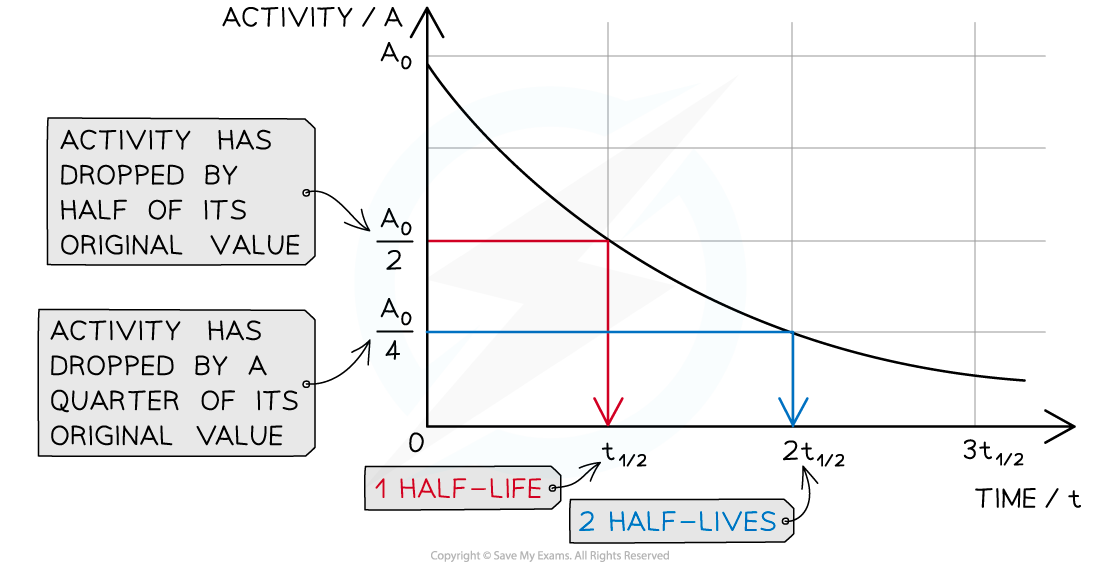
When a time equal to the half-life passes, the activity falls by half, when two half-lives pass, the activity falls by another half (which is a quarter of the initial value)
- To find an expression for half-life, start with the equation for exponential decay:
N = N0 e–λt
-
Where:
- N = number of nuclei remaining in a sample
- N0 = the initial number of undecayed nuclei (when t = 0)
- λ = decay constant (s-1)
- t = time interval (s)
-
When time t is equal to the half-life t½, the activity N of the sample will be half of its original value, so N = ½ N0

- The formula can then be derived as follows:



- Therefore, half-life t½ can be calculated using the equation:

-
This equation shows that half-life t½ and the radioactive decay rate constant λ are inversely proportional
- Therefore, the shorter the half-life, the larger the decay constant and the faster the decay
Worked Example Strontium-90 is a radioactive isotope with a half-life of 28.0 years.A sample of Strontium-90 has an activity of 6.4 × 10⁹ Bq. Calculate the decay constant λ, in s–1, of Strontium-90.
Answer:
Step 1: Convert the half-life into seconds
- t½ = 28 years = 28 × 365 × 24 × 60 × 60 = 8.83 × 10⁸ s
Step 2: Write the equation for half-life
Step 3: Rearrange for λ and calculate


Exam Hint Although you may not be expected to derive the half-life equation, make sure you're comfortable with how to use it in calculations such as that in the worked example.
Was this revision note helpful?
Build on this topic