Calculating Current & Drift Velocity (Edexcel IAL Physics)
Spec point —
73
Calculating Current & Drift Velocity
Drift Velocity
-
In a conductor, the current is due to the movement of charge carriers
- The charge carriers can be negative or positive
- However current is always taken to be in the same direction
-
Drift velocity is the average velocity of the charge carriers travelling through the conductor
-
In conductors, the charge carrier is usually free electrons
- Free electrons only travel small distances before colliding with a metal ion
- Therefore they have a relatively slow drift velocity of ∼ 10−3 m s−1
-
In the diagram below, the current in each conductor is from right to left
- In diagram A (positive charge carriers), the drift velocity is in the same direction as the current
- In diagram B (negative charge carriers), the drift velocity is in the opposite direction to the current
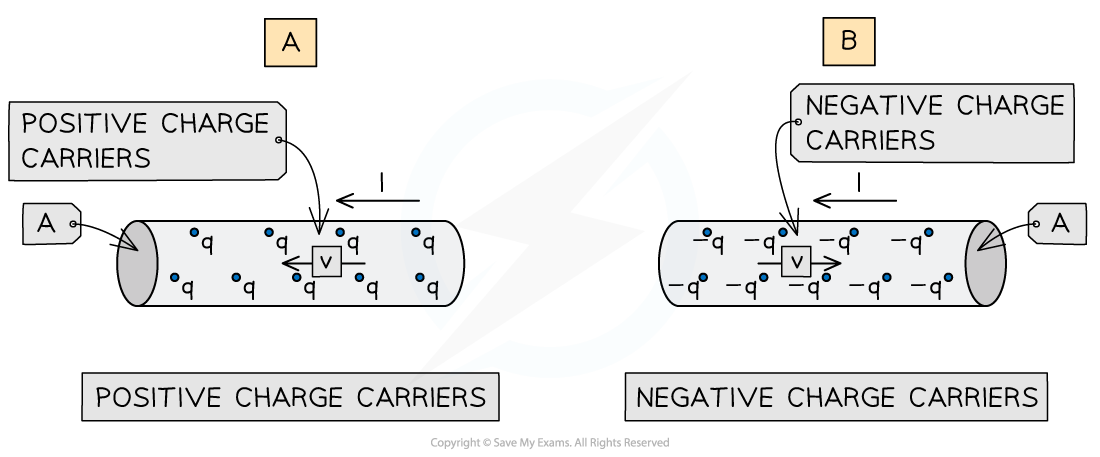
Conduction in a current-carrying conductor
-
The density n represents the number of free charge carriers (electrons) per unit volume
- Conductors, such as metals, have a high value of n
- Insulators, such as plastics, have a low value of n
-
Since the density of charge carriers is so large in conductors, the flow of current flow appears to happen instantaneously
The Transport Equation
- The current can be expressed in the transport equation:
-
Where:
- I = current (A)
- n = number density (m−3)
- q = the charge of the charge carrier (C)
- v = drift velocity (m s−1)
- A = cross sectional area of the wire (m2), calculated using A = πr2
-
The same equation is used whether the charge carriers are positive or negative
- A negative value for v will indicate current in the opposite direction to the charge carriers
-
The transport equation shows that v is inversely proportiona l to n
- Since the more charge carriers available per unit volume the more the density will slow down their speed through the conductor
-
The transport equation also shows that I is directly proportional to n
- Greater n means a greater charge is flowing and therefore a larger current I
-
When the value of n is lower, the charge carriers must travel faster to carry the same current
Worked Example The number density of conduction electrons in a copper wire is 9.2 × 1028 m−3. The wire carries a current of 3.5 A and it has a cross-sectional area of 1.5 mm2.
Determine the average drift velocity of the electrons.
Answer:
Step 1: Consider the situation
- A copper wire is a conductor, and the free electrons are charge carriers
- Use the transport equation I = nqvA
Step 2: Rearrange the equation for drift speed v
Step 3: Substitute in values
- Current, I = 3.5 A
- Cross-sectional area,A = 1.5 mm2 = 1.5 ÷ 10002 = 1.5 × 10⁻⁶ m2
- Number density of conduction electrons, n = 9.2 × 1028 m−3
- Charge on an electron, q = 1.60 × 10⁻¹⁹ C (From the data sheet)
m s−1
mm s−1 (2 s.f.)
The Large Range of Material Resistivities
Spec point —
73
Resistivity
-
The transport equation tells us that current,I ∝ number of charge carriers, n
- Therefore, the larger the number of charge carriers, the greater the current will be for the same applied voltage
- This is because resistivity has decreased with more charge carriers available
-
Different materials have different numbers of charge carriers
-
Insulators have few charge carriers:
- They have such a high resistivity that virtually no current will flow through them
- A perfect insulator would have no charge carriers, n = 0
- A perfect insulator would have a current of zero regardless of the voltage applied
-
Conductors have a large number of charge carriers
- Metals are good conductors because they have free electrons
- Free electrons are the atoms from the outer shell of each atom
- Therefore there are lots of charge carriers per unit volume
- This means resistivity is low
-
Semiconductors have a small number of free electrons
- There are fewer delocalised electrons in a semiconductor than in a metal
- There are a greater number of free electrons at a higher temperature
- Resistivity changes in a semiconductor, due to the variation with temperature in free electrons which are available as charge carriers
- Silicon is an example of a semiconductor
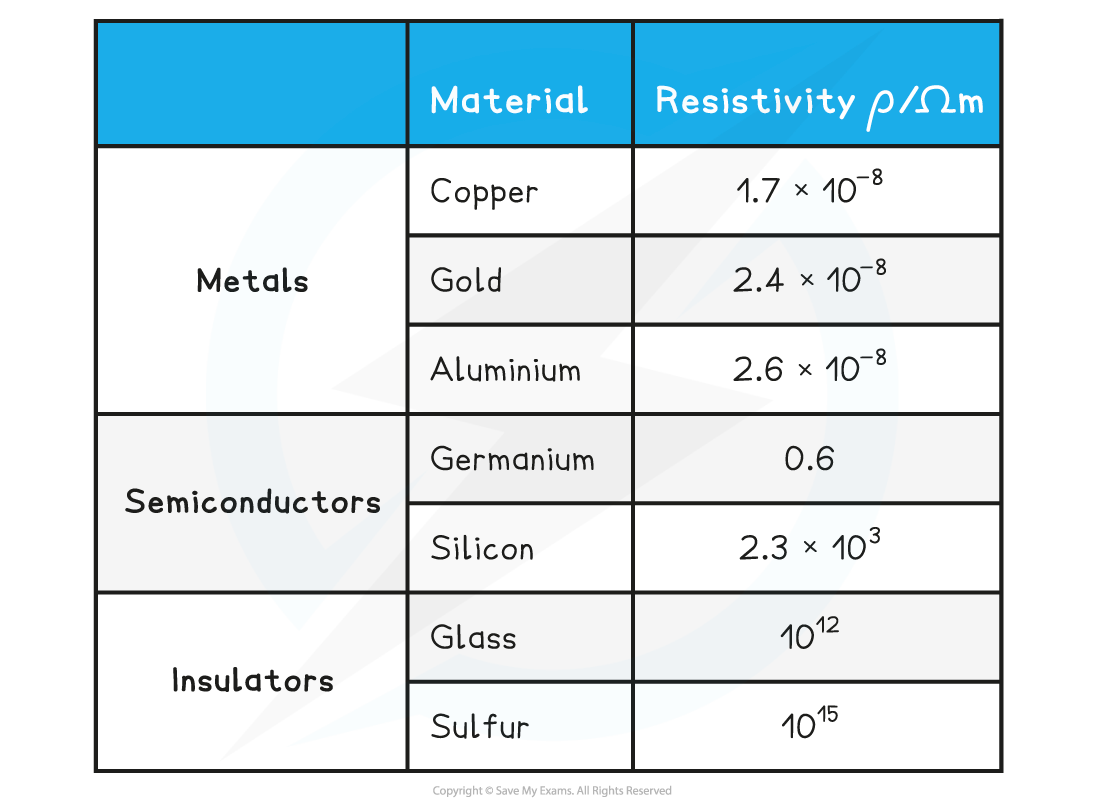
The resistivity of some materials at room temperature
Exam Hint Remember that the cross-sectional area is in m2, the drift velocity is in m s-1 and the number density is in m-3.
Therefore, sometimes unit conversions from cm or mm may be required, so make sure you're comfortable with these.
Was this revision note helpful?
Build on this topic