Calculating Percentage Uncertainties (Edexcel IAL Physics)
Percentage Uncertainties
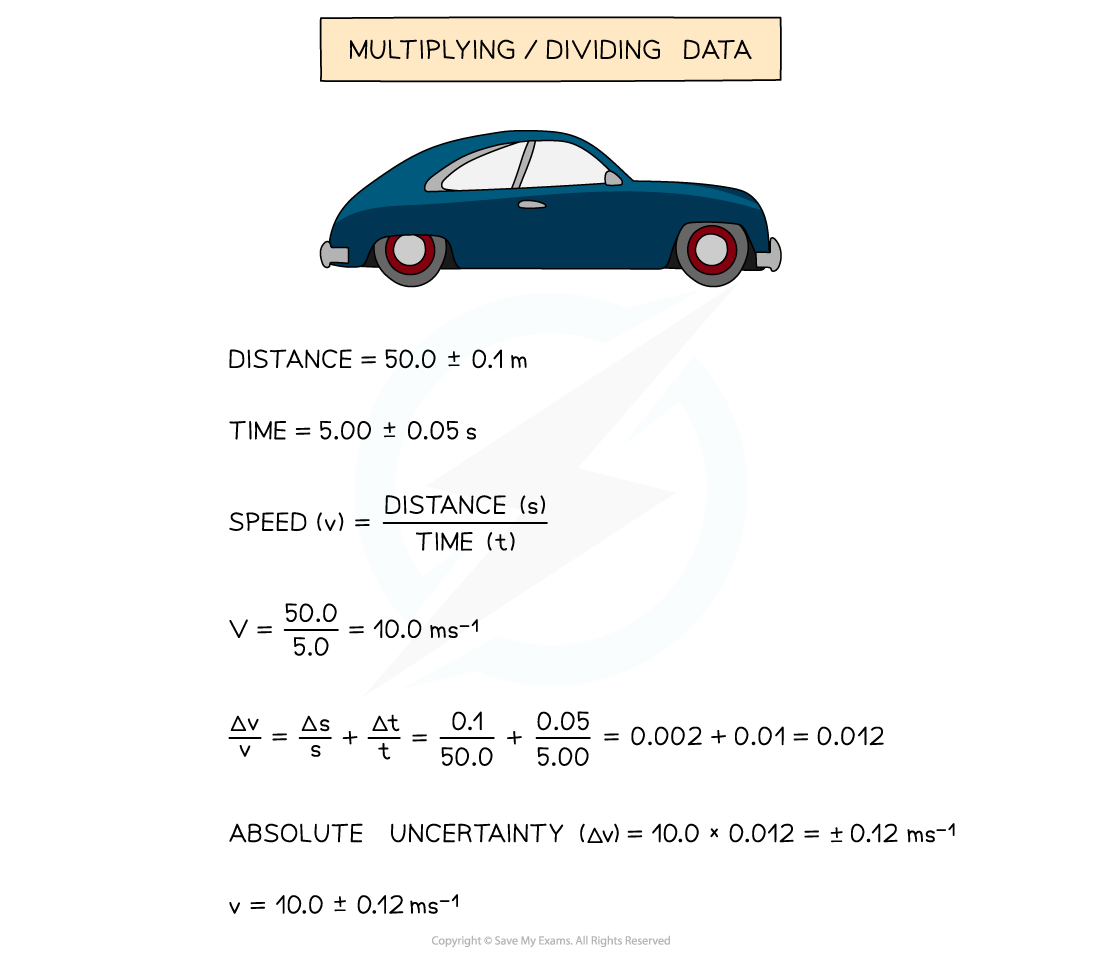
- Percentage uncertainties are compounded when multiplying or dividing data
Multiplying / Dividing Data
- Add the percentage or fractional uncertainties
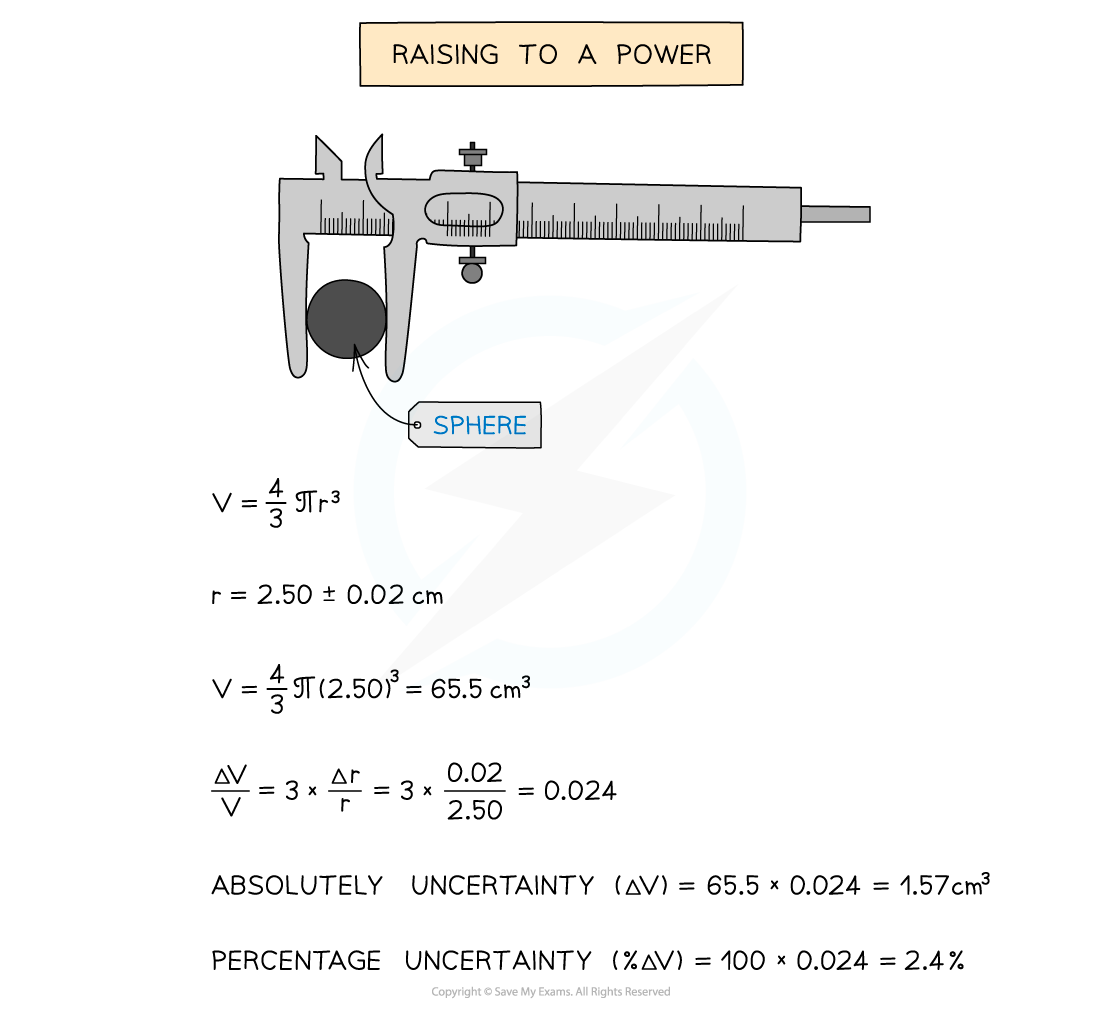
Raising to a Power
- Multiply the percentage uncertainty by the power
Exam Hint Remember:
- Percentage uncertainties have no units
- The uncertainty in numbers and constants, such as π, is taken to be zero
In Edexcel International A level, the uncertainty should be stated to at least one few significant figures than the data but no more than the significant figures of the data.
For example, the uncertainty of a value of 12.0 which is calculated to be 1.204 can be stated as 12.0 ± 1.2 or 12.0 ± 1.20.
Single & Multiple Readings
Single Reading
- Percentage uncertainty for a single reading (measured value) is defined by the equation:
Percentage uncertainty =× 100 %
- The (absolute) uncertainty in a single reading is half the resolution of the instrument
Multiple Readings
-
The percentage uncertainty in measurements from multiple readings (e.g. repeat readings) use half the range of the readings
- The range of the readings is the difference between the highest and lowest reading
Worked Example A student achieves the following results in their experiment for the angular frequency, ω.
0.154, 0.153, 0.159, 0.147, 0.152
Calculate the percentage uncertainty in the mean value of ω.
Answer:
Step 1: Calculate the mean value
mean ω = = 0.153 rad s–1
Step 2: Calculate half the range (this is the uncertainty for multiple readings)
× (0.159 – 0.147) = 0.006 rad s–1a
Step 3: Calculate percentage uncertainty
× 100 % = × 100 %
× 100 % = 3.92 %
Exam Hint Remember that percentage uncertainties have no units, only the % sign! Always make sure your percentage uncertainty is at least one significant figures smaller than the measurement.
Was this revision note helpful?
Build on this topic