The Poisson Distribution (Edexcel IAL Maths)
Properties of Poisson Distribution
Spec point —
1.1
What is a Poisson distribution?
-
A Poisson distribution is a discrete probability distribution
-
The discrete random variable X follows a Poisson distribution if it counts the number of events that occur at random in a given time or space
-
For a Poisson distribution to be valid it must satisfy the following properties:
-
Events occur singly and at random in a given interval of time or space
-
The mean number of occurrences in the given interval(λ) is known and finite
- λ has to be positive but does not have to be an integer
-
Each occurrence is independent of the other occurrences
-
-
If X follows a Poisson distribution then it is denoted
- λ is the mean number of occurrences of the event
-
The formula for the probability of r occurrences in a given interval is:
- for r=0, 1, 2, ...,n
- e is the constant 2.718…
r factorial=r (r−1)(r−2)....2×1
What are the important properties of a Poisson distribution?
-
The mean and variance of a Poisson distribution are roughly equal
-
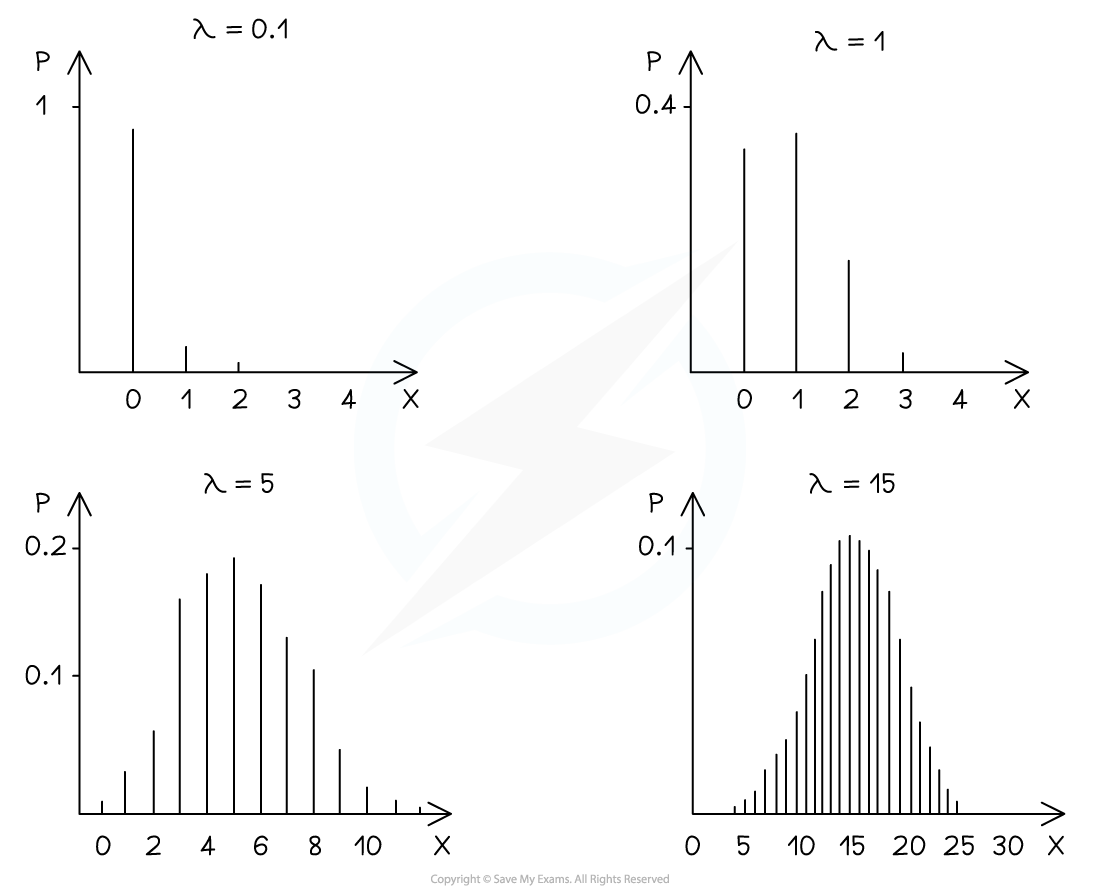
The distribution can be represented visually using a vertical line graph
- If λ is close to 0 then the graph has a tail to the right (positive skew)
- If λ is at least 5 then the graph is roughly symmetrical
-
The Poisson distribution becomes more symmetrical as the value of the mean (λ) increases
Worked Example is the random variable ‘The number of cars that pass a traffic camera per day’. State the conditions that would need to be met for to follow a Poisson distribution.
Answer:
Modelling with Poisson Distribution
Spec point —
1.1
How do I set up a Poisson model?
-
Find the mean and variance and check that they are roughly equal
- You may have to change the mean depending on the given time/space interval
-
Make sure you clearly state what your random variable is
- For example, let X be the number of typing errors per page in an academic article
-
Identify what probability you are looking for
What can be modelled using a Poisson distribution?
-
Anything that occurs singly and randomly in a given interval of time or space and satisfies the conditions
-
For example, let X be the random variable 'the number of emails that arrive into your inbox per day'
-
There is a given interval of a day, this is an example of an interval of time
-
We can assume the emails arrive into your inbox at random
-
We can assume each email is independent of the other emails
- This is something that you would have to consider before using the Poisson distribution as a model
-
If you know the mean number of emails per day a Poisson distribution can be used
-
-
Sometimes the given interval will be for space
- For example, the number of daisies that exist on a square metre of grass
- look carefully at the units given as you may have to change them when calculating probabilities
Worked Example State, with reasons, whether the following can be modelled using a Poisson distribution and if so write the distribution.
(i) Faults occur in a length of cloth at a mean rate of 2 per metre.
(ii) On average 4% of a certain population has green eyes.
(iii) An emergency service company receives, on average, 15 calls per hour.
Answer:
Exam Hint
- If you are asked to criticise a Poisson model always consider whether the trials are independent, this is usually the one that stops a variable from following a Poisson distribution!
Was this revision note helpful?