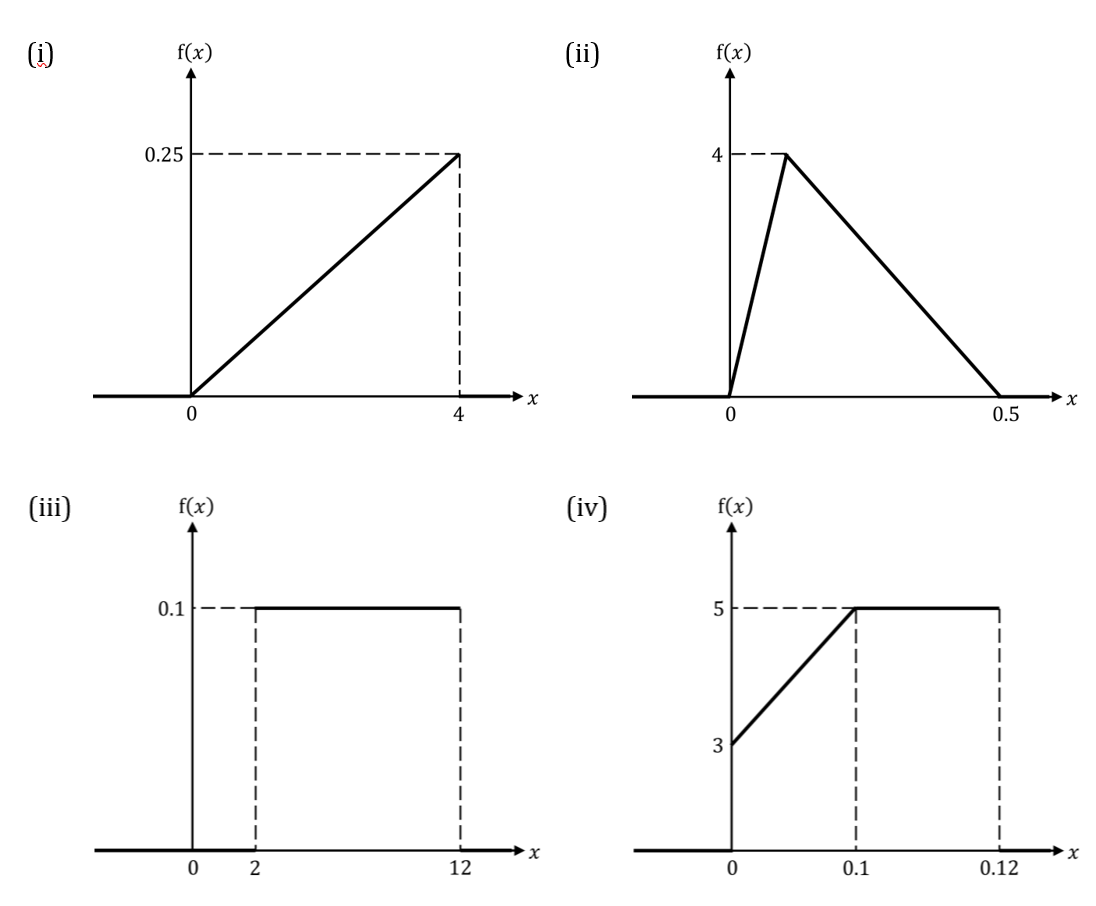
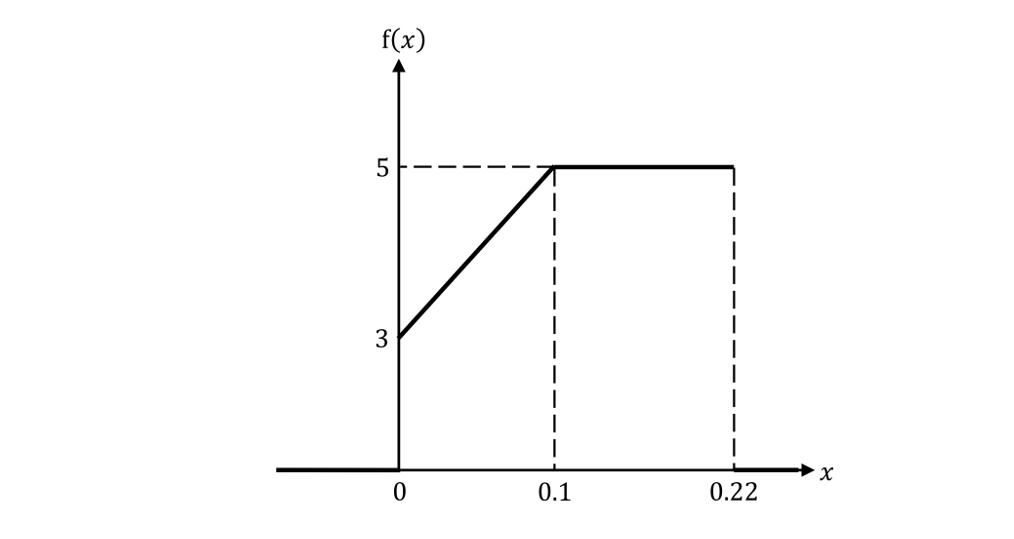
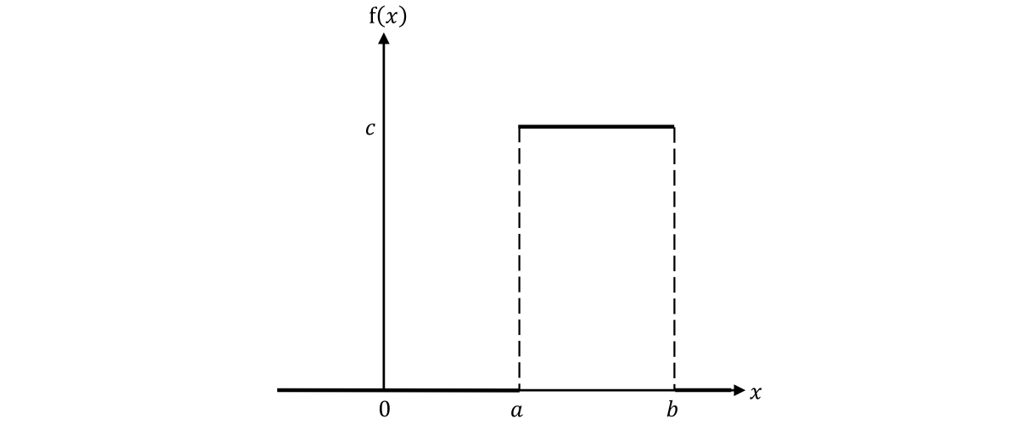
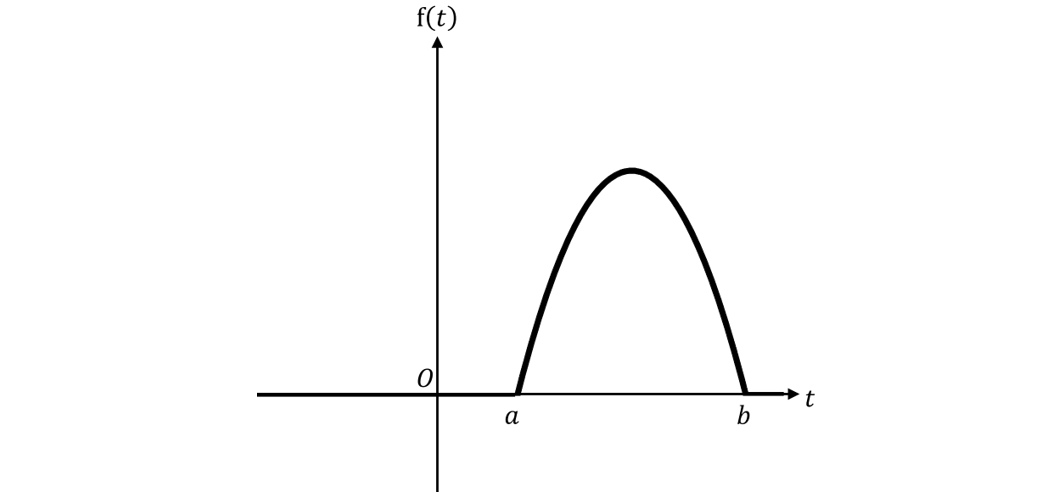
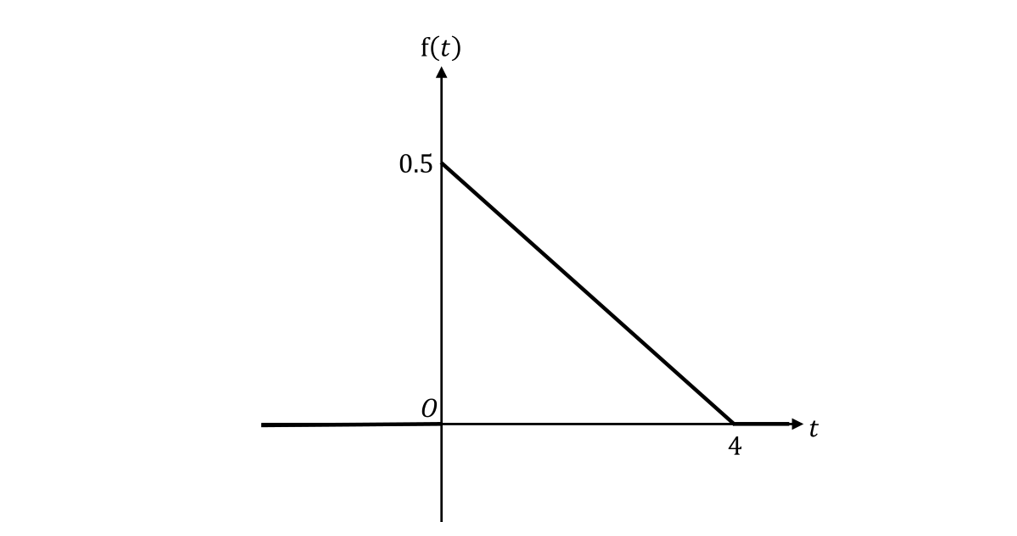
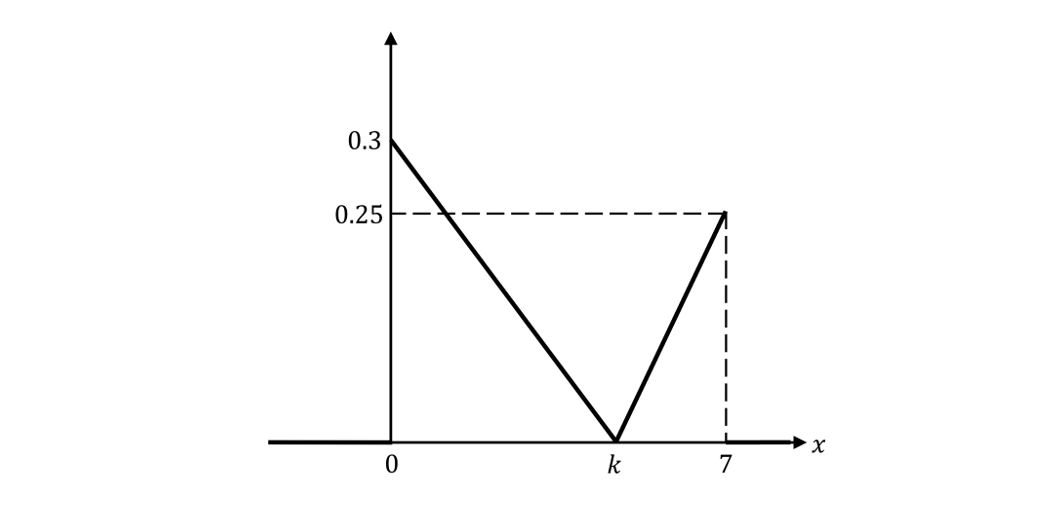
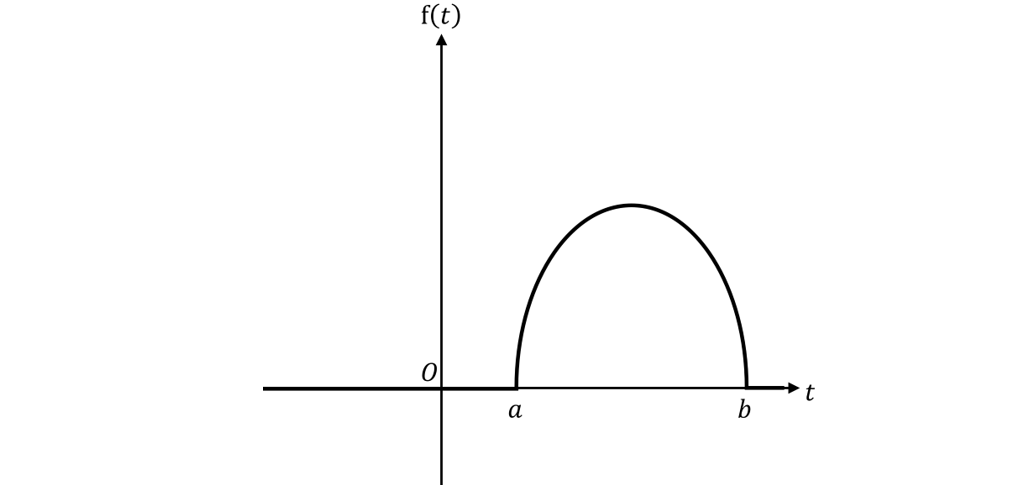
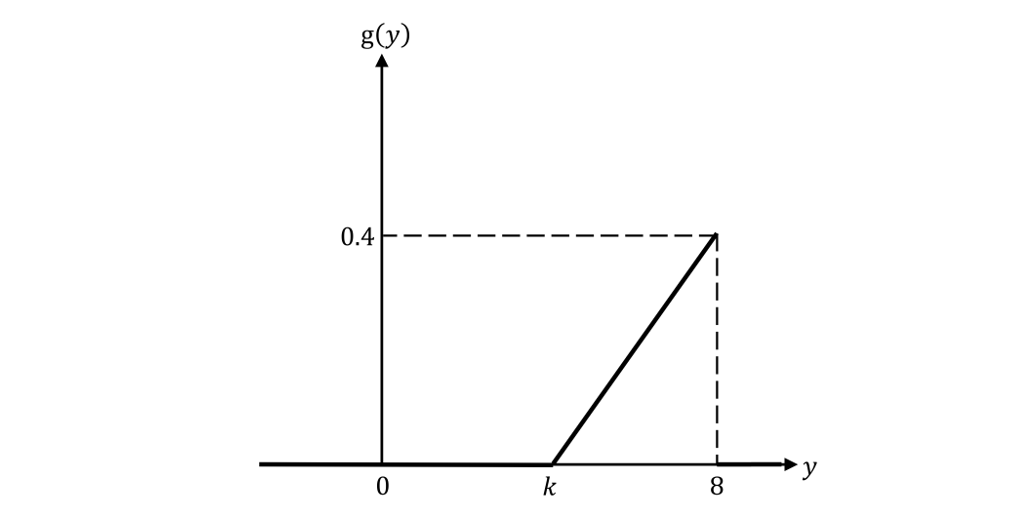
If is the probability density function for a random variable, then the area under the graph of the probability density function must equal 1.
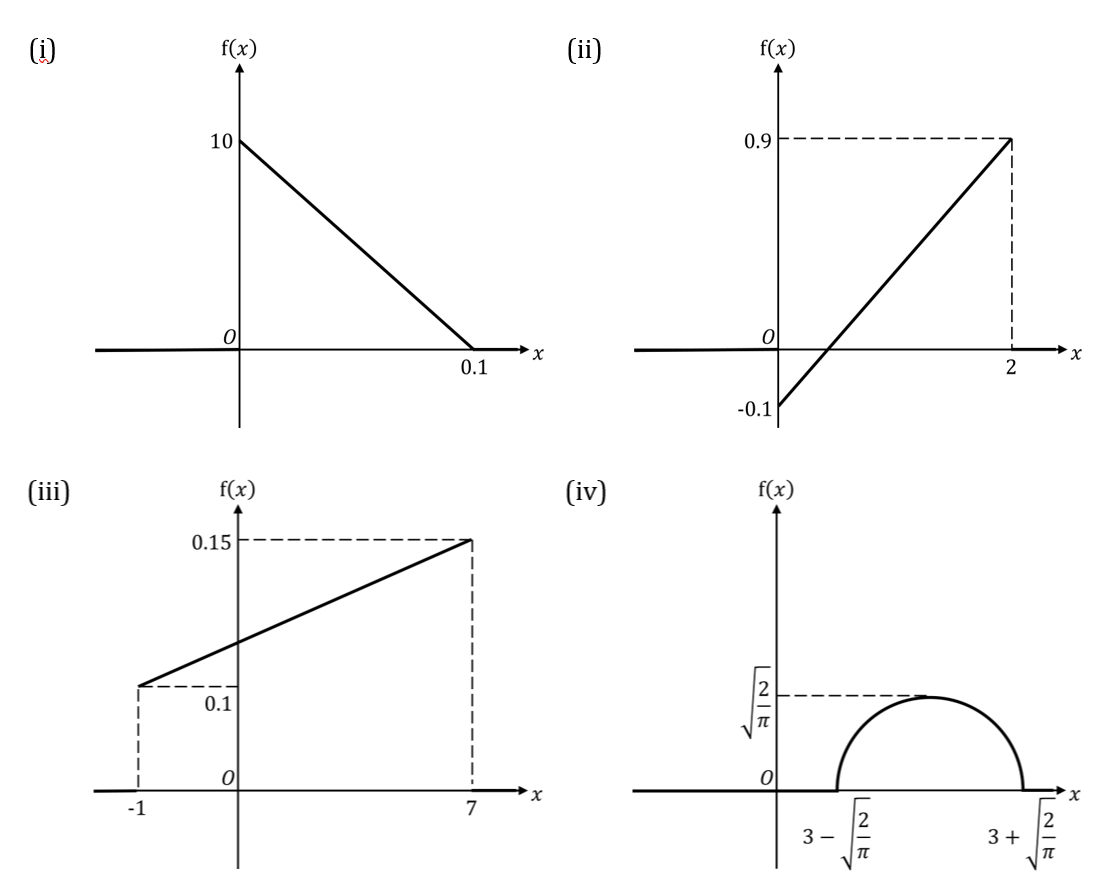
State, with a reason, whether each of the following could be graphs of probability density functions.

36 questions · 243 marks · ≈ 4 hours
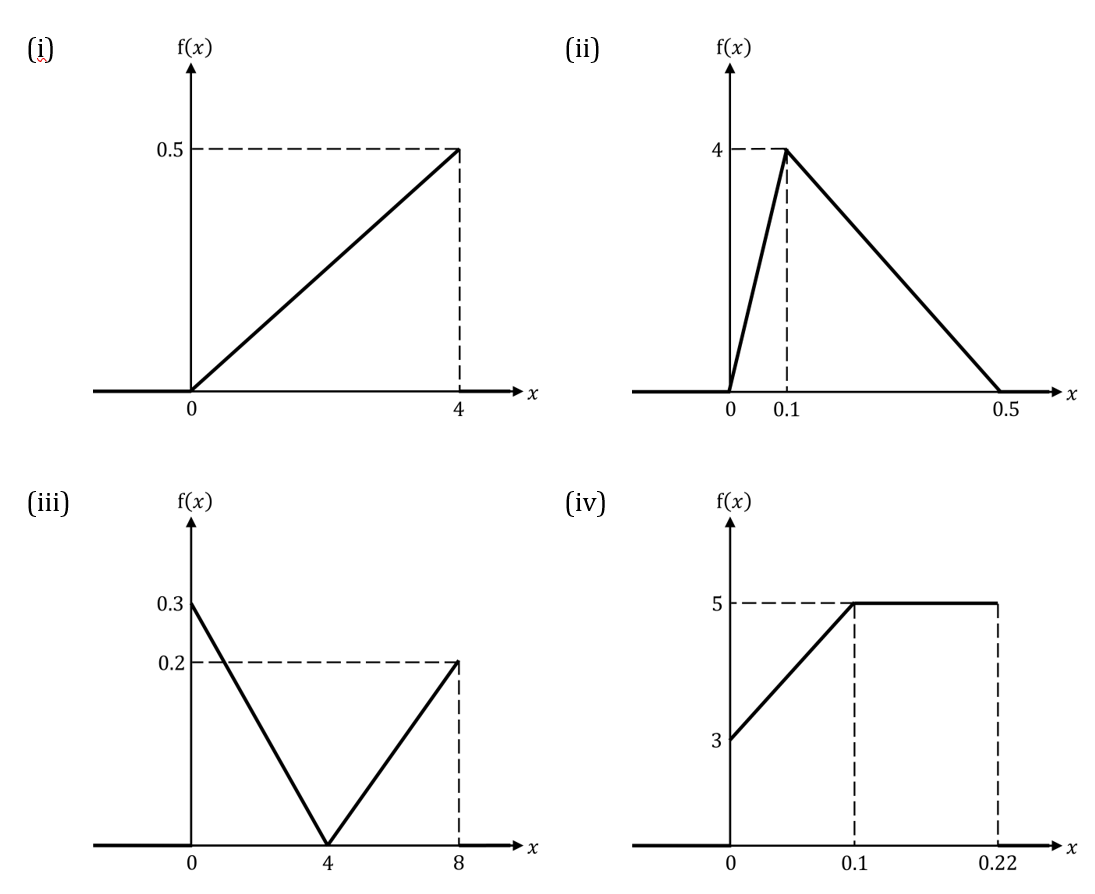
If is the probability density function for a random variable, then the area under the graph of the probability density function must equal 1.
State, with a reason, whether each of the following could be graphs of probability density functions.

If is the probability density function for a random variable, which takes values in the interval then:
Use integration to decide whether the following functions could represent probability distribution functions.
(i)
(ii)
(iii)
The continuous random variable, , has probability density function
The value of is equal to
Find
(i) Explain why
(ii) Hence find .
State, with a reason, the value of
(i)
(ii)
The graph below shows the probability density function of a continuous random variable, .

By finding relevant areas under the graph, find:
(i)
(ii)
(iii) .
Evaluate the following definite integral, giving your answer in terms of .
Hence find the value of given that is a probability density function where
The continuous random variable has probability density function
Find
Hence find the value of using the formula
Find
Hence find the value of using the formula
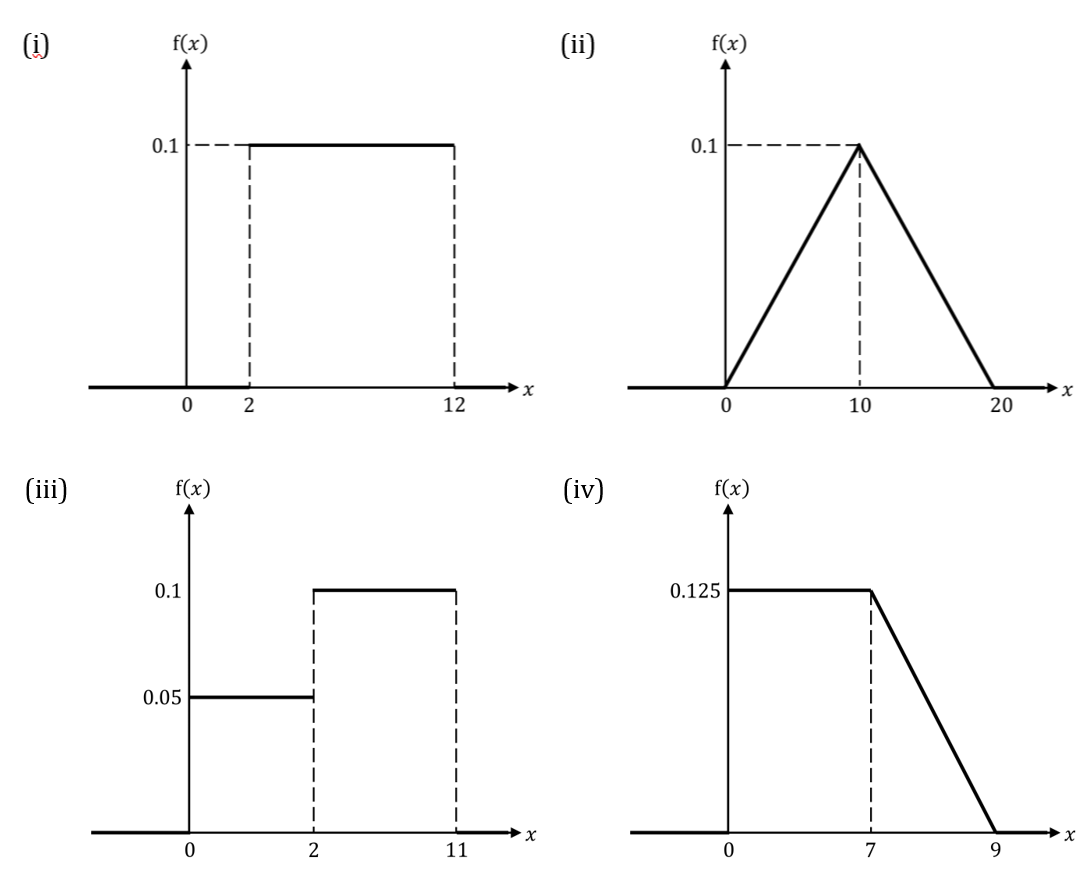
The mode of a continuous random variable , where it exists, is a value for where the probability density function is at its maximum.
State the mode, where it exists, of the continuous random variables which have probability density functions show in the graphs below.

The median, , of a continuous random variable , is the value for which splits the under the graph of the probability density function exactly in half, such that .
Find the value of the median of the continuous random variables which have probability density functions show in the graphs below.

The continuous uniform (rectangular) distribution over the interval has probability density function
The random variable follows a rectangular distribution over the interval .
The graph below shows the probability density function of . Write down the values of and .

Write down
(i) the median of
(ii) the value of
(iii) .
The continuous random variable has probability density function given by
Find by calculating
Find by calculating
State, with a reason, whether each of the following could be graphs of probability density functions.

This is a semicircle.
State, with a reason, whether the following functions could represent probability distribution functions.
(i)
(ii)
(iii)
The continuous random variable, , has probability density function
Show that
(i) Find
(ii) Find
The continuous random variable has probability density function
Show that
Find
Find
Find the mode of the continuous random variable, , which has probability density function defined by:
(i)
(ii)
(iii)
The continuous random variable has probability density function
Find an expression, in terms of , for
Hence find the median of .
The continuous random variable follows a continuous uniform distribution over the interval so that its probability density function is
Find
(i)
(ii)
(iii)
(i) Write down .
(ii) Find .
May calls her nephew Peter each day to check on him. May enjoys talking so much so that Peter has programmed his phone to disconnect from a call after 15 minutes. The length of a call, in minutes, between May and Peter is denoted by the continuous random variable . It is modelled by the probability density function
Find the mean length of a call.
Find the standard deviation of the lengths of calls.
Find the probability that a random call between May and Peter will last longer than 10 minutes.
Out of the next 100 calls between May and Peter, estimate the number of them that will last less than 10 minutes.
The mass, in kilograms, of a wrestler in a local club is denoted by the continuous random variable . It is modelled by the probability density function
Show that
Wrestlers who weigh less than 85 kg can enter Heavy Middleweight competitions.
Find the probability that a randomly selected wrestler can enter Heavy Middleweight competition.
Wrestlers who weigh less than 80 kg can enter Middleweight competitions.
Given that a wrestler can enter Heavy Middleweight competitions, find the probability that they can also enter Middleweight competitions.
The continuous random variable has probability density function given by
Find the value of
Find
Show that .
State, with a reason, whether the following functions could represent probability distribution functions.
(i)
(ii)
(iii)
The continuous random variable has probability density function
f ( x ) = { table columnalign left columnspacing 1.4ex end | begin inline style 1 fourth x ( x - 1 ) ( x + 1 ) | 1 <= x <= k | | 0 otherwise. | | close
Find the exact value for .
Find
Harry is trying to draw specific lengths without measuring equipment. He draws a straight line and stops when he thinks it is 10 cm long. The actual length of Harry’s line, cm, can be modelled by the probability density function
Estimate the lower quartile of the lengths of Harry’s lines.
Harry tries to draw a 10 cm line 80 times.
Write down how many of Harry’s lines you would expect to be less than the lower quartile.
The diagram below shows the probability density function, , of a random variable . when , otherwise

Write down an expression for in terms of .
Find a simplified expression for in terms of .
Given thatfind the value of .
Find the mode of the continuous random variable, , which has probability density function defined by:
(i)
(ii)
(iii)
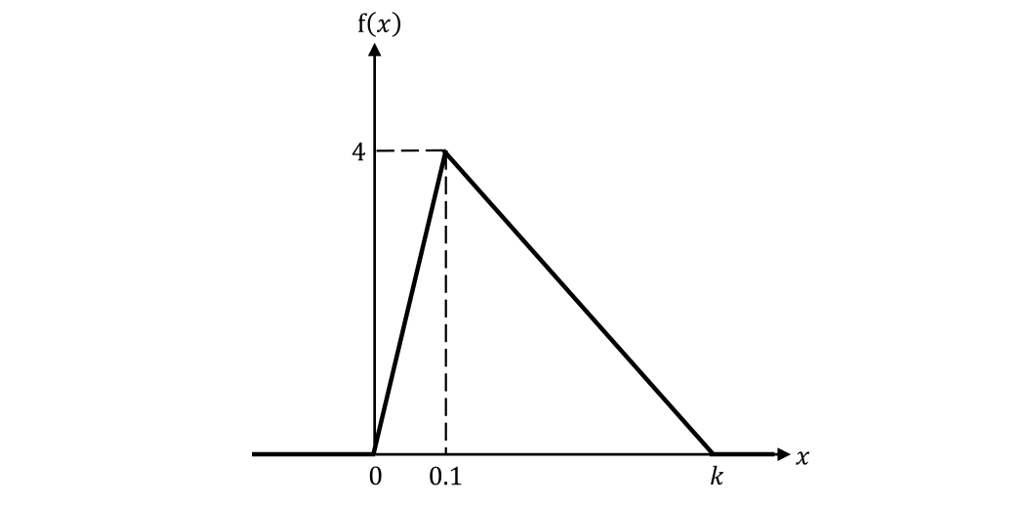
The diagram below shows the probability density function, , of a random variable .

Find the value of .
Find
Find the median of .
The diagram below shows the probability density function, , of a random variable .

For elsewhere .
Find the values of and .
State the value of and find .
Find .
Given that find
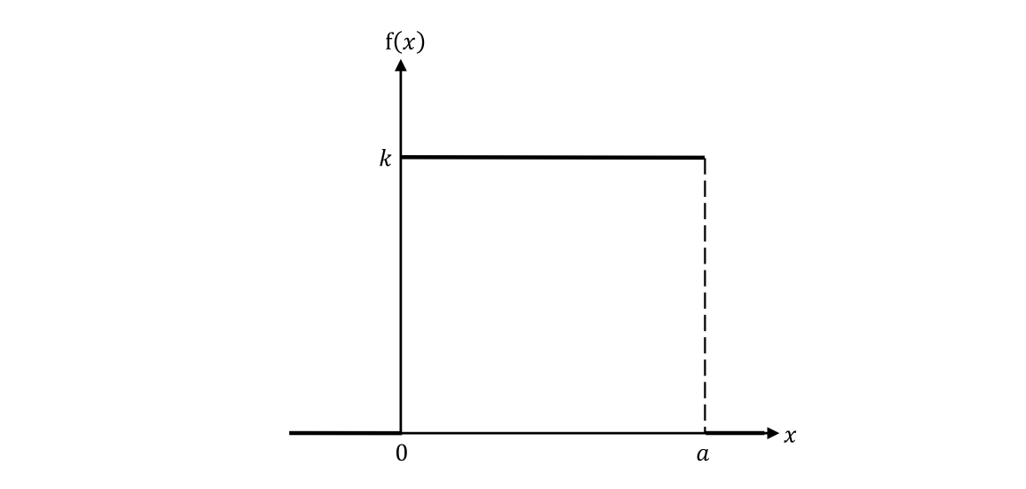
Geoff is taking part in a quiz where he has 4 seconds to answer each question. The time, in seconds, it takes Geoff to answer a question is denoted which can be modelled by the probability density function, shown below.

Find the probability that Geoff answers a question in less than 2 seconds.
Find the mean time it takes Geoff to answer a question.
There are 10 questions in the quiz. Find the probability that for at least one of the questions Geoff takes longer than 3 seconds.
The diagram below shows the probability density function, , of a random variable .

Find the value of .
Find
Find the interquartile range of .
A computer takes seconds to start up. The random variable, , can be modelled by the probability distribution, , shown below.

For elsewhere .
Find the values of and .
State the mean time for the computer to start up.
Find probability that the computer takes between 6 and 15 seconds to start up.
Given that find the exact value of .
The diagram below shows the probability density function, , of a random variable .

Find the value of .
Find
Find the median of .
Find
The random variable, , follows a continuous uniform distribution on the interval . The probability density function is defined by:
(i) Write down an expression for in terms of and .
(ii) Write down an expression for in terms of and .
(iii) Show that .
Given that and , find the values of and .
A meeting at a company lasts hours. The random variable can be modelled by the probability density function
Find the mean time of a meeting and find the standard deviation of times.
Show that the median length of a meeting is 0.771 hours, correct to 3 significant figures.
By using differentiation, find the mode of the times.
The continuous random variable has probability density function
Show that
Given that show that and hence find the value of .
Find the exact value of .
Paul is travelling around France to try to find the perfect baguette. The random variable represents the cost, in euros, of a baguette. It can be modelled by the probability density function
Sketch the graph of
Explain why the mean price of a baguette is €7.
Given that find the value of
The continuous random variable has probability density function given by
where is a constant.
Find the exact value of .
Find
Find .