16 markseasy
3 marks
Given that u = 3x + 2 show that
(i) du = 3 dx,
(ii) integral3 cos(3x +2) dx = integralcos u du.
3 marks
Hence find an expression in terms of x for the integral
integral3 cos(3x +2) dx.
26 questions · 161 marks · ≈ 3 hours
Given that u = 3x + 2 show that
(i) du = 3 dx,
(ii) integral3 cos(3x +2) dx = integralcos u du.
Hence find an expression in terms of x for the integral
integral3 cos(3x +2) dx.
Use the substitution u = 4x + 1 to find
Use integration by parts to find an expression for
Show that
can be written in the form
Hence find
writing your answer as a single logarithm.
The diagram below shows the region R, bounded by the straight lines with equations y = 2x + 1, x =2, x =4 and the x-axis.
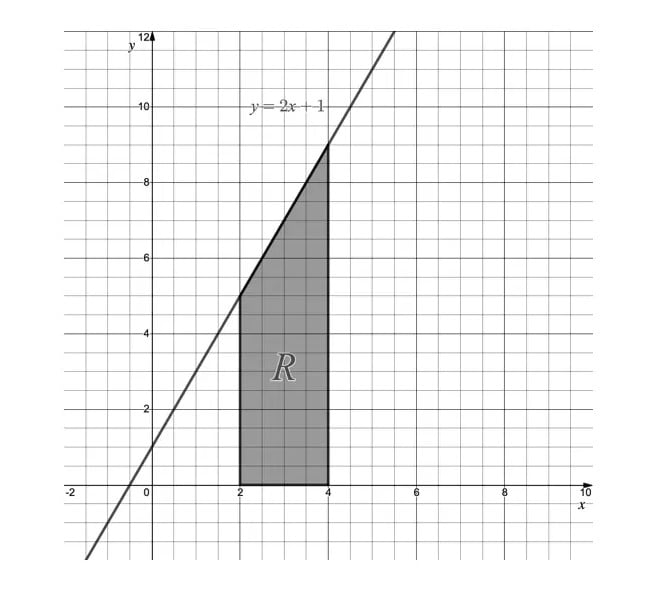
(i) For y = 2x + 1, show that y2 = 4x2 + 4x + 1.
(ii) Find the volume of the solid formed when the region R is rotated 360° around the x-axis.
Use the substitution u = sin x to find the value of
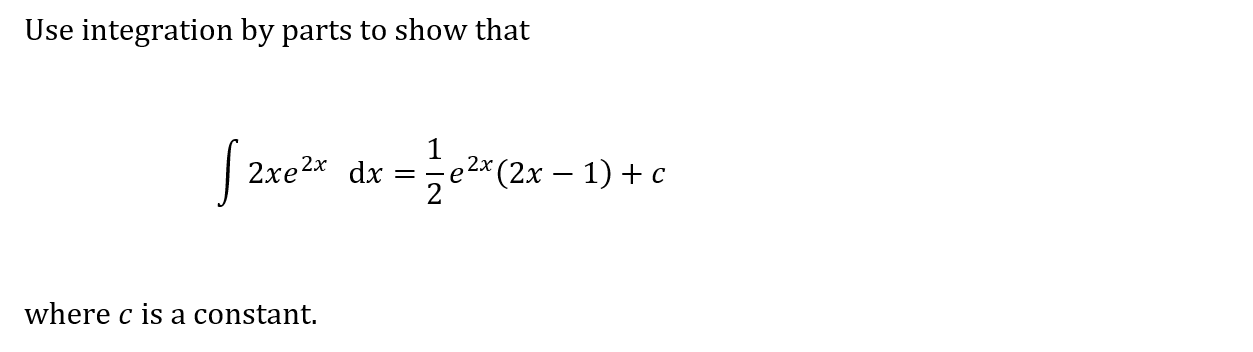
Use a suitable substitution to find
integral-15 sin(5x-2) dx
Use calculus and the substitution u = x + 4 to show that
Use integration by parts to find, in terms of e, the exact value of
(5x - 4)e3x dx
Show that
can be written in the form
Hence find
writing your answer as a single logarithm.
The diagram below shows the graph of the curve with equation y = 4 - x2.
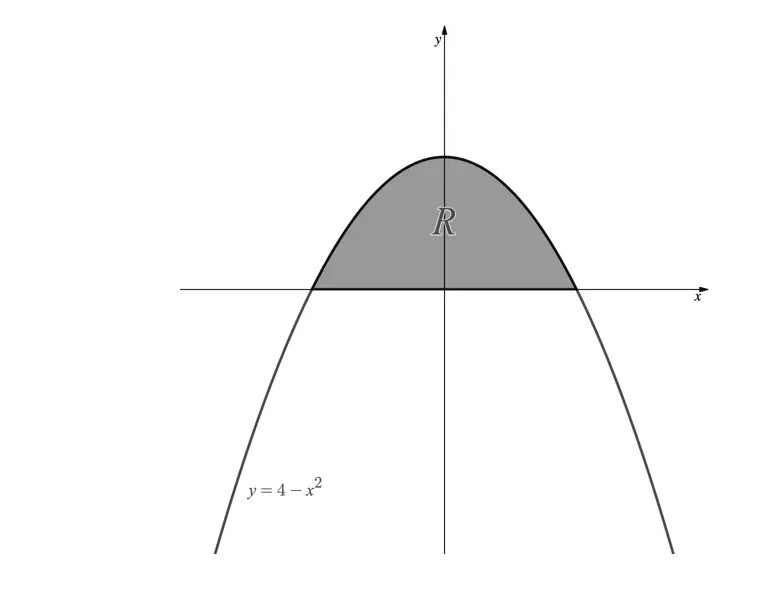
(i) Find the x-coordinates of the points where the graph of y = 4 - x2 intercepts the x-axis.
(ii) The shaded region, R, is to be rotated 360° around the x-axis.
Find the volume of the shape generated.
Use a suitable substitution to find the following
Use the substitution u = 2 + In x to show that
where c is the constant of integration.
Use integration by parts to find
Show that
where c is the constant of integration.
Express
as partial fractions.
Hence, or otherwise, find
The diagram below shows a right-angled triangle with vertices at the origin, the point (h,0) and the point (h,r), where r > 0 and h > 0.
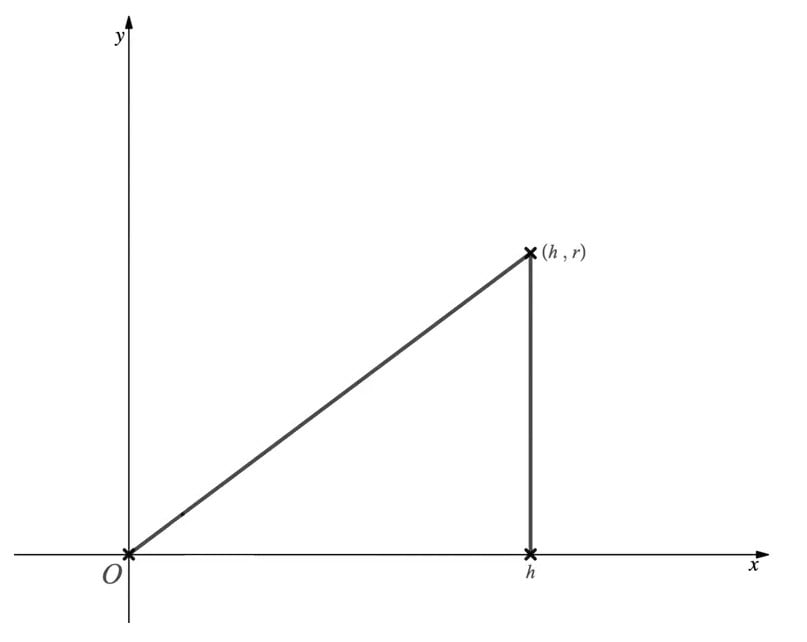
Find an equation of the line on which the hypotenuse of the right-angled triangle lies, giving your answer in the form y = f(x).
The triangle is rotated 360° about the x-axis to form a cone.
Thus use calculus to prove that the general formula for the volume, V, of a cone is
where r is the base radius of the cone and h is its perpendicular height.
The diagram below shows part of the curve C defined by the equation , where a is a positive constant. The shaded region R is bounded by the curve, the x-axis, and the lines x = 1 and x = 6.
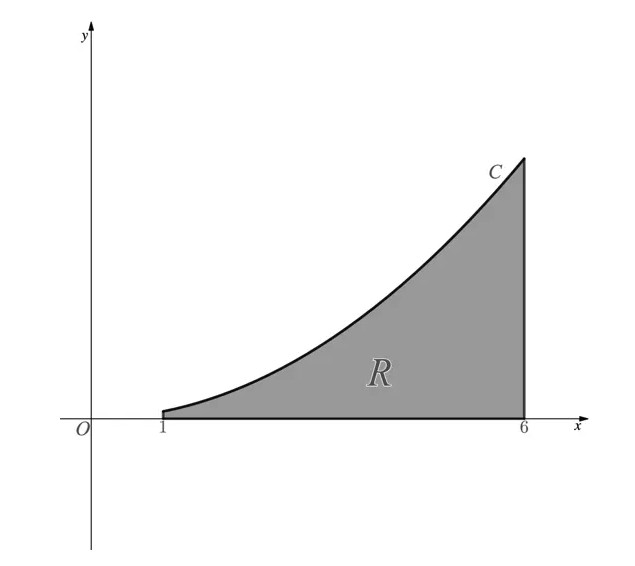
Given that the volume of the solid formed when the region R is rotated 360° about the x-axis is cubic units, find the value of a.
Find an expression for y given that
Integrate
Use calculus and the substitution x = cos to find the exact value of
Find
Find
Find the integral
Use integration by parts to show that
where c is the constant of integration.
Sketch the region described by the following inequalities
x ≥ 2 x≤ 6 2y ≤ x + 4 y≥p, where 0<p< 2
The region described in part (a) is rotated through 360° about the x-axis.
Find the volume of the solid formed, giving your answer in terms of p.
The solid formed in part (b) will have a 'hole' in its centre.
(i) Find the volume of this 'hole', giving your answer in terms of p.
(ii) Hence show that there are no values of p in the given interval that make the volume of the solid equal to the volume of the 'hole'.
Starting with the equation of a semicircle of radius r, y = (where r > 0), use calculus to prove that the general formula for the volume, V, of a sphere of radius r is
Express in partial fractions.
Use your answer from part (a) to help find