Can we find the area between y=e−x and y=e−xsinx?
Question
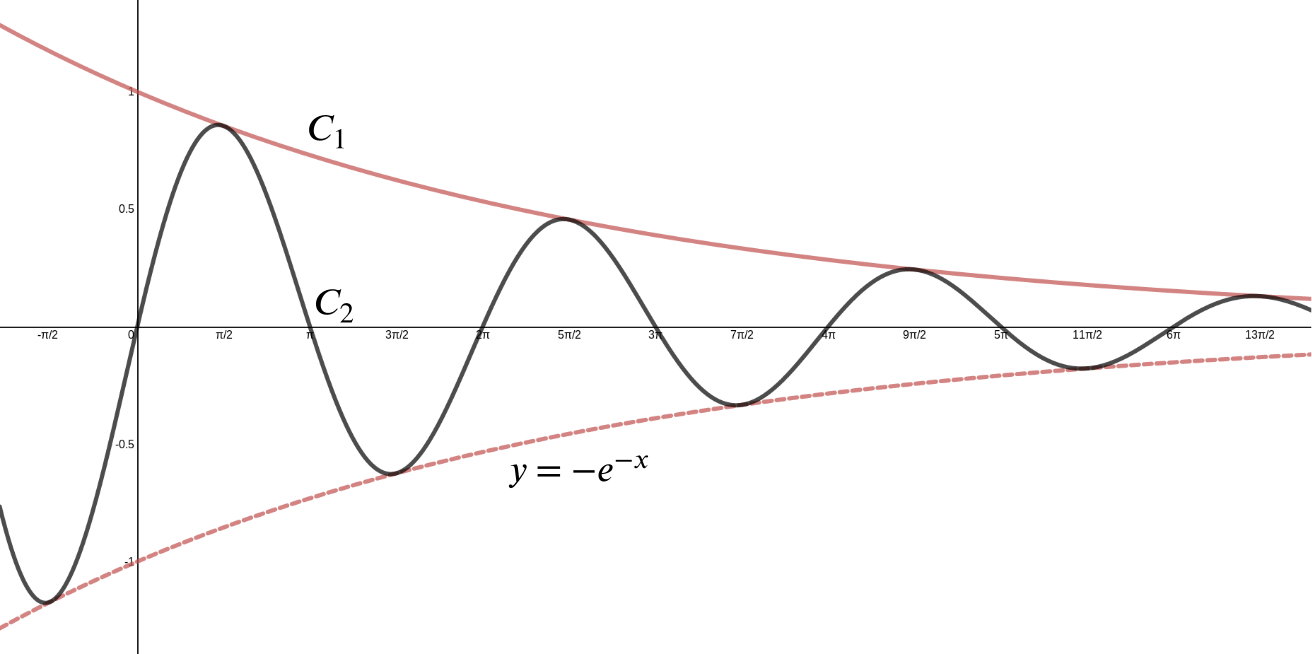
The curves C1 and C2 are defined by y=e−x(x>0)andy=e−xsinx(x>0), respectively. Sketch roughly C1 and C2 on the same diagram.
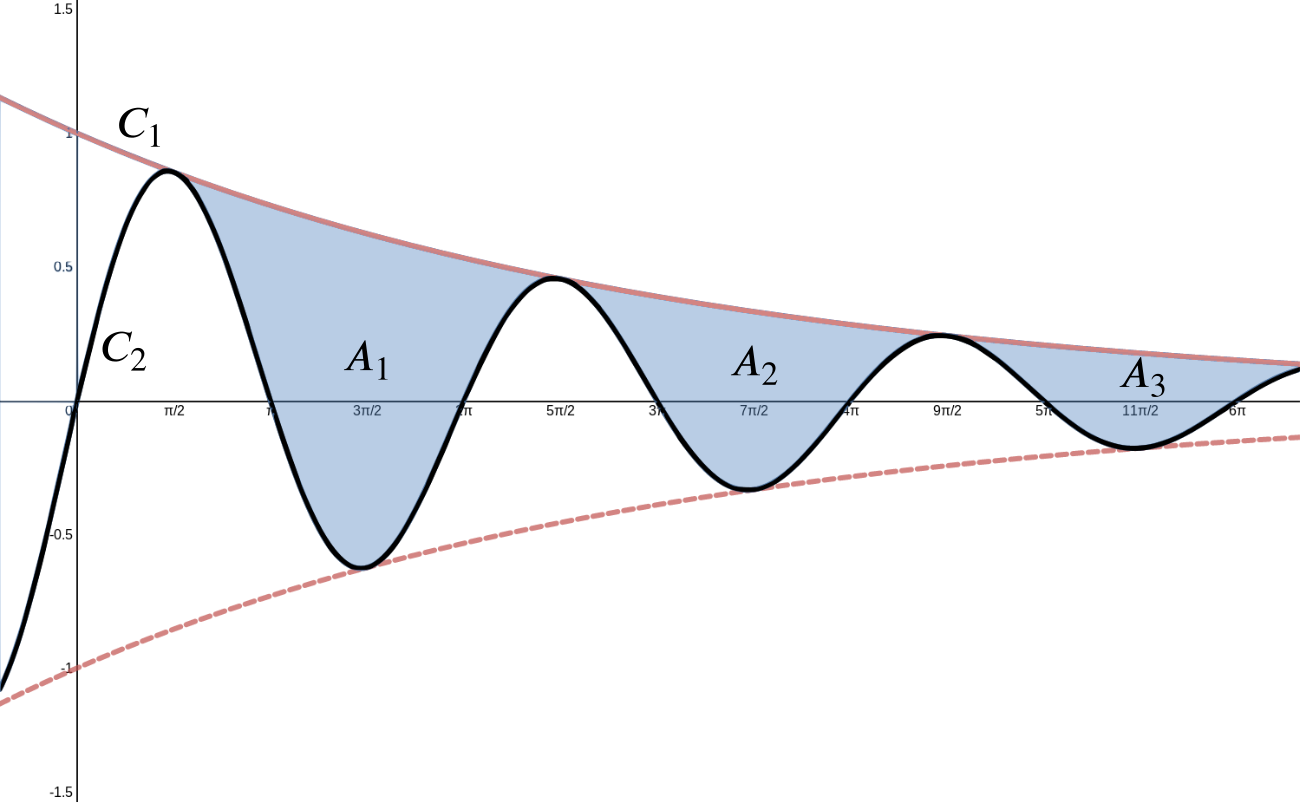
Let xn denote the x-coordinate of the nth point of contact between the two curves, where 0<x1<x2<…b, and let An denote the area of the region enclosed by the two curves between xn and xn+1. Show that An=21(e2π−1)e−(4n+1)π/2 and hence find n=1∑∞An.
Suggestion
When does e−xsinx equal e−x?
Where do the points xn occur?
If we look at the area that forms A1 on your graph, how can we write that in terms of integrals? What about An?
How could we find I=∫e−xsinxdx? Could we use integration by parts twice?
…and hence find n=1∑∞An.
Could we write out the first few terms of the infinite sum n=1∑∞An?
What’s the expression for the infinite sum in this case? Can we spot a geometric series anywhere? What’s the sum to infinity for this?
Solution
For C1 and C2, we need the parts of these curves that satisfy x>0.
The two curves y=e−x and y=−e−x form what is known as an `envelope’ around y=e−xsinx.
First we need to know what the points xn are. Solving e−x=e−xsinx,(e−x=0) ⟹sinx=1⟹x1=2π,x2=2π+2π…b Thus xn=2π(n−1)+2π=21(4n−3)π and An=∫21(4n−3)π21(4n+1)πe−x(1−sinx)dx, the difference between the two curves C1 and C2. This can be seen below.
Consider
I=∫e−xsinxdx
. We can solve this via integration by parts, with
u=sinx
and
v′=e−x
:
I⟹2I⟹I=∫e−xsinxdx=[−e−xsinx]+∫e−xcosxdx=[−e−xsinx]+[−e−xcosx]−∫e−xsinxdx (by integrating the integral above by parts again)=[−e−xsinx]+[−e−xcosx]−I=−e−x(sinx+cosx)=−21e−x(sinx+cosx)
Thus
An=∫xnxn+1e−x(1−sinx)dx=∫21(4n−3)π21(4n+1)πe−xdx−∫21(4n−3)π21(4n+1)πe−xsinxdx=[−e−x+21e−x(sinx+cosx)]21(4n−3)π21(4n+1)π(recognising the second integral above as I)=[21e−x(sinx+cosx−2)]21(4n−3)π21(4n+1)π=21e−21(4n+1)π[sin(2nπ+2π)+cos(2nπ+2π)−2]−21e−21(4n+1)πe2π[sin(2(n−1)π+2π)+cos(2(n−1)π+2π)−2].
With
sin(2nπ+2π)=sin2π=1
and
cos(2nπ+2π)=cos2π=0
for all integers
n
, we find
An=21e−21(4n+1)π(1+0−2)−21e−21(4n+1)πe2π(1+0−2)=21e−21(4n+1)π(−1+e2π)=21(e2π−1)e−21(4n+1)π,
as required.
[…] and hence find n=1∑∞An.
Let
A=n=1∑∞An
. Then
AAAAA=n=1∑∞21(e2π−1)e−21(4n+1)π=21(e2π−1)n=1∑∞e−2nπe−2π=21(e2π−1)e−2πn=1∑∞(e−2π)n=21(e2π−1)e−2π[e−2π+(e−2π)2+(e−2π)3+…b]=21(e2π−1)e−2πe−2π[1+e−2π+(e−2π)2+…b]
We therefore have the infinite sum of a geometric series, with first term
a=21(e2π−1)e−25π
and ratio
r=e−2π
. Since
2π>0
,
e−2π<1
and the series converges, with infinite sum
S∞=1−ra
. Therefore
A=21(e2π−1)e−25π×1−e−2π1=21(e2π−1)e−25π×e2π−1e2π=21e−25π×e2π=21e−2π.
So n=1∑∞An=21e−2π.