Stationary Points & Turning Points (Edexcel IAL Maths)
Spec point —
7.1
Stationary points & turning points
What are stationary points?
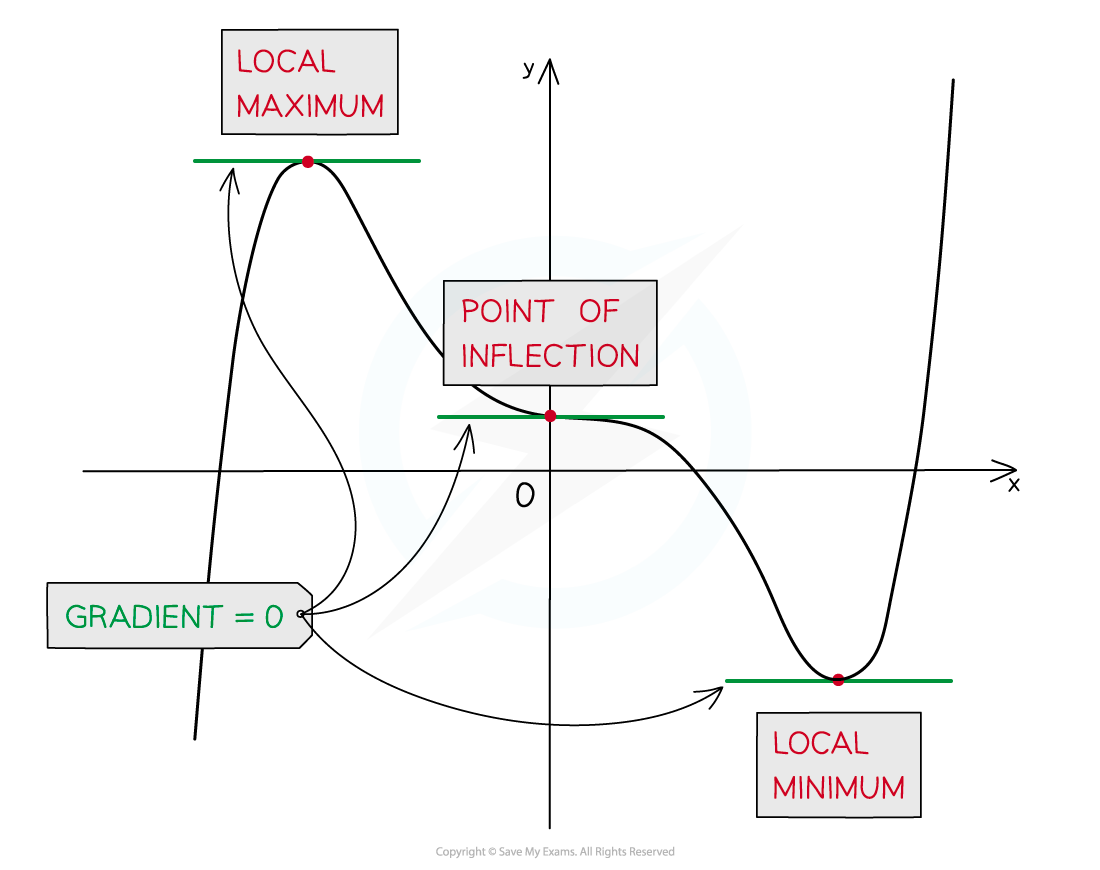
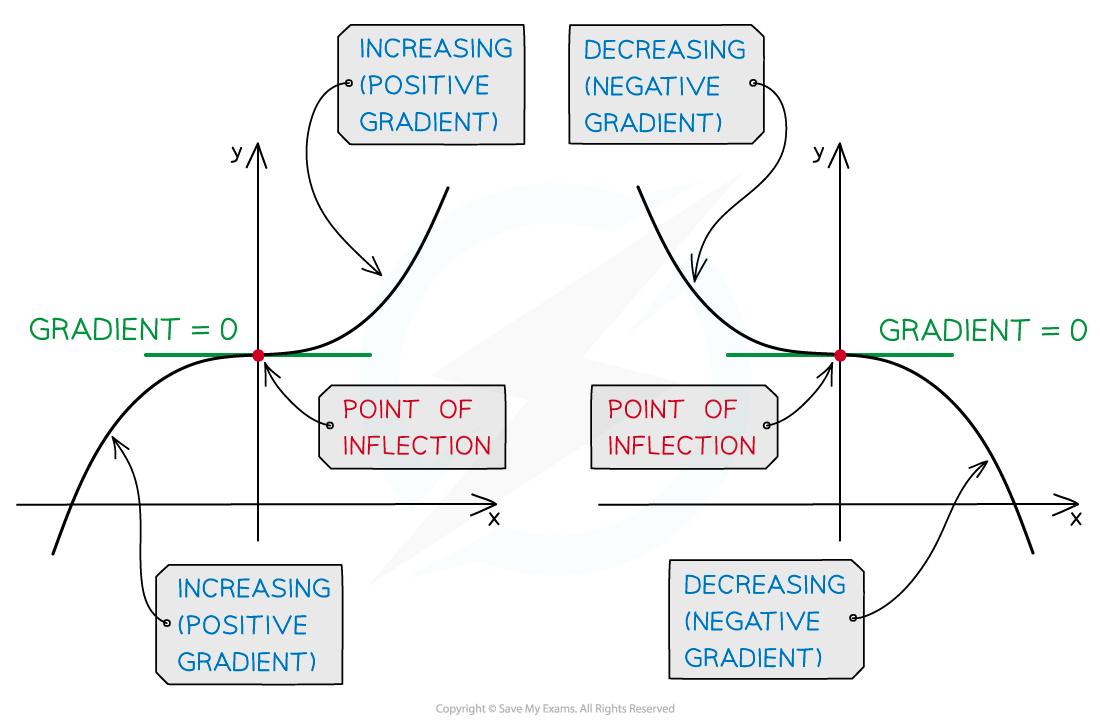
- A stationary point is any point on a curve where the gradient is zero
- To find stationary points of a function f(x)
Step 1: Find the first derivative f'(x)
Step 2: Solve f'(x) = 0 to find the x-coordinates of the stationary points
Step 3: Substitute those x-coordinates into f(x) to find the corresponding y-coordinates
-
A stationary point may be either a local minimum, a local maximum, or a point of inflection
-
Turning points are maximum points or minimum points only
- The graph turns from going up to down (or down to up)
How do I determine the type of stationary point on a quadratic?
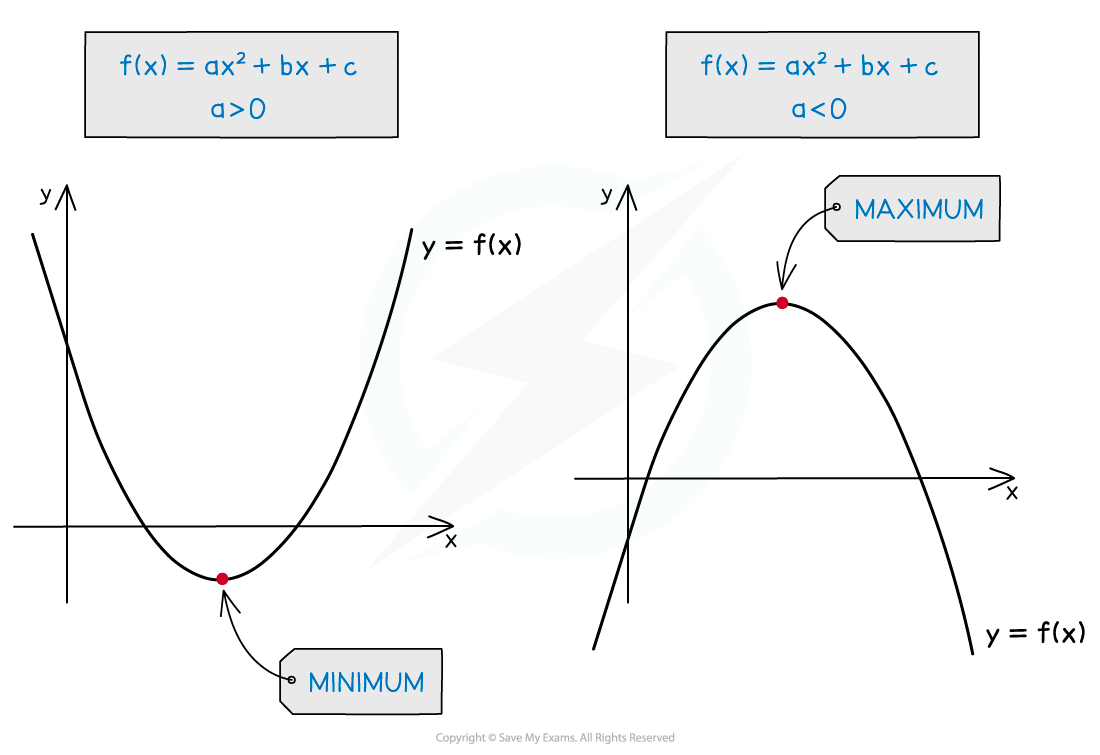
- The graph of a quadratic function (ie a parabola) only has a single stationary point
- For an 'up' parabola this is the minimum; for a 'down' parabola it is the maximum (no need to talk about 'local' here)
-
The y value of the stationary point is thus the minimum or maximum value of the quadratic function
-
Quadratics can only have minimum and maximum points
- so quadratics have turning points (also called a vertex)
How do I determine the type of stationary point on a curve?
-
For a function f(x) there are two ways to determine the nature of its stationary points
-
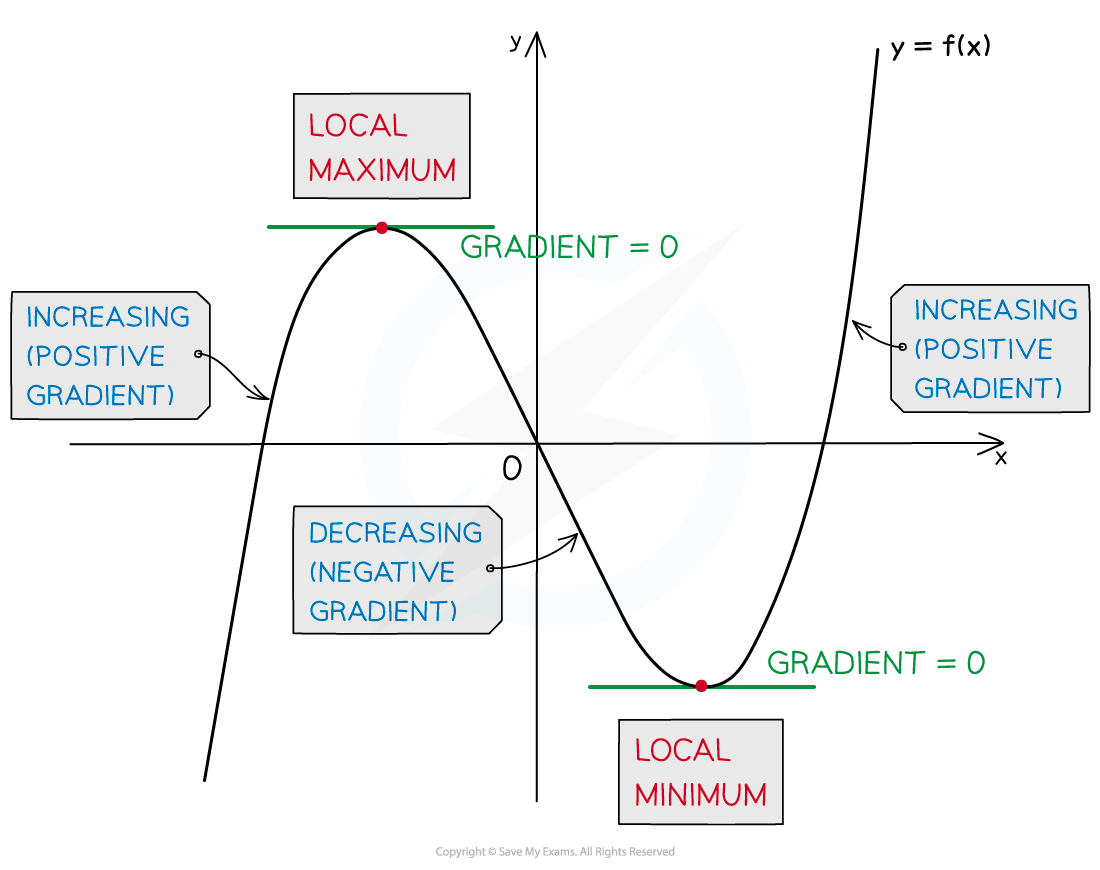
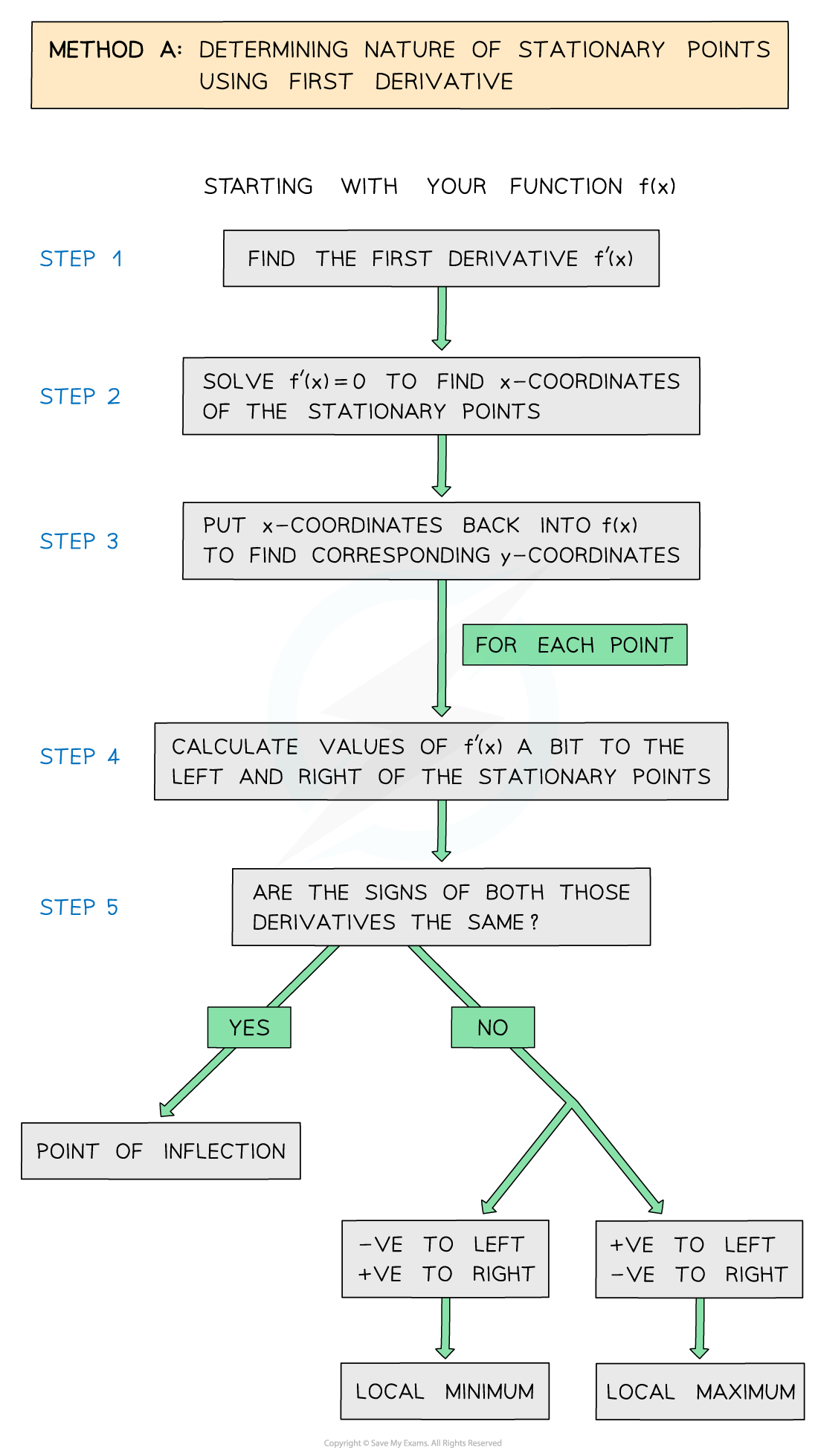
Method A: Compare the signs of the first derivative (positive or negative) a little bit to either side of the stationary point
- (After completing Steps 1 - 3 above to find the stationary points)
Step 4: For each stationary point find the values of the first derivative a little bit 'to the left' (ie slightly smaller x value) and a little bit 'to the right' (slightly larger x value) of the stationary point
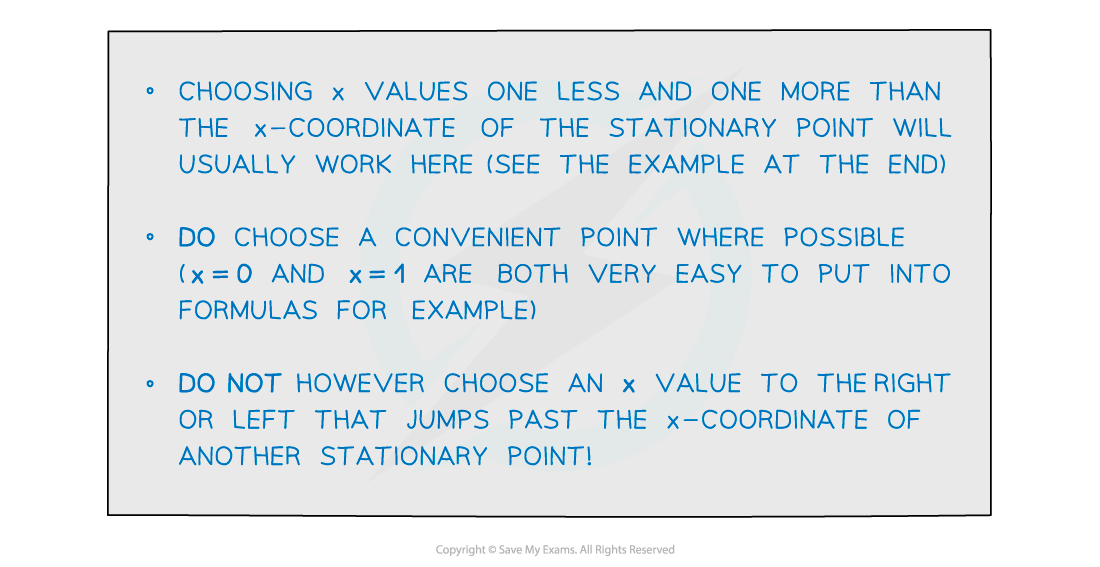
Step 5: Compare the signs (positive or negative) of the derivatives on the left and right of the stationary point
- If the derivatives are negative on the left and positive on the right, the point is a local minimum
- If the derivatives are positive on the left and negative on the right, the point is a local maximum
- If the signs of the derivatives are the same on both sides (both positive or both negative) then the point is a point of inflection
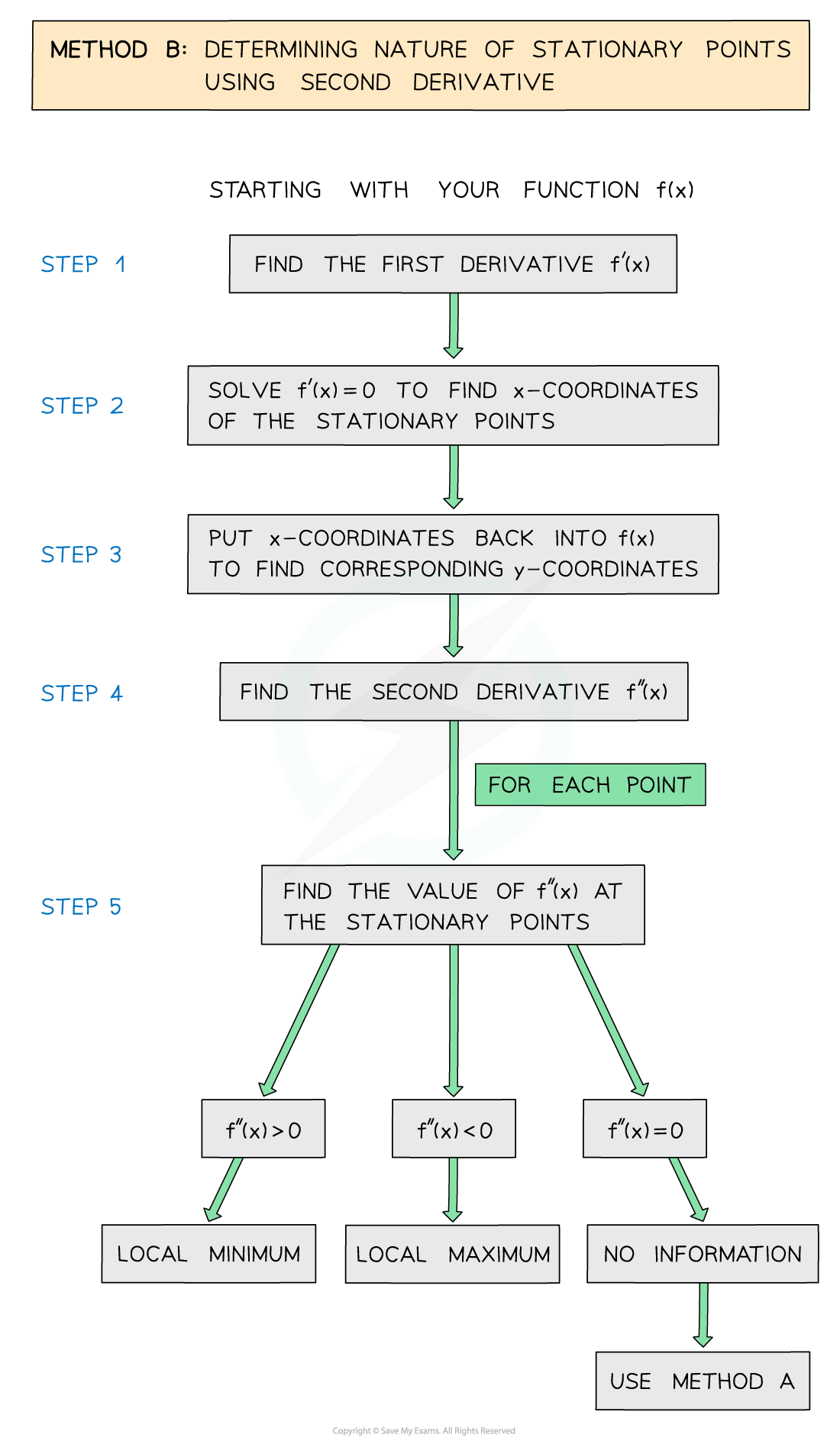
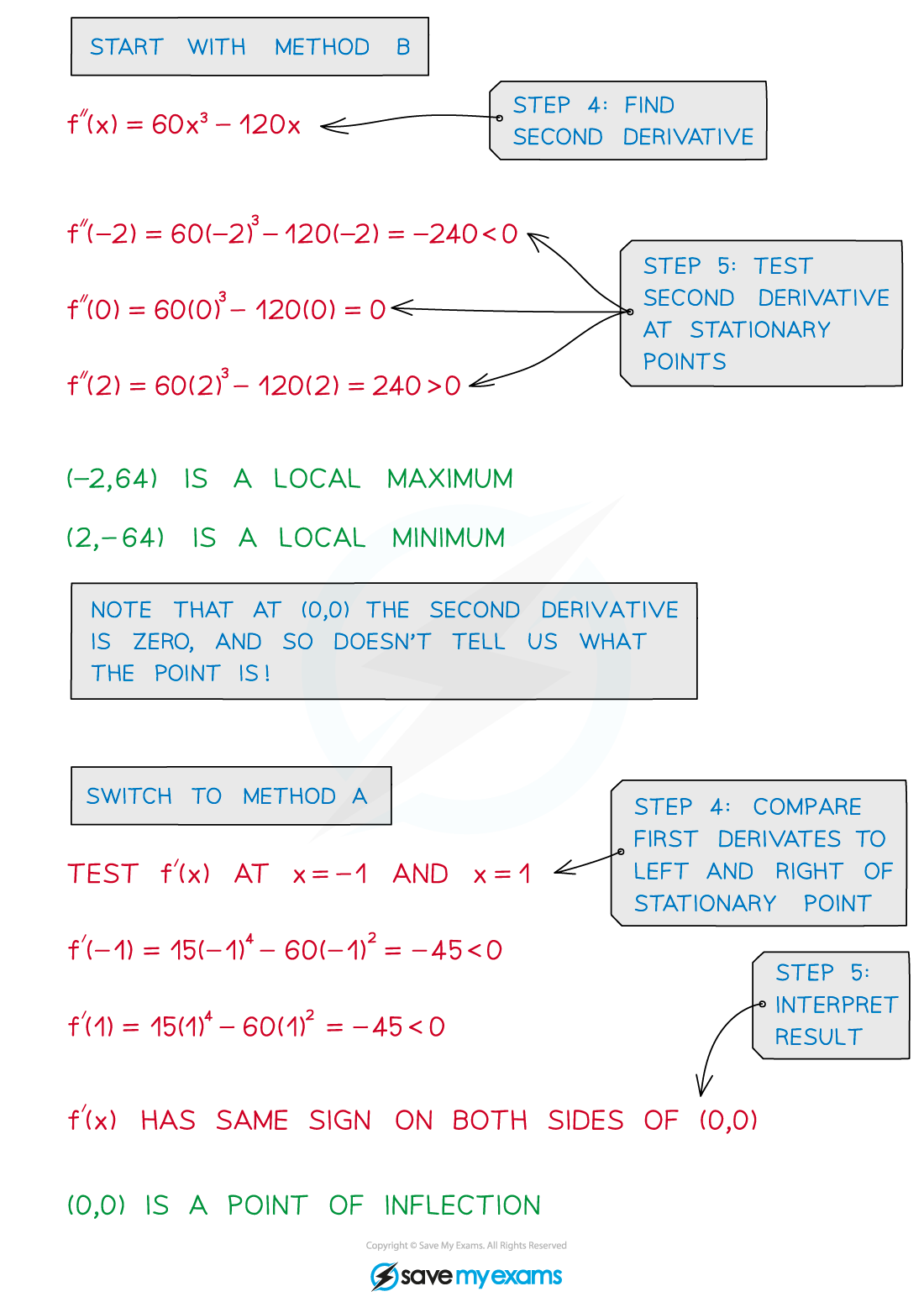
Method B: Look at the sign of the second derivative (positive or negative) at the stationary point
(After completing Steps 1 - 3 above to find the stationary points)
Step 4: Find the second derivative f''(x)
Step 5: For each stationary point find the value of f''(x) at the stationary point (ie substitute the x-coordinate of the stationary point into f''(x))
- If f''(x) is positive then the point is a local minimum
- If f''(x) is negative then the point is a local maximum
- If f''(x) is zero then the point could be a local minimum, a local maximum OR a point of inflection (use Method A to determine which)
Exam Hint
Usually using the second derivative (Method B above) is a much quicker way of determining the nature of a stationary point.
However, if the second derivative is zero it tells you nothing about the point.
- In that case you will have to use Method A (which always works – see the Worked Example).
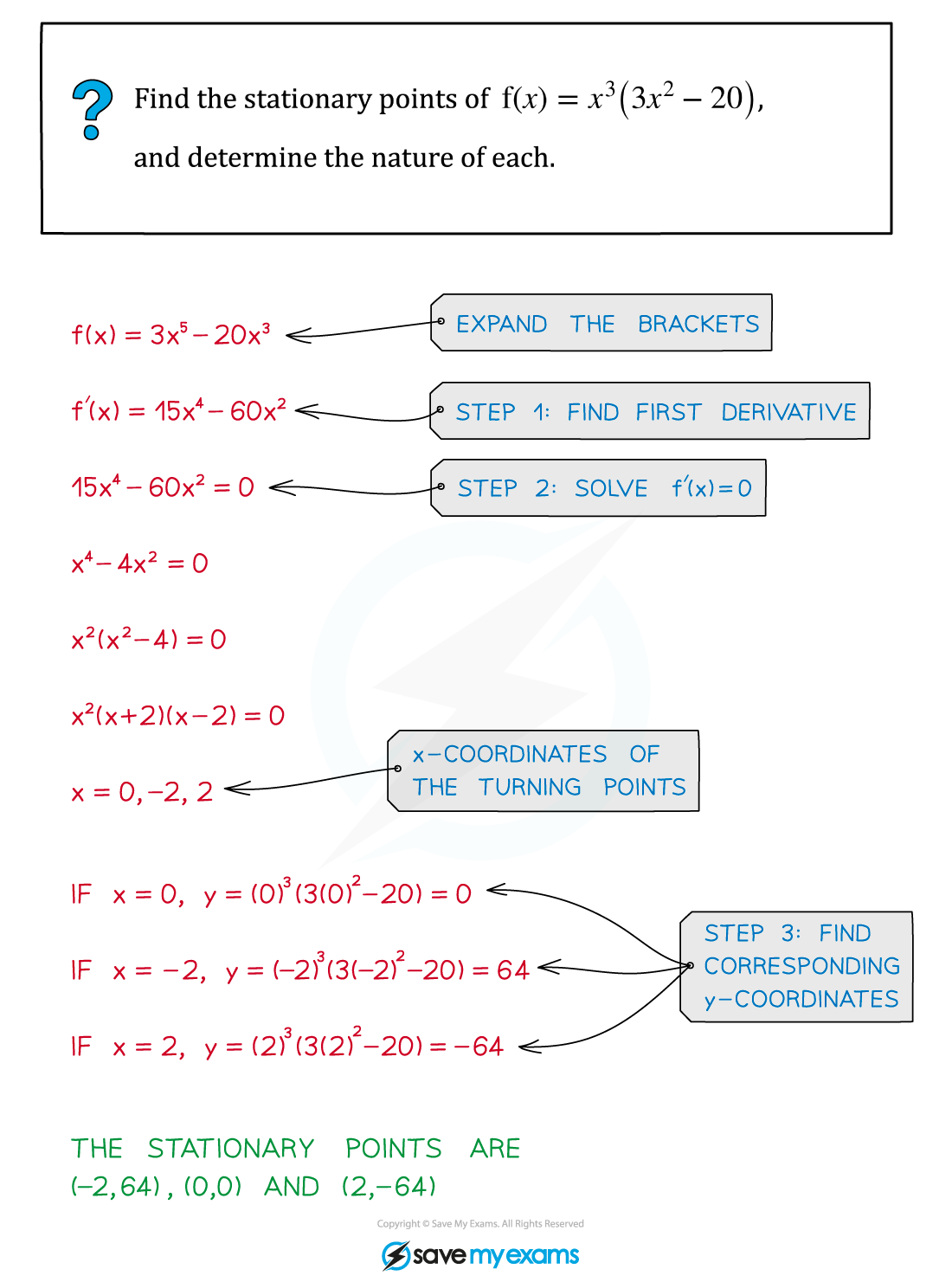
Worked Example
Was this revision note helpful?
Build on this topic