The circle of Apollonius... coordinate edition
Excerpt: Coordinate geometry is used to explore and solve an ancient geometry problem involving loci.
Problem 1
Two fixed points and lie in the plane, and the distance between them is , where .
A point moves in the plane so that the ratio of its distances from and is constant: where .
- Can you sketch the locus of the point for different values of ?
- Using Cartesian coordinates, work out (the equation of) the locus of . Suggestion You may find it more straightforward to first work with specific values of and , say and .
Suggestion 1
Two fixed points and lie in the plane, and the distance between them is , where .
A point moves in the plane so that the ratio of its distances from and is constant: where .
- Can you sketch the locus of the point for different values of ? You might find it helpful to fix the value of , say . Here are some values of you might consider: If you choose to draw things on a coordinate grid, it might make things simpler if you place and at convenient locations.
- Using Cartesian coordinates, work out (the equation of) the locus of . You may find it more straightforward to first work with specific values of and , say and . The question has not specified the coordinates of the points or , so what options do we have? In particular, what would be “nice” coordinates to choose for the points and ? If we let be at , how can we work out the distances and (in terms of and ) once we have specified the coordinates of and ?
Solution 1
Two fixed points and lie in the plane, and the distance between them is , where .
A point moves in the plane so that the ratio of its distances from and is constant: where .
- Can you sketch the locus of the point for different values of ? Here are some values of you might consider: This GeoGebra applet shows the locus of . The points and are movable, and the value of can be adjusted using the slider. You can use this applet to check your sketches for the cases , and . > [interactive embed (geogebra-iframe): https://www.geogebratube.org/material/iframe/id/UwzKjXjC/width/587/height/502/border/888888/rc/false/ai/false/sdz/false/smb/false/stb/false/stbh/false/ld/false/sri/true/asb/false/at/html5] — not part of the text import; see the source page. Download GeoGebra file You may have noticed that the loci for the cases and look essentially the same as each other, just reflected. Why should this be the case? Reason If we write out the equations for these two loci, we see: If we now take the reciprocal of the second equation, these become The equations are identical, except that and have swapped roles. So the loci are identical except for swapping and , which can be achieved by reflecting in the perpendicular bisector of . We’d like to show that the locus really is a circle, which brings us to question 2.
- Using Cartesian coordinates, work out (the equation of) the locus of . You may find it more straightforward to first work with specific values of and , say and . Suggestion: The question has not specified the coordinates of the points or , so what options do we have? In particular, what would be “nice” coordinates to choose for the points and ? As we are going to be using coordinates in this problem, and are looking for the locus of , we will let have coordinates . We could let be at and be at , for example. However, this is likely to make our algebra very messy, having so many letters around. A better approach is to choose “nice” coordinates for and . Let’s take to be at the origin, and to be on the -axis. This way, and , and most of the coordinates involved are zero. Another good choice would be and , so that the points are symmetrically placed about the origin. We will go with the first option in this solution, but you might like to have a go with this alternative choice and compare them. We let have the coordinates , and then apply Pythagoras to find as seen in this sketch:
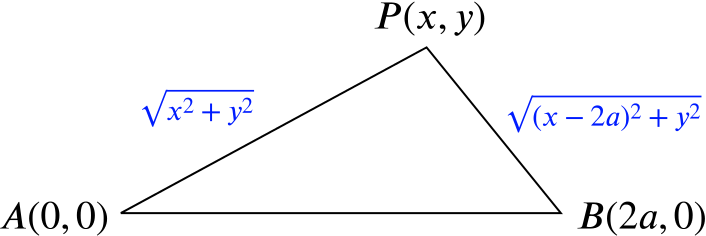 Using these, we then see that
We will give the rest of the solution first for the specific example suggested, and , and then for the general case. A specific example We rewrite with and , giving
If we now square this to get rid of the square roots, we get We can multiply through to lose the fractions, obtaining: It now makes sense to expand the inner brackets, giving We can then rearrange this to collect all of the terms on one side, giving which can be divided by to give
This is the equation of a circle, so we’ve achieved what we set out to do after question 1! We also observe that every step of this argument can be reversed, so if the point lies on the circle, which means that it satisfies , it will also satisfy . (Note too that does not satisfy , so there is no problem of dividing by zero in when working backwards.) To find the centre and radius of the circle, we complete the square to get so Therefore the locus is a circle with centre at and radius . The general case To do the general case, we do exactly the same as in the specific example, we simply use in place of and in place of . So we again begin with , square it and multiply through to get We then expand and rearrange to find
If , that is, (as ), we can divide by to get This is the equation of a circle. As in the specific example above, the argument can be reversed, and so every point on the circle satisfies the original condition. To find the centre and radius of the circle, we now complete the square to get
Thus the locus is a circle with centre and radius . Do check that this gives the same answer as we had above in the case and ! We need the absolute value in the formula for the radius to handle the case : try substituting in and to see why. If , then lies within the circle, whereas if , then lies within the circle, as shown in the applet above. (You might like to try showing this is the case from the algebra.) The only remaining case is when , where we know that the answer is a straight line. We can obtain this from the algebra: when , equation becomes Dividing by (which is not zero) gives or equivalently : this is the perpendicular bisector of . This makes sense, because the case gives , and the locus of all points equidistant from and is their perpendicular bisector. You might like to consider what happens as tends to zero or infinity, or when tends to . How does the algebra relate to what you have seen in the applet? If you did try this question with coordinates such as for and for , you will have found that the algebra was very messy indeed. It is always worth asking oneself what options one has when choosing coordinates: a good choice can have huge advantages. In this situation, we were free to choose both the origin and the orientation of the axes, so we were able to choose useful ones.
The locus of is known as the circle of Apollonius. See the Historical background for this problem to read more about Apollonius and this circle.
A further question to consider: Can we go backwards?
In other words, if we begin with a specified circle, is it always possible to find two points and and a value so that the given circle is the locus of the point satisfying ?
If it is possible, is there any choice in how we can choose , and ?
Problem 2
Following on from problem 1, we have two fixed points and in the plane with , where .
A point moves in the plane so that where .
We shall now assume that , so that the locus of is a circle.
What is the length of the tangent to this circle from the mid-point of , that is, the length in the applet below?
What is the locus of as varies?
If you have not already done so, you will first need to find the radius and centre of the circle traced by .
(In this applet, may be adjusted and the point will be traced if you click the button. is the centre of the circle that describes.)
Download GeoGebra file
The locus of is known as the circle of Apollonius. See the Historical background for this problem to read more about Apollonius and this circle.
Solution 2
The radius and centre of the circle were found in the solution to problem 1.
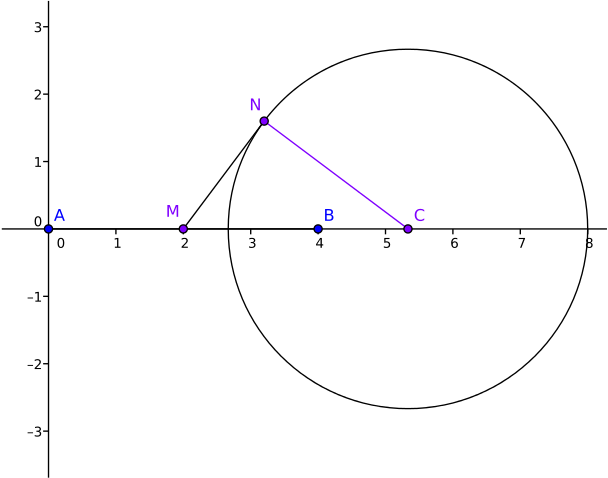
This image shows the situation described in the case , where a coordinate system has been imposed and the line has been drawn in.
Incidentally, there are actually two tangents from to the circle, but their lengths are equal. (Can you prove this?) We have only drawn one of them.
We note first that the tangent at is perpendicular to the radius at , so the triangle is right-angled. We can therefore use Pythagoras’s Theorem:
Since we know the coordinates of from the first part of the problem and is the midpoint of , we can easily work out the length . The length is the known radius of the circle, and so we can deduce the length .
We use the nice coordinates approach from the first solution to perform our calculations: is at and is , as in the diagram above. Then is and the circle has radius .
The midpoint
has coordinates
, so
Therefore , which is , independent of the choice of !
What is the locus of as varies?
As is a constant and is fixed, it follows that the locus of as varies is (part of) the circle with diameter , which is very pretty.
Which parts of this circle are included in the locus of as varies? Are there any parts which are not?
Historical background
Apollonius of Perga was a famous Greek geometer (262 BCE – 190 BCE), who studied conics intensively, and invented the terms parabola, ellipse and hyperbola still in common use today. Among other things, he invented the parabolic mirror.
Regarding this “Circle of Apollonius”, Heath1 writes:
“This locus was discussed by Apollonius in his Plane Loci, Book II, as we know from Pappus…
But the construction was not discovered by Apollonius; it belongs to a much earlier date, since it appears in exactly the same form in Aristotle, Meteorologica III. 5, 376 a 3 sqq."
- Heath, Thomas L., Euclid: The thirteen books of the elements, 2nd. ed, Cambridge 1926 (reprinted by Dover, 1956), vol. 2, pp. 198–200.↩