Factorising Expressions (Edexcel IAL Maths)
Spec point —
1.10
Factorising expressions
What is meant by factorising expressions?
-
Many expressions in mathematics are written as a sum of terms
- e.g. is the sum of three the terms , and
-
Many expressions are written as a product of factors
- e.g. is the product of the two (linear) factors and
-
Factorising is the process of rewriting the sum of terms as a product of factors
- The other way round is expanding
How do I factorise an expression?
-
This will depend on the nature of the expression you are dealing with
-
In all cases the first thing to consider is if there is a factor (number and/or letter) of all terms in the expression
- e.g.
-
A quadratic expression may be able to be factorised into two linear factors
-
Look out for special cases
- No constant term:
- Difference of two squares (no x term and constant is square):
- Perfect squares:
- ‘Hidden’ quadratics:
- More than one variable:
-
-
A cubic expression (at this level) will not contain a constant term
-
This means will be a factor (and there might be a number as a factor too)
-
The remaining expression will be a quadratic
- this quadratic may also be able to be factorised
- e.g.
-
How do I factorise harder quadratics?
-
There are many shortcuts to factorise quadratic expressions, but they often only apply under certain conditions (such as when a = 1)
- the method below works for any quadratic expression
- it is most useful when the coefficient of the term is greater than 1 (and not prime)
-
Follow the steps:
-
STEP 1 Starting with find the product
- For example: for
-
STEP 2 Find two numbers m & n whose product is and sum is
- For example: &
- So
m = 9 & n = - 2
-
STEP 3 Split the term into
- For example:
-
STEP 4 Factorise the first two terms and the last two terms
- For example:
-
STEP 5 Factorise once more for the final answer
- For example:
-
-
If a and/or c are prime, factorising can be done “by inspection”
- For example: the only way to split (prime) 3 into factors would be 3 and 1
Why does the 'ac' method work?
-
Suppose
-
then expanding and simplifying gives
-
-
By comparing coefficients
-
Let and then:
- Therefore these are the two numbers whose product is ac and sum is b
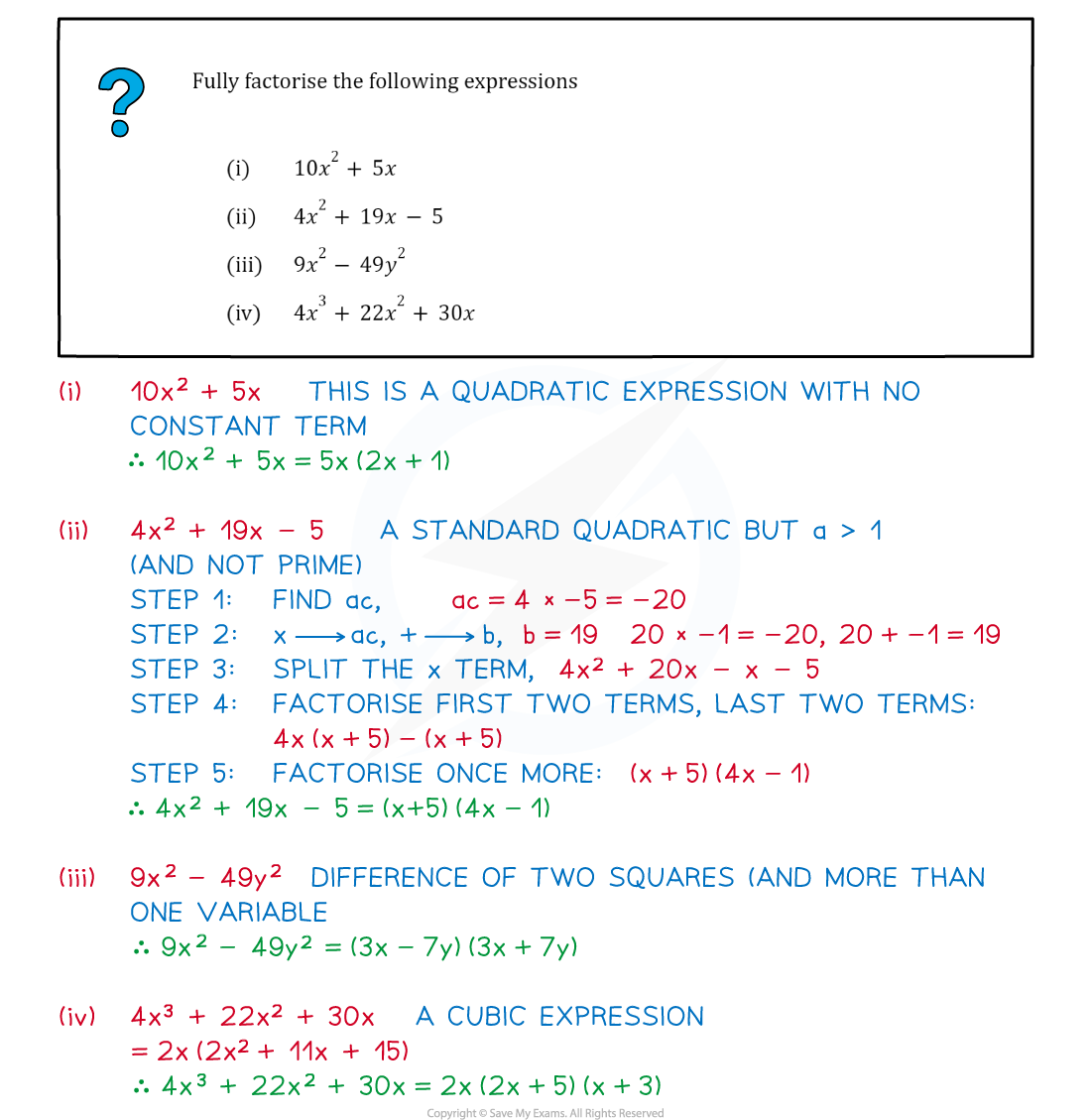
Worked Example
Exam Hint
Do use your tried and tested shortcuts for factorising quadratics
- We’ve explained it in full above to help you understand the process rather than to learn ‘tricks’
You don't need to learn why the 'ac' method works - but we thought you might think that the algebra is cool
Was this revision note helpful?
Build on this topic