Coefficient of Friction & F = ma (Edexcel IAL Maths)
Coefficient of Friction - F = ma
Spec point —
4.4
Coefficient of friction & F = ma
How do I use F = ma in problems involving friction?
-
The coefficient of friction combined with F= ma allows you to determine an object's motion where friction is involved in a problem
-
For problems where the surface is horizontal:
-
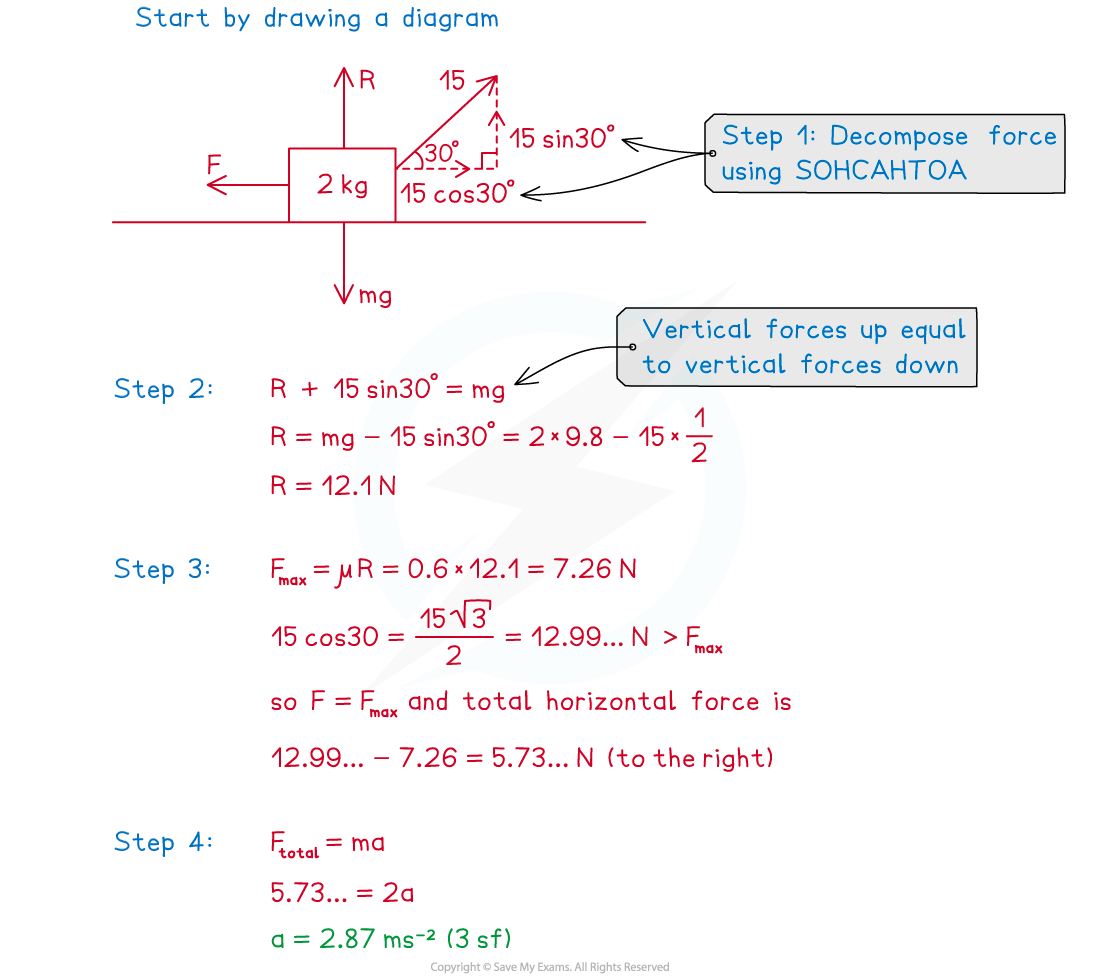
Step 1. If necessary, resolve any angled forces into vertical and horizontal components
-
Step 2. Calculate the normal reaction force
- Be careful – if there are vertical forces other than gravity these will affect the value of R
- with a horizontal surface R will always be directed vertically upwards
- the magnitude of **R **will be such as to make the total vertical force on the object zero
-
Step 3. Calculate FMAX= μR and find the resultant (total force) of all the horizontal forces on the object
- Remember – if the resultant of the other horizontal forces is less than or equal to FMAX then friction will exactly balance those forces out and the object will remain stationary
-
Step 4. Use F = ma to determine the acceleration of the object
-
For non-horizontal surfaces see the notes on inclined planes
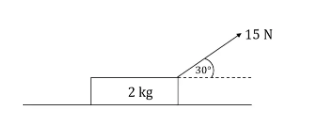
Worked Example A wooden block of mass 2 kg is at rest on a rough horizontal floor, where the coefficient of friction between the block and the floor is 0.6. A constant force of 15 N is applied to the block at an angle of 30o to the horizontal, as shown in the diagram below.
Find the acceleration of the block.
Answer:
Exam Hint
Always draw a force diagram and label it clearly.* *Look out for the words smooth and rough in mechanics problems involving an object moving (or potentially moving) along a surface:
- If the surface is described as smooth then you can ignore friction in the problem (ie μ= 0)
- If the surface is described as rough than you need to include the force of friction in solving the problem
Be aware of whether the question is on a horizontal surface or an inclined plane.
Was this revision note helpful?