Deriving the suvat Formulae (Edexcel IAL Maths)
Exam board Pearson Edexcel · IALUpdated 2026-07-02
Spec point —
3.1
Deriving the suvat Formulae
What is suvat?
-
suvat is an acronym for the five quantities used when modelling motion in a straight-line with constant acceleration
- s – displacement (from the starting point)
- u – initial velocity
- v – final velocity
- a – acceleration
- t – time
-
All except time are vector quantities and can be negative
- time is a scalar quantity
What are the suvat (constant acceleration) equations?
- The five equations for motion in a straight line are:
-
The equations can only be used when the motion has constant acceleration
-
All equations connect four of the five quantities
- Knowing any three allows a fourth to be found
-
The equations are not provided in the exam so you need to memorise them
How do I derive the suvat equations?
-
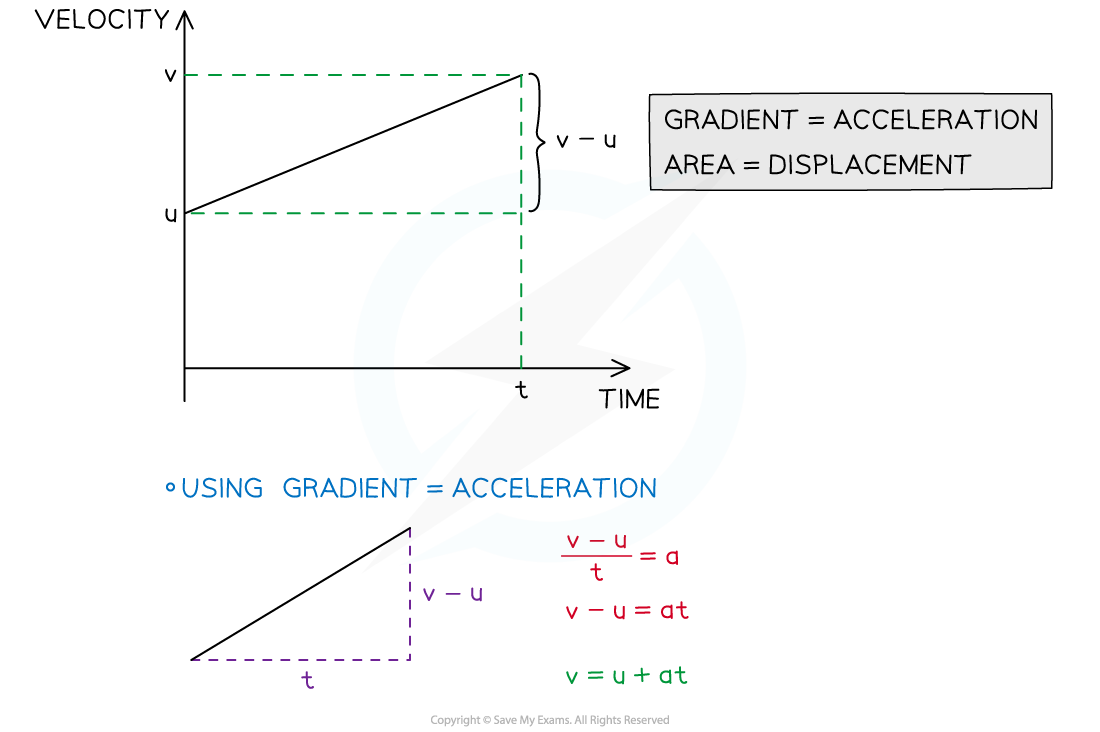
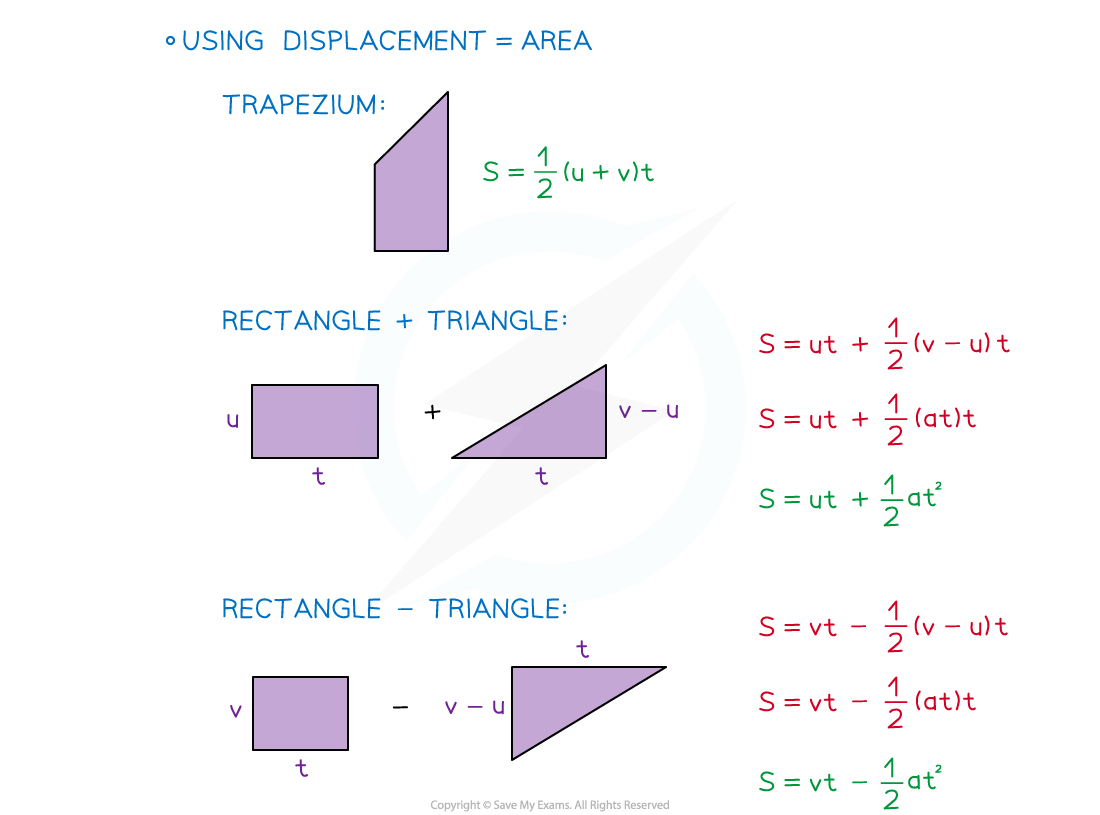
The four equations that involve time can be derived from a velocity-time graph
- The velocity-time graph will be a straight line as the acceleration is constant
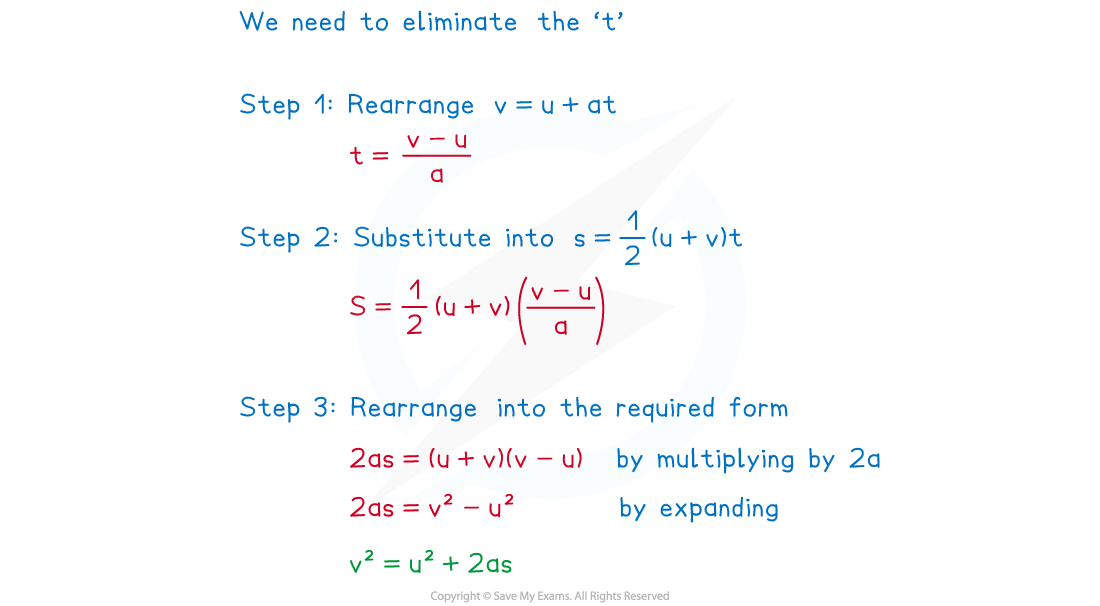
- The fifth equation can be found by choosing any two of the equations and eliminating the t variable (see the worked example)
Worked Example Use the constant acceleration equations
s = (u+v)t and v = u + at
to show that
v2 = u2 + 2as.
Answer:
Exam Hint
- If asked to derive any of the formulae there may be a velocity-time graph provided. Make sure you show each step and state any reasons such as the gradient of the graph being the acceleration.
- If the question does not ask you to derive the formulae then you can use them freely without proof.
Was this revision note helpful?