Drawing Travel Graphs (Edexcel IAL Maths)
Spec point —
3.1
Drawing Travel Graphs
How do I draw a displacement-time graph or a velocity-time graph?
-
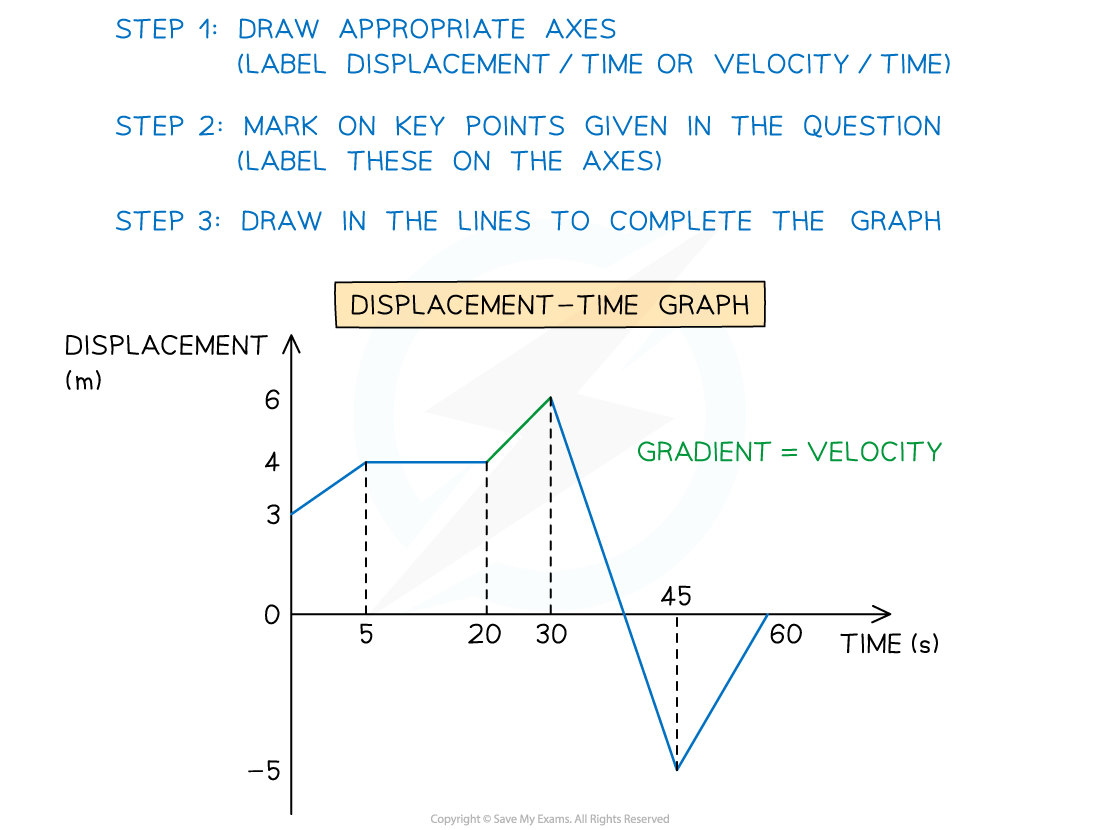
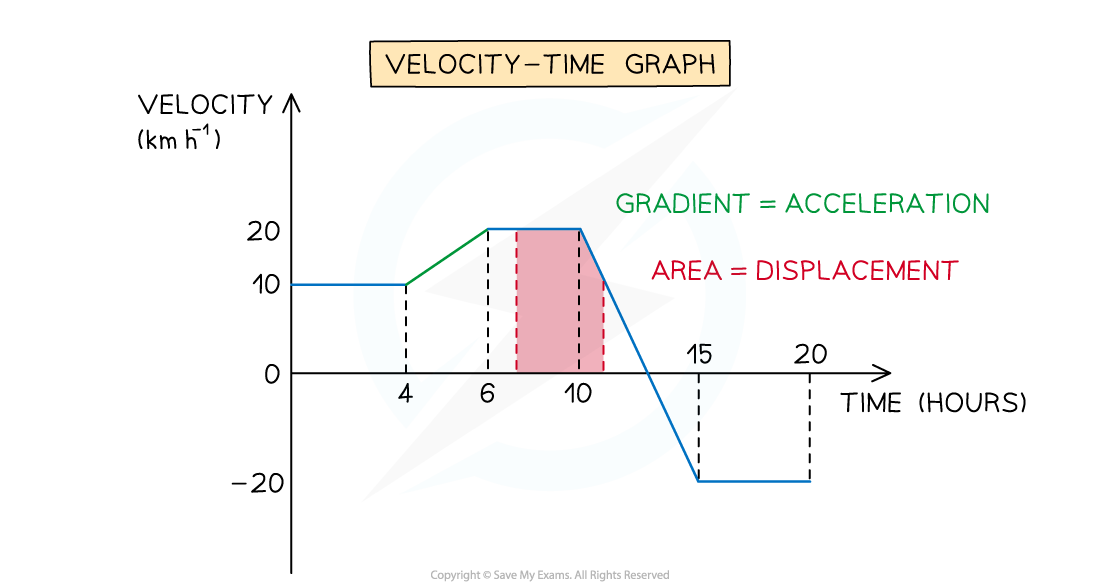
You may be asked to draw a displacement-time graph or a velocity-time graph
-
You will be given information about different sections of a journey and must draw each section and label the points on the axes
-
Remember that time will always be on the x-axis
-
Always remember to include units when you label the axis
-
Use appropriate facts about the gradient and area under the graph to work backwards and find relevant or missing information
- The gradient of a displacement-time graph is the velocity and the gradient of a velocity-time graph is the acceleration
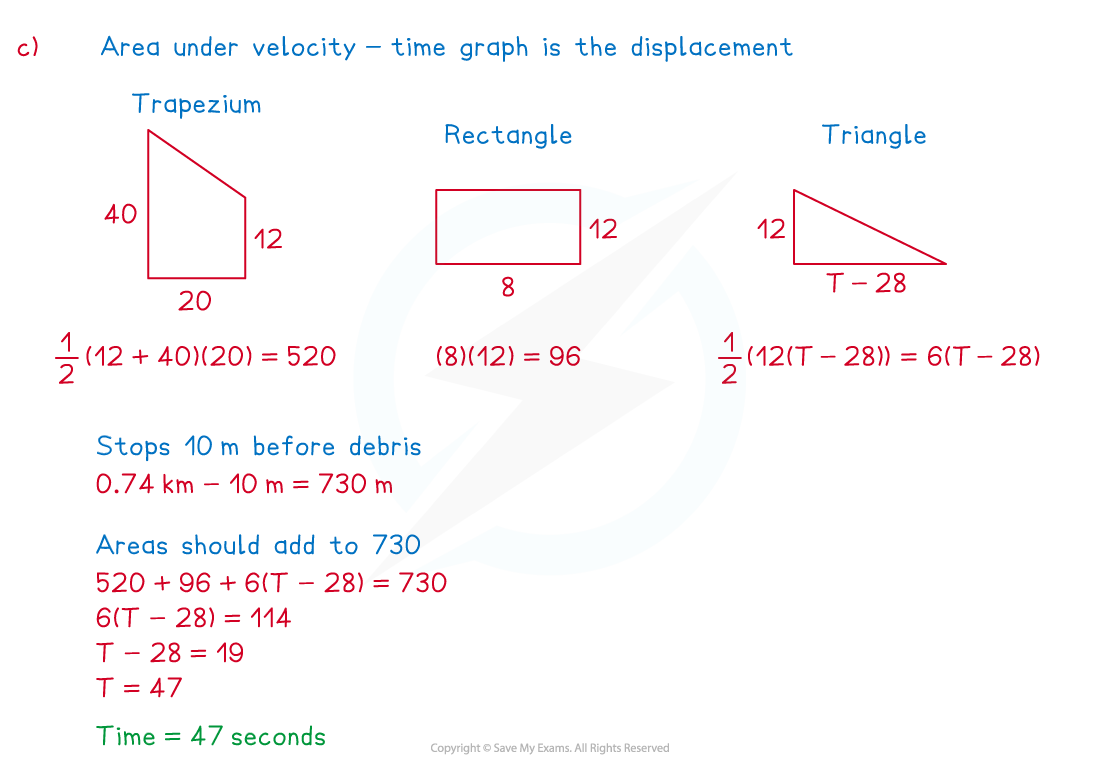
- The area between a velocity-time graph and the x-axis is the displacement
How do I draw an acceleration-time graph?
-
Most of the time the acceleration will be constant so you have to draw horizontal lines
-
There will be discontinuities in the graph if the object instantaneously changes from acceleration at a constant rate to moving with constant velocity
-
The area between an acceleration-time graph and the x-axis is the change in velocity
-
You might not be given the acceleration but instead expected to calculate it
-
Remember acceleration is the rate of change of velocity
-
If acceleration is constant then:
-
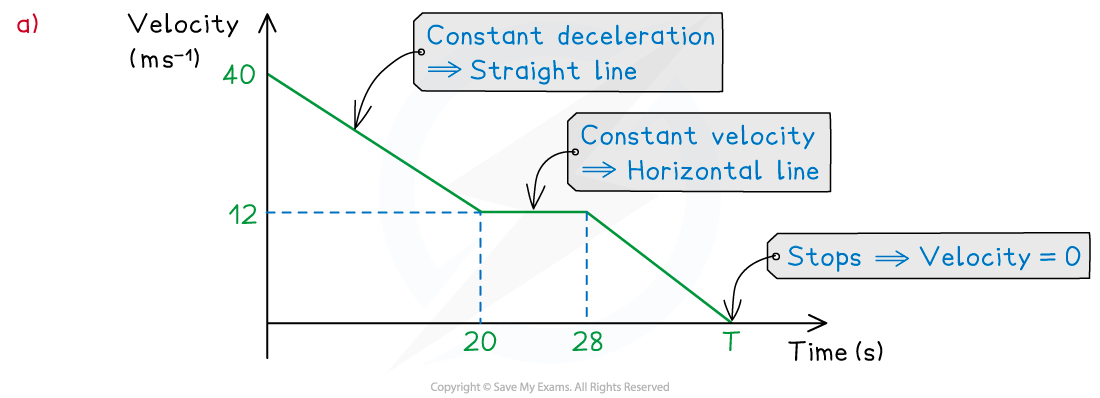
Worked Example The driver of a train, travelling at 40 m s-1 on a straight horizontal track, is informed of debris on the track 0.74 km ahead and immediately applies the brakes. The train decelerates uniformly for 20 seconds to a speed of 12 m s-1. The train then maintains this speed for another 8 seconds. The driver reapplies the brakes to slow down the train at a constant rate and bring it to a complete stop 10 m before the debris.
(a) Sketch a velocity-time graph to show the motion of the train.
Answer:
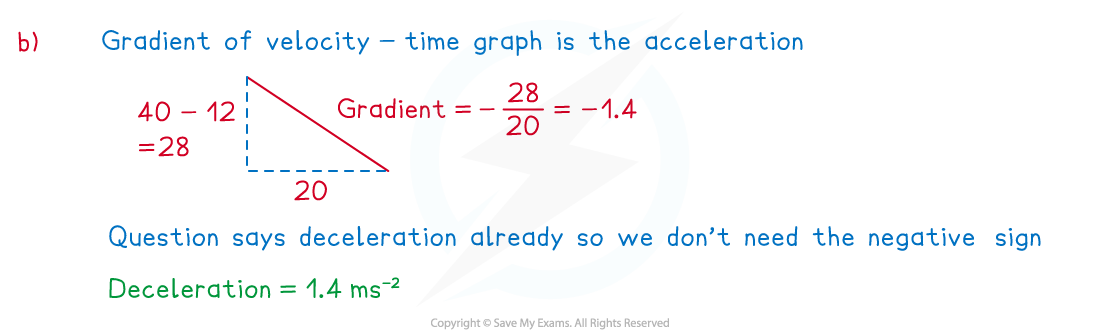
(b) Find the deceleration of the train from the moment the brakes were first applied to the moment its speed first reached 12 m s-1.
Answer:
(c) Calculate the total time from the moment the brakes were first applied to the moment the train came to rest.
Answer:
Exam Hint
- As in the worked example, examiners can use other words, such as uniformly, to mean constant.
- Remember that displacement and velocity can be negative whereas distance and speed can not be negative.
- Take care when a velocity-time graph is below the x-axis, if it has a negative gradient then it is speeding up and moving backwards. If it has a positive gradient below the x-axis then it is still moving backwards but it is slowing down.
Was this revision note helpful?