Momentum & Impulse (Edexcel IAL Maths)
Momentum
Spec point —
4.3
What is momentum?
-
Any object that has mass and is moving has momentum
-
Momentum measures the quantity of motion that an object has
-
The momentum of a particle is defined as the product of its mass ( kg) and its velocity ()
- Momentum =mv
-
The SI unit for momentum is
-
Momentum is a vector quantity - so it has a magnitude and direction
- The direction of the momentum of a particle is the same as the direction of motion of the particle
- The momentum is negative if the velocity is negative
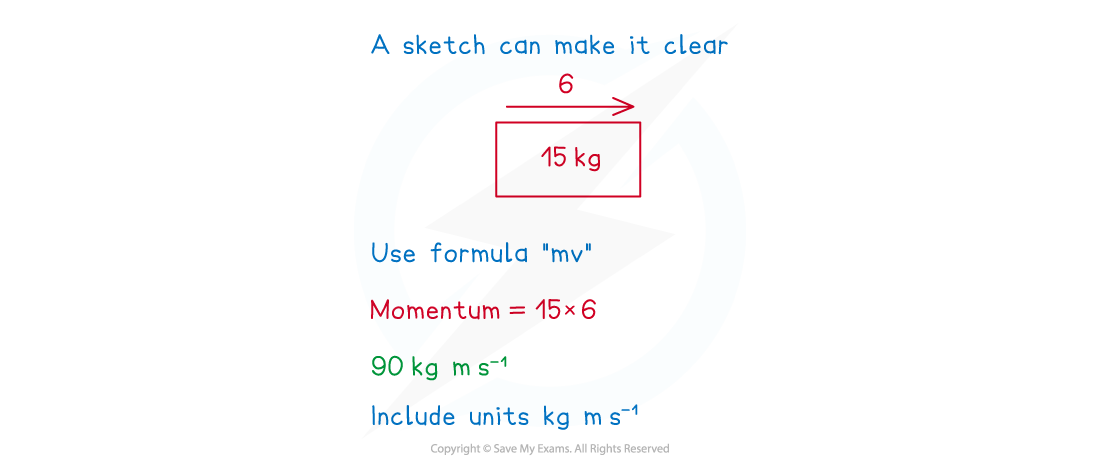
Worked Example A dog of mass 15 kg is running with speed .
Find the momentum of the dog.
Answer:
Impulse
Spec point —
4.3
What is impulse?
-
Impulse measures the effect of a force acting on a particle over time
-
If a constant force ( ) acts on a particle for seconds then the impulse () of the force is defined to be the product of the force and time
-
The SI unit for impulse is N s(newton seconds) which is equivalent to
- This is the same as the units for momentum
-
Impulse is a vector quantity – so it has magnitude and direction
- The direction of the impulse of a force is the same as the direction of the force
-
The Impulse-Momentum Principle states that impulse is equal to the change in momentum
- where m is the mass, u is the initial velocity and v is the final velocity
What happens when two objects are in contact?
-
If two objects are in contact with each other then by Newton’s Third Law there will be equal and opposite reaction forces
-
This means there will be equal and opposite impulses
-
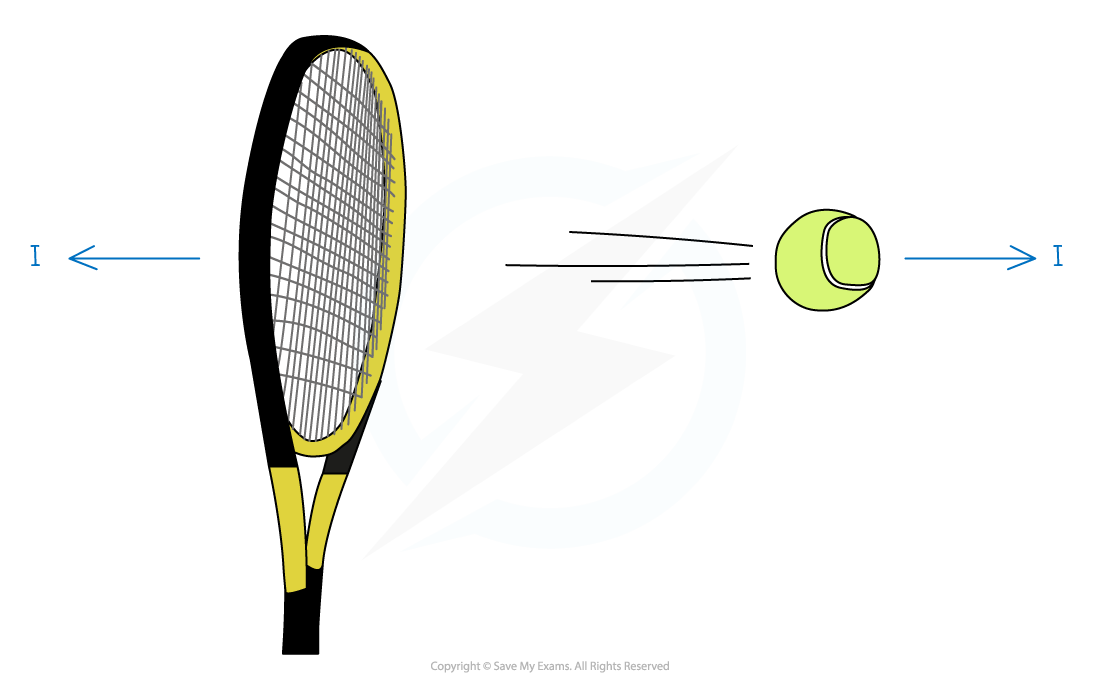
For example, consider hitting a tennis ball with a racket, there will be
- an impulse exerted by the racket on the ball which propels the ball forward
- an impulse exerted by the ball on the racket which reduces the velocity of the racket
- The magnitudes of these impulses are equal but they are in opposite directions
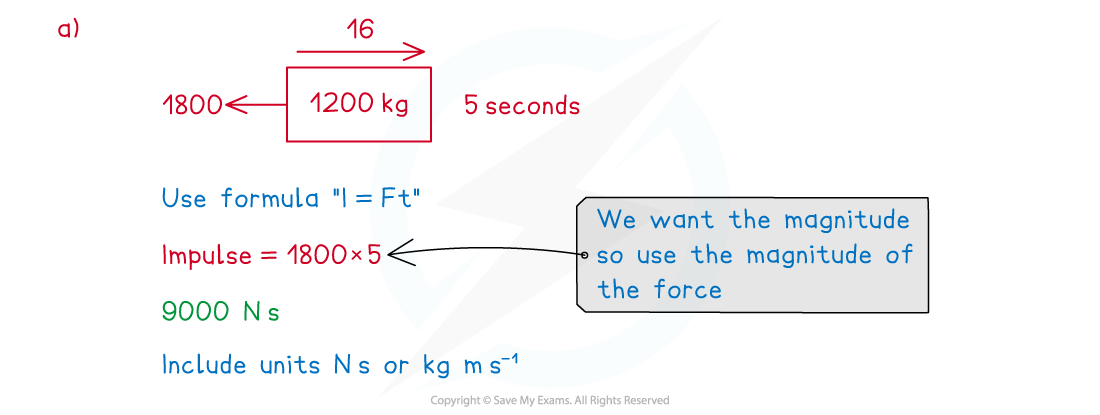
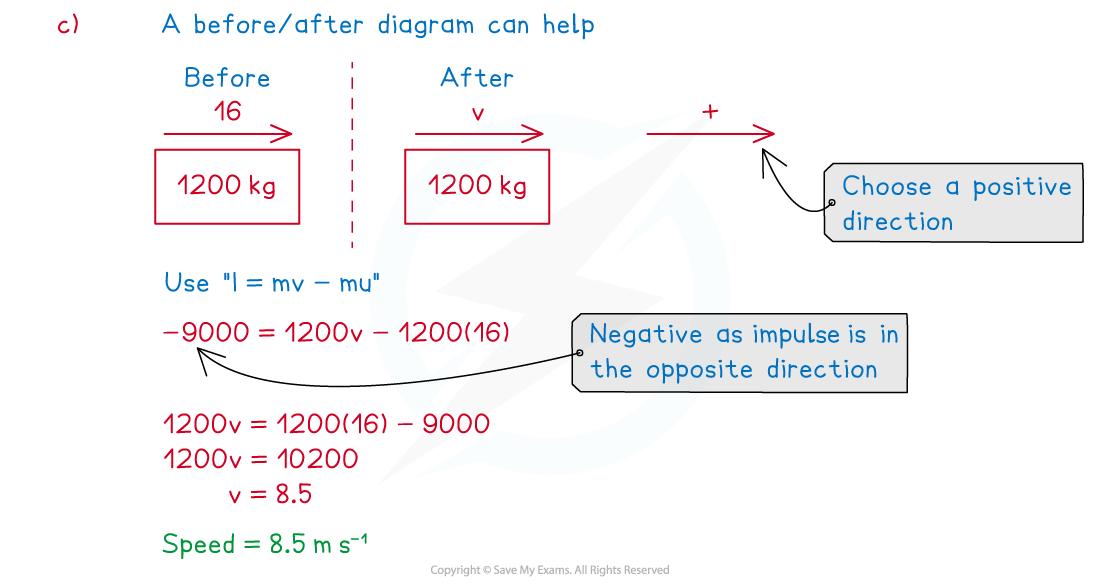
Worked Example A car with mass 1200 kg is driving to the right along a smooth horizontal road with speed 16 m s-1 . The driver applied a constant braking force of magnitude 1800 N for 5 seconds.
(a) Find the magnitude of the impulse of the braking force.
(b)State the direction of the impulse.
(c) Find the speed of the car 5 seconds after the braking force was applied.
Answers:
(a) Find the magnitude of the impulse of the braking force.
(b) State the direction of the impulse.
(c) Find the speed of the car 5 seconds after the braking force was applied.

Exam Hint
- Always define a positive direction and be careful with negatives. Use common sense to see if your answer makes sense - would you expect the velocity to have increased or decreased?
Was this revision note helpful?