Networks & Matrices (Edexcel IAL Maths)
Introduction to Networks & Matrices
Spec point —
2.1
What is a network?
-
A network is a weighted graph
- A network is used to model real-world situations
- The weight of an edge usually represents a measure such as distance or time
What is a matrix?
-
A matrix can be used to represent a graph or network in the form of a table
- The elements within the matrix give information about the connections between the different vertices
-
A matrix is typically set up with the following labelling system
- Rows are labelled with the 'from' vertices
- Columns are labelled with the 'to' vertices
Networks & Matrices
Spec point —
2.1
What is an adjacency matrix?
-
An adjacency matrix is a square matrix
- All of the vertices in the graph are listed as the headings for both the rows and columns
- The leading diagonal is the the line going from the top left cell to the bottom right cell
-
An adjacency matrix can be used to show the number of direct connections between two vertices
-
An entry of 1 in the matrix means that there is a direct connection (i.e. an edge) between that pair of vertices
-
An entry of 0 in the matrix means that there is no direct connection between that pair of vertices
-
In a simple graph the only entries are 0 or 1
-
A loop is indicated in an adjacency matrix with a value in the leading diagonal
-
In an undirected matrix the value in the leading diagonal will be 2
- You can use the loop to travel out of and into the vertex in two different directions
-
In a directed matrix, if the loop has direction, the value in the leading diagonal will be 1
- You can only travel along the loop out of and back into the vertex in one direction
- An undirected loop in a directed matrix will still have a value of 2
-
For a graph with no loops every entry in the leading diagonal will be 0
-
-
An undirected graph is symmetrical about the leading diagonal
- A directed graph is not symmetrical about the leading diagonal
What is a distance matrix?
-
A distance matrix is different to an adjacency matrix
- The value in each cell is the weight of the edge connecting that pair of vertices
- Weight could be cost, distance, time etc.
-
An empty cell is used to indicate that there is no connection (i.e. no edge) between a pair of vertices
-
An undirected network is symmetrical about the leading diagonal
- A directed network is not symmetrical about the leading diagonal
-
When drawing a network from its distance matrix be careful when labelling the edges
-
For an undirected graph the two cells between a pair of vertices will be the same
- Connect the vertices with one edge labelled with the relevant weight
-
For a directed graph where two cells between a pair of vertices have different values
- Draw two edges between the vertices
- Label each with the correct weight and direction
-
-
A distance matrix can be used to work out the weight of different walks in the network
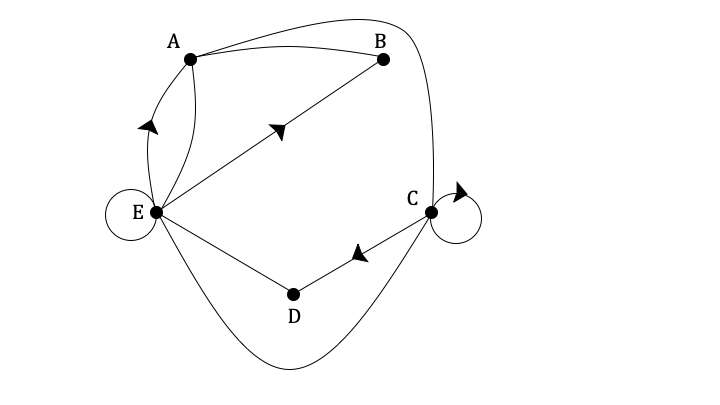
Worked Example a) Write down the adjacency matrix for the graph shown below.
Answer:
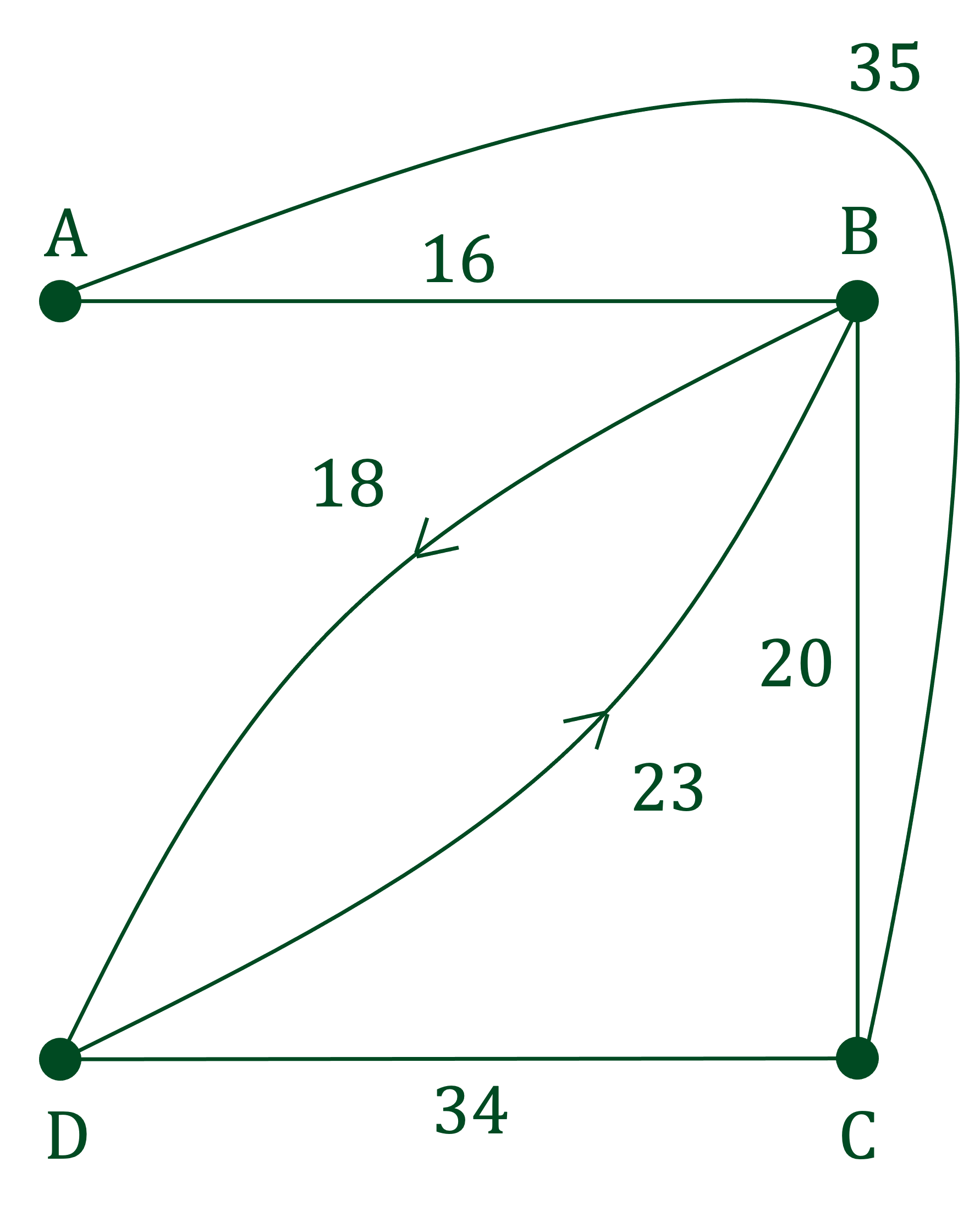
b) The table below shows the time taken in minutes to travel by car between 4 different towns.
A B C D A 16 35 B 16 20 18 C 35 20 34 D 23 34 Draw the network described by this distance matrix.
Answer:
Was this revision note helpful?
Build on this topic