Finding the Optimal Integer Solution (Edexcel IAL Maths)
Integer Solutions
Spec point —
5.3
What is meant by integer solutions?
-
The optimal solution to a linear programming problem lies on a vertex of the feasible region
- The values of the decision variables at this vertex may not take integer values
-
Sometimes the context of the problem may demand that the decision variables take integer values
-
Decision variables are often a 'number of things'
- Is it possible for the furniture manufacturer to make 3.65 chairs per day?
- For public health reasons, it would not be appropriate for a food factory to leave a tin of beans partially produced overnight!
-
-
This is what is meant by the phrase integer solutions
How do I find the integer solutions to a linear programming problem?
-
Find the optimal solution of the linear programming problem as usual
- Use the objective line or vertex method
-
Consider the four points with integer coordinates that surround the optimal solution
- E.g.
- For an optimal solution of , the four surrounding points would be (3, 4), (3, 5), (4, 5) and (4, 4)
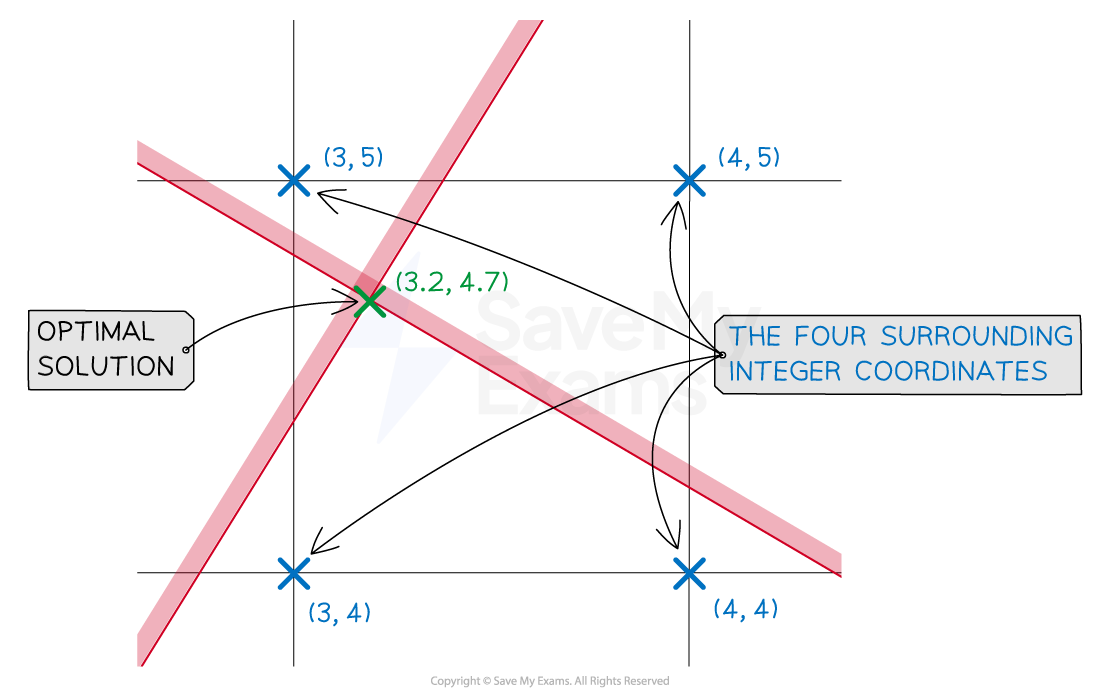
-
Check whether each of these four points satisfies all of the constraints
- It may be obvious that one (or more) do not but they should still be mentioned
-
For those coordinates that do satisfy all the constraints
- Evaluate the objective function () at each of the coordinates
- The integer solution will be the point that maximises or minimises the objective function as required
-
The integer solution may not be the optimal solution
-
Depending on the exact nature (gradient) of the objective line
- The objective line 'moves away' from the boundary of the feasible region when an integer solution is found
- So there could be another integer solution inside (or on the boundary of) the feasible region some way from the optimal solution
- This other integer solution may be closer to the boundary of the feasible region than the one just found
-
You will not be expected to find this other integer solution
- Just recognise that the integer solution found using the above process is not necessarily optimal
-
Exam Hint
Questions won't necessarily indicate if integer solutions are required
- Use common sense and think carefully about the context of the problem
Worked Example The linear programming problem formulated as
Maximise
subject to
has optimal solution .
However, the decision variables may only take integer values. Find the solution closest to the optimal solution, stating the values of the decision variables and the resulting value of .
Answer:
The four surrounding integer coordinates to (3.2, 4.7) are
(3, 4), (3, 5), (4, 5), (4, 4)
Check that these satisfy all the constraints and if so, evaluate Once a point fails to satisfy an inequality we do not need to make any further checks
Final answer: The integer solution closest to the optimal solution isand

Was this revision note helpful?
Build on this topic