Ionic Equations (Edexcel IAL Chemistry)
Chemical Formulae & Oxidation Numbers
Spec point —
8.4
-
Oxidation numbers are a useful tool for naming compounds as some elements can exist with more than one oxidation number
-
For compound with two elements it is straight forward to name the compound
-
For example
- PCl3 is phosphorus(III) chloride or phosphorus trichloride
- PCl5 is phosphorus(V) chloride or phosphorus pentachloride
- OF2 is oxygen difluoride
- O2F2 is dioxygen difluoride
-
In order to name a more complete compound we use Roman numerals for the element that has a variable oxidation number
- K2CrO4 potassium chromate(VI)
Worked Example Can you name these transition metal compounds?
- Cu2O
- MnSO4
- Na2CrO4
- KMnO4
- Na2Cr2O7
Answer:
Answer 1: copper(I) oxide:
The ox. no. of 1 O atom is -2 and Cu2O has overall no charge so the ox. no. of Cu is +1
Answer 2: manganese(II) sulfate:
The charge on the sulfate ion is -2, so the charge on Mn and ox. no. is +2
Answer 3: sodium chromate(VI):
The ox. no. of 2 Na atoms is +2 so CrO4 has an overall -2 charge, so the ox. no. of Cr is +6
Answer 4: potassium manganate(VII):
The ox. no. of a K atom is +1 so MnO4 has overall -1 charge, so the ox. no. of Mn is +7
Answer 5: sodium dichromate(VI):
The ox. no. of 2 Na atoms is +2 so Cr2O7 has an overall -2 charge, so the ox. no. of Cr is +6. To distinguish it from CrO4 we use the prefix di in front of the anion
Forming Anions & Cations
Spec point —
3.2
Metals
-
Metals, in general, will form positive ions by losing electrons
-
Therefore, they are oxidised and the oxidation number increases
-
Example 1:
- When sodium reacts with water, sodium hydroxide and hydrogen gas is formed
2Na (s) + H2O (l) → 2NaOH (aq) + H2(g)
-
The oxidation number of sodium changes from 0 to +1
-
Example 2:
- When magnesium reacts with hydrochloric acid, magnesium chloride and hydrogen gas is formed
Mg (s) + 2HCl (l) → MgCl2(aq) + H2(g)
- The oxidation number of magnesium changed from 0 to +2
Non-metals
-
Non-metals, in general, will form negative ions by gaining electrons
-
Therefore, they are reduced and the oxidation number decreases
-
Example:
- When sodium reacts with oxygen, sodium oxide is formed
4Na (s) + O2(g) → Na2O (s)
- The oxidation number of oxygen changes from 0 to -2
Constructing Ionic Equations
Spec point —
8.10
Half Equations and Ionic Equations
-
Half equations and ionic equations are specific types of equations for showing some of the fine details going on in chemical reactions
-
Half equations are used to show what happens to the electrons in reactions where atoms, molecules or ions are gaining or losing electrons
-
They are called half equations, because they represent only half of what is happening in a reaction involving electron transfer
- One species gains electrons
- Another species loses electrons
-
Examples of half equations are:
Pb2++ 2e- → Pb
2Br-→ Br2+ 2e-
-
Some half equations are more complicated and require the addition of water and hydrogen ions in addition to electrons
-
The steps required to balance a half equation are:
- Step 1: Write the unbalanced equation to show the species that undergoes reduction or oxidation, if necessary, balance the atom that is being reduced or oxidised
- Step 2: Add H2O to balance O atoms
- Step 3: Add H+ to balance H atoms
- Step 4: Add e- to balance the charge
-
Half equations can be combined to form an ionic equation
-
An ionic equation shows what happens in terms of ions in a chemical reaction
-
This is best shown with an example:
Worked Example Dichromate ions, Cr2O72- ions react with iron(II) ions, Fe2+, in acidic conditions, forming chromium(III) ions, Cr3+, and iron(III) ions, Fe3+. Write the half equations and use these to construct an ionic equation for this reaction.
Answer:
Fe2+ ions are being oxidised as they gain an electron to form Fe3+, this half equation can be simply constructed showing the loss of an electron:
- Fe2+ → Fe3+ + e-
The reduction of Cr2O72- ions to Cr3+ is not as straightforward, so use the steps above to construct the half equation:
Step 1: Write the unbalanced equation to show the species that undergoes reduction or oxidation, if necessary, balance the atom that is being reduced or oxidised:
- Cr2O72- → 2Cr3+
Step 2: Add H2O to balance O atoms
- Cr2O72- → 2Cr3+ + 7H2O
Step 3: Add H+ to balance H atoms
- Cr2O72- + 14H+ → 2Cr3+ + 7H2O
Step 4: Add e- to balance the charge
- Cr2O72- + 14H+ + 6e- → 2Cr3+ + 7H2O
To construct the full ionic equation, combine the two half equations
To do this, the number of electrons in each half equation needs to be the same so that they cancel out when the equations are combined, and so that electrons do not appear in the ionic equation
In this example, multiply the first half equation by 6:
- 6Fe2+ → 6Fe3+ + 6e-
- Cr2O72- + 14H+ + 6e- → 2Cr3+ + 7H2O
Now add all of the reactants and products together - the electrons will cancel to give the full ionic equation:
- 6Fe2+ + Cr2O72- + 14H+ → 6Fe3+ + 2Cr3+ + 7H2O
Balancing full ionic equations
- You do not have to construct the half equations to be able to write a full ionic equation, you can use oxidation numbers to balance them
- This is not as straightforward as just balancing the atoms involved
- Balancing equations using redox principles is a useful skill and is best illustrated by following an example
- It is important to follow a methodical step-by-step approach so that you don't get lost:
Worked Example Writing overall redox reactions
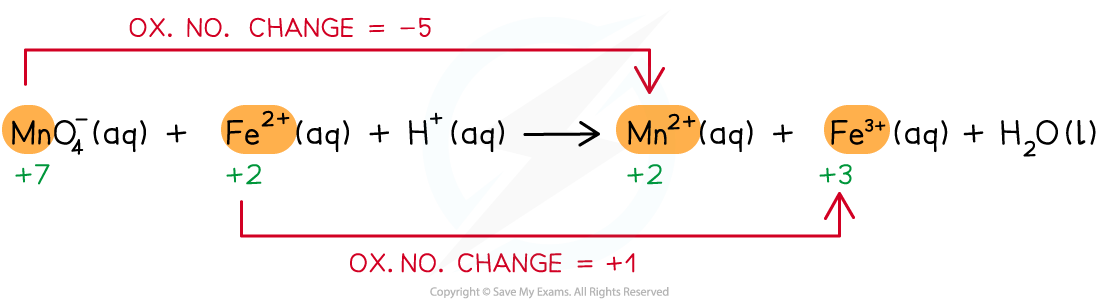
Manganate(VII) ions (MnO4- ) react with Fe2+ ions in the presence of acid (H+) to form Mn2+ ions, Fe3+ ions and water
Write the overall redox equation for this reaction
Answer
Step 1: Write the unbalanced equation and identify the atoms which change in oxidation number
Step 2: Deduce the oxidation number changes
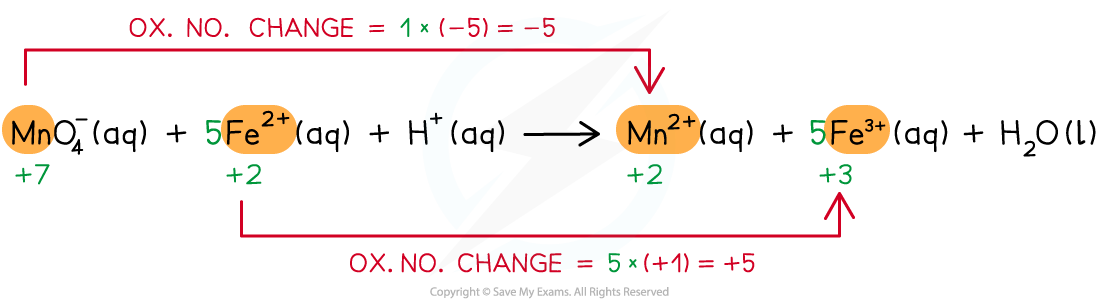
Step 3: Balance the oxidation number changes
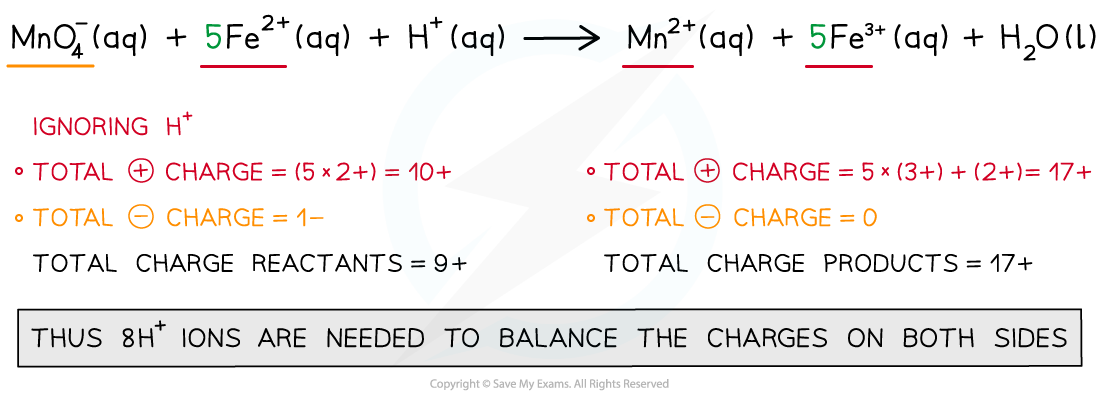
Step 4: Balance the charges
Step 5: Finally, balance the atoms


Was this revision note helpful?
Build on this topic