Ionic Bonding & Structures (Edexcel IAL Chemistry)
Ionic Dot & Cross Diagrams
Spec point —
3.3
Ionic Dot-and-Cross Diagrams
-
As a general rule, metals are on the left of the periodic table and nonmetals are on the right-hand side
-
Ionic bonding involves the transfer of electrons from a metallic element to a non-metallic element
-
Transferring electrons usually leaves the metal and the non-metal with a full outer shell
-
Metals lose electrons from their valence shell forming positively charged cations
-
Non-metal atoms gain electrons forming negatively charged anions
-
Once the atoms become ions, their electronic configurations are the same as a noble gas
- A potassium ion (K+) has the same electronic configuration as argon: [2,8,8]+
- A chloride ion (Cl-) also has the same electronic configuration as argon: [2,8,8]-
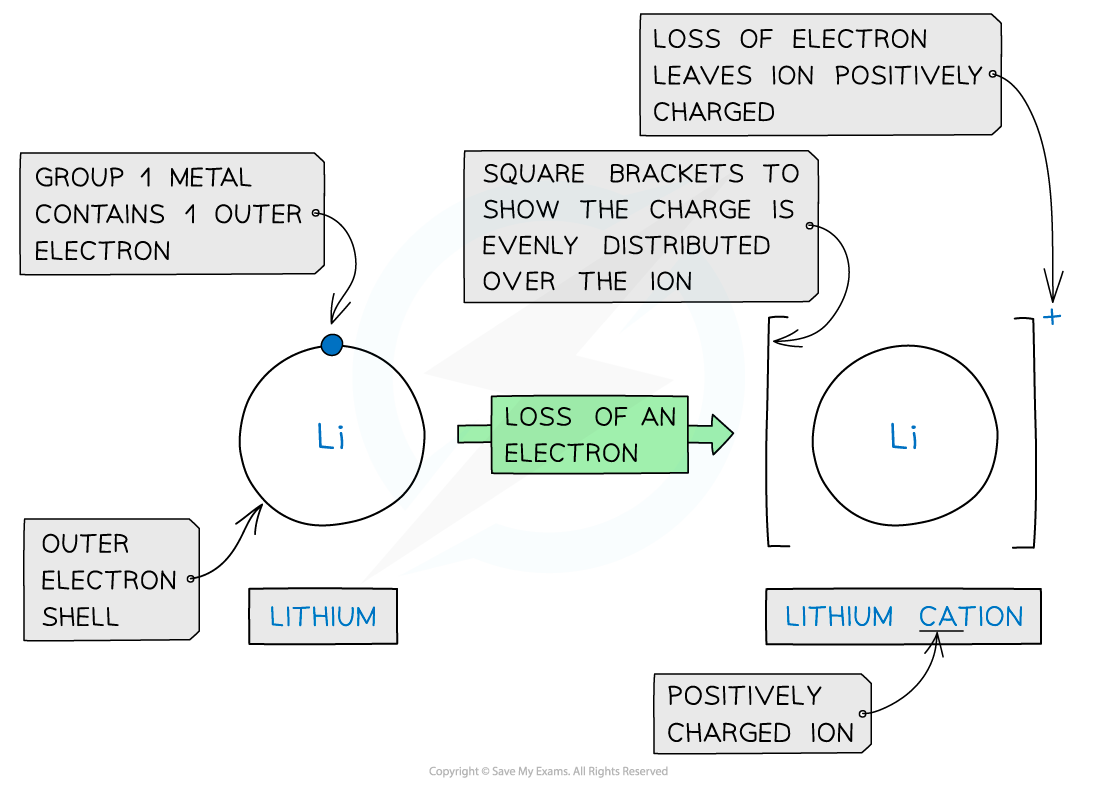
Forming cations by the removal of electrons from metals
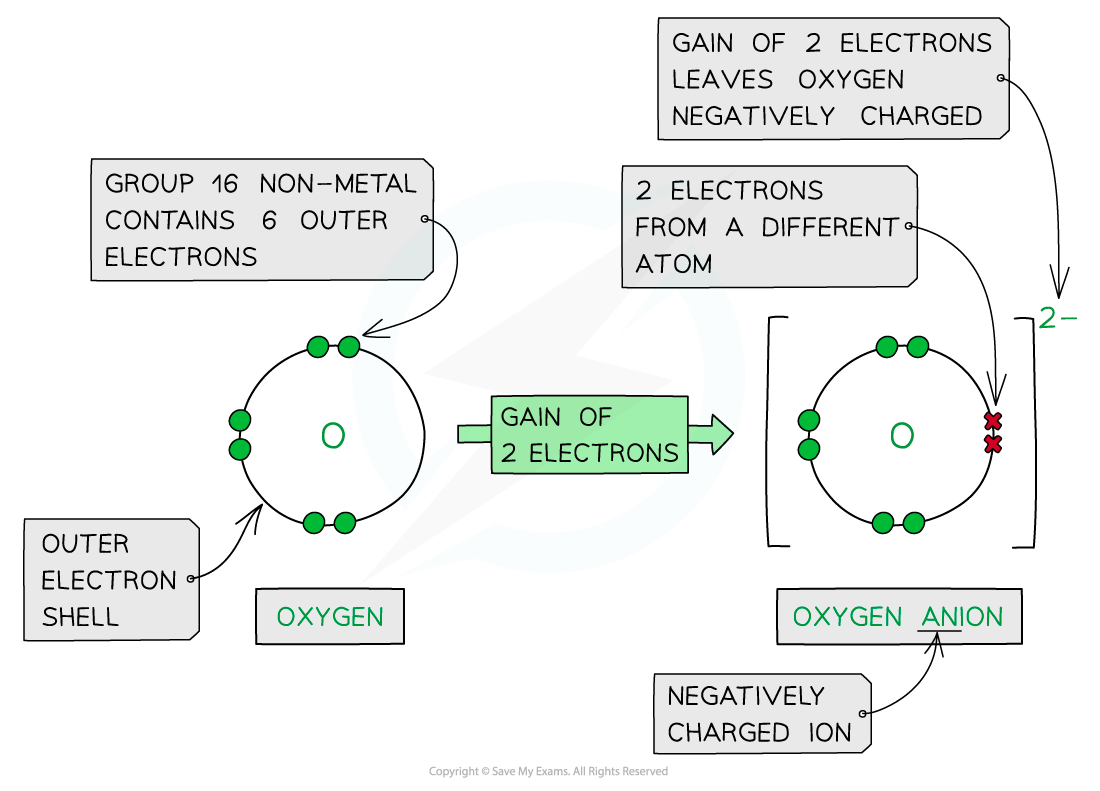
Forming anions by the addition of electrons to nonmetals
-
Cations and anions are oppositely charged and therefore attracted to each other
-
Electrostatic attractions are formed between the oppositely charged ions to form ionic compounds
-
The ionic bond is the electrostatic attraction formed between the oppositely charged ions, which occurs in all directions ( this called non-directional bonding)
-
This form of attraction is very strong and requires a lot of energy to overcome
- This causes high melting points in ionic compounds
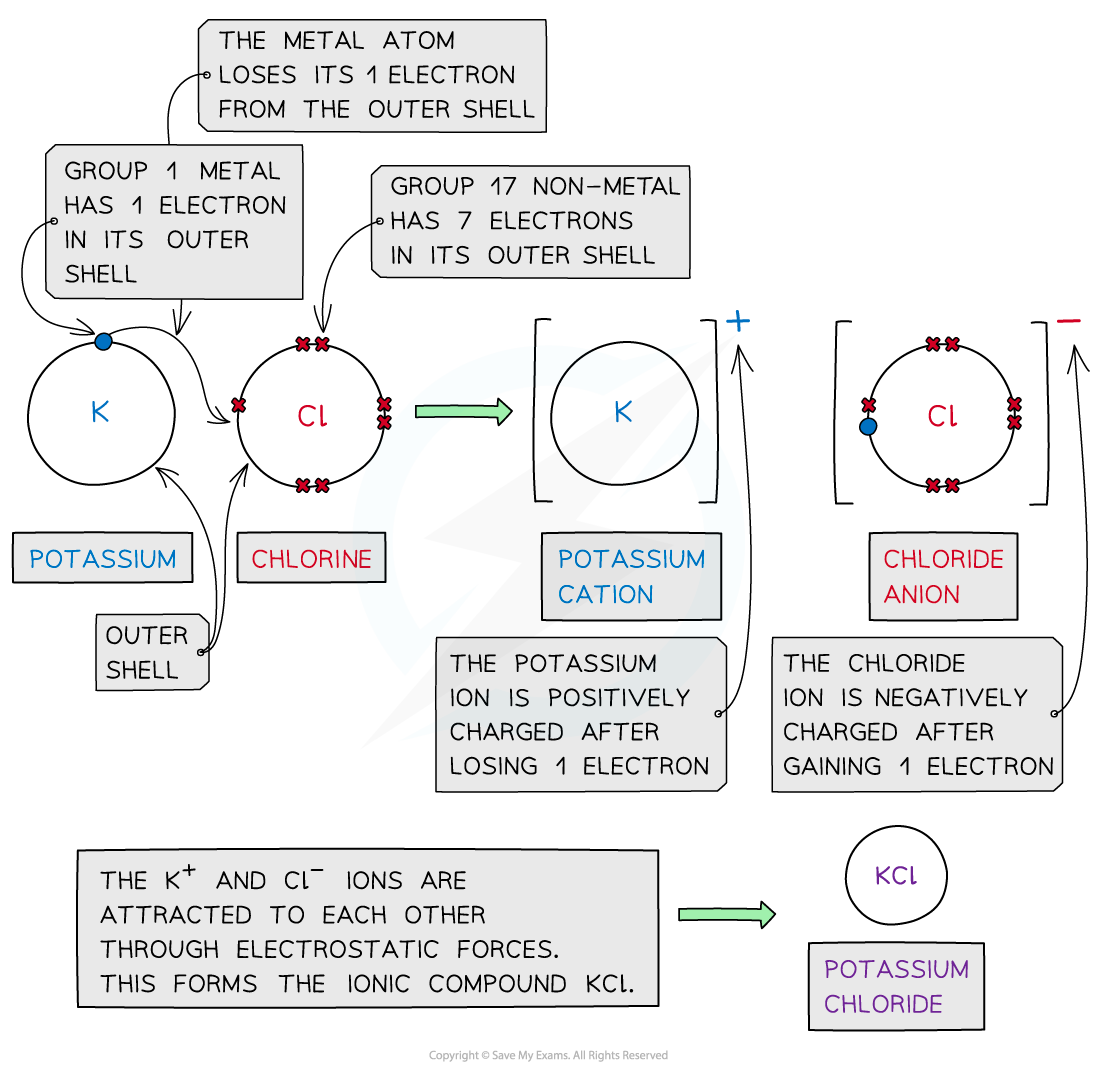
Cations and anions bond together using strong electrostatic forces, which require a lot of energy to overcome
-
The ions form a lattice structure which is an evenly distributed crystalline structure
-
Ions in a lattice are arranged in a regular repeating pattern so that positive charges cancel out negative charges
-
The attraction between the cations and anions is occurring in all directions
- Each ion is attracted to all of the oppositely charged ions around it
-
Therefore the final lattice is overall electrically neutral
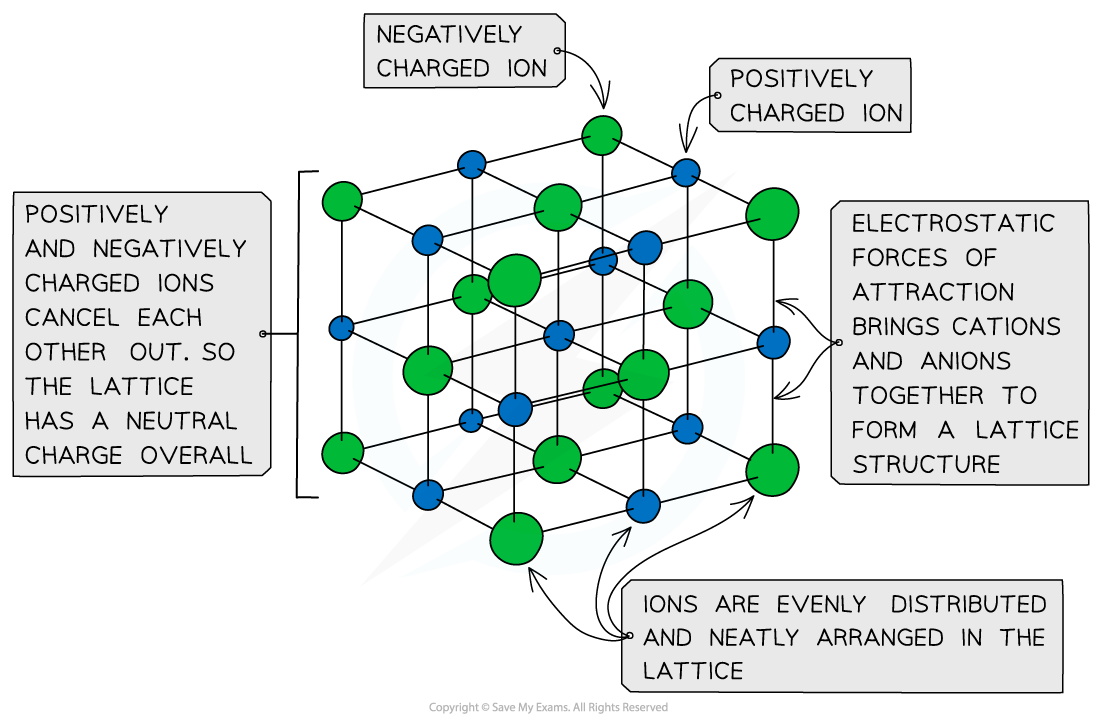
Ionic solids are arranged in lattice structures
Dot and cross diagrams
-
These are diagrams that show the arrangement of the outer-shell electrons in an ionic or covalent compound or element
-
The electrons are shown as dots and crosses
-
In a dot and cross diagram:
- Only the outer electrons are shown
- The charge of the ion is spread evenly which is shown by using brackets
- The charge on each ion is written at the top right-hand corner
Ionic compounds
- Ionic bonds are formed when metal atoms transfer electrons to a non-metal to form a positively charged and negatively charged ion
- The atoms achieve a noble gas configuration
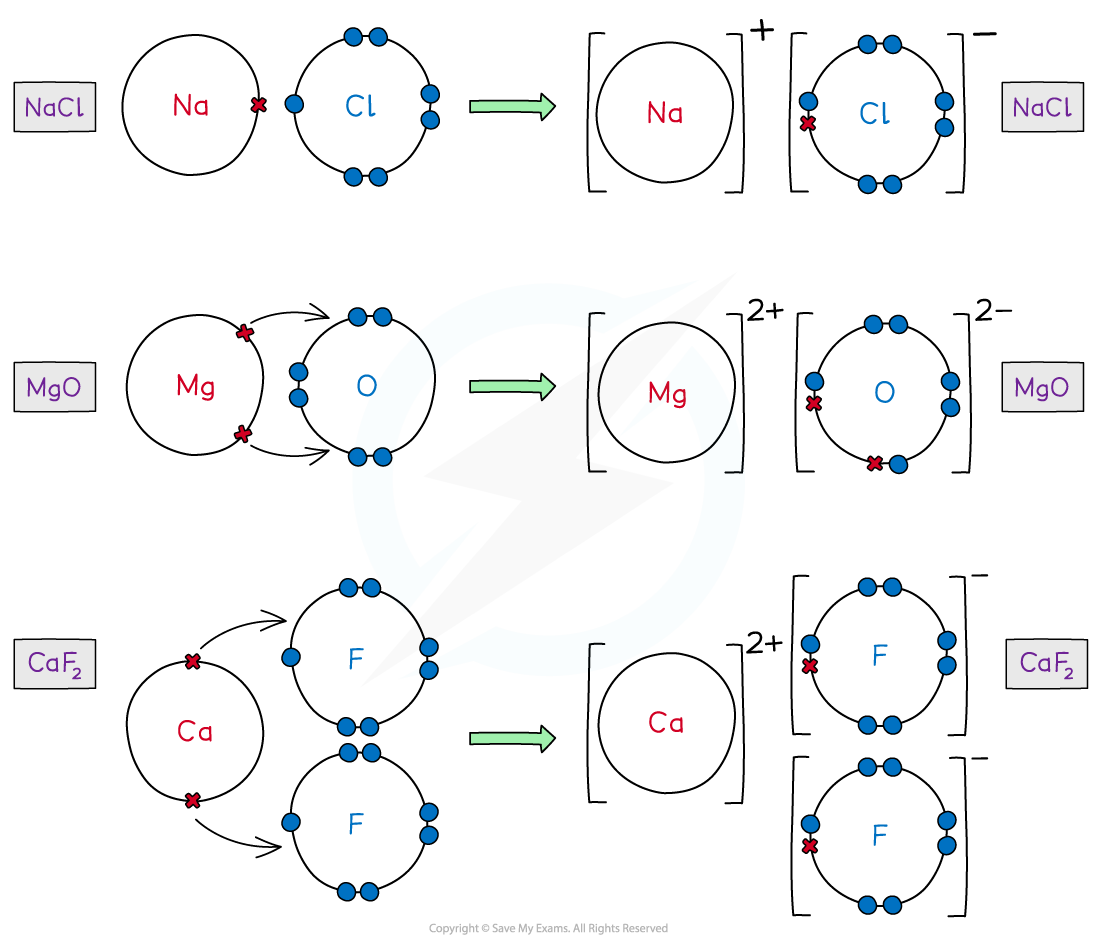
Dot-and-cross diagrams of ionic compounds in which one of the atoms transfers their valence electrons to the other
Calcium fluoride
-
Calcium is a Group 2 metal
- It loses its 2 outer electrons to form a calcium ion with a +2 charge (Ca2+)
-
Fluorine is a Group 7 non-metal
- It gains 1 electron to form a fluoride ion with a -1 charge (F-)
-
As before, the positive and negative ions are attracted to each other via an ionic bond
-
However, to cancel out the 2+ charge of the calcium ion, 2 fluorine atoms are needed
- Each fluorine atom can only accept 1 electron from the calcium atom
- 2 fluoride ions will be formed
-
Calcium fluoride is made when 1 calcium ion and 2 fluoride ions form ionic bonds, CaF2
-
The final ionic solid of CaF2 is neutral in charge
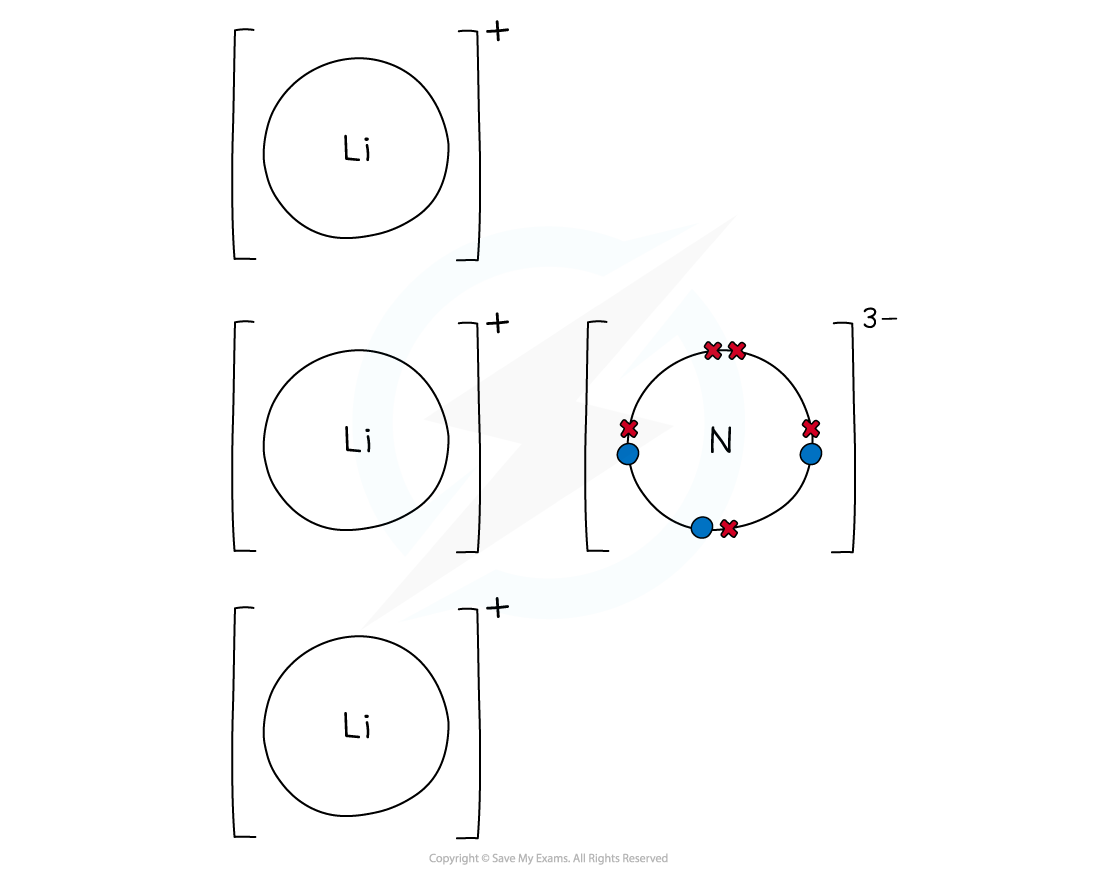
Worked Example Draw a dot cross diagram for lithium nitride
Answer
Lithium is a Group 1 metal
- It loses its outer electron to form a lithium ion with a +1 charge (Li+)
- Nitrogen is a Group 5 non-metal
- It gains 3 electrons to form a nitride ion with a -3 charge (N3-)
- To cancel out the -3 charge of the nitride ion, 3 lithium atoms are needed and 3 lithium ions will be formed
- Lithium nitride is made when 1 nitride ion and 3 lithium ions form ionic bonds
- The final ionic solid of Li3N is neutral in charge
Dot and cross diagram to show the ionic bonding in lithium nitride
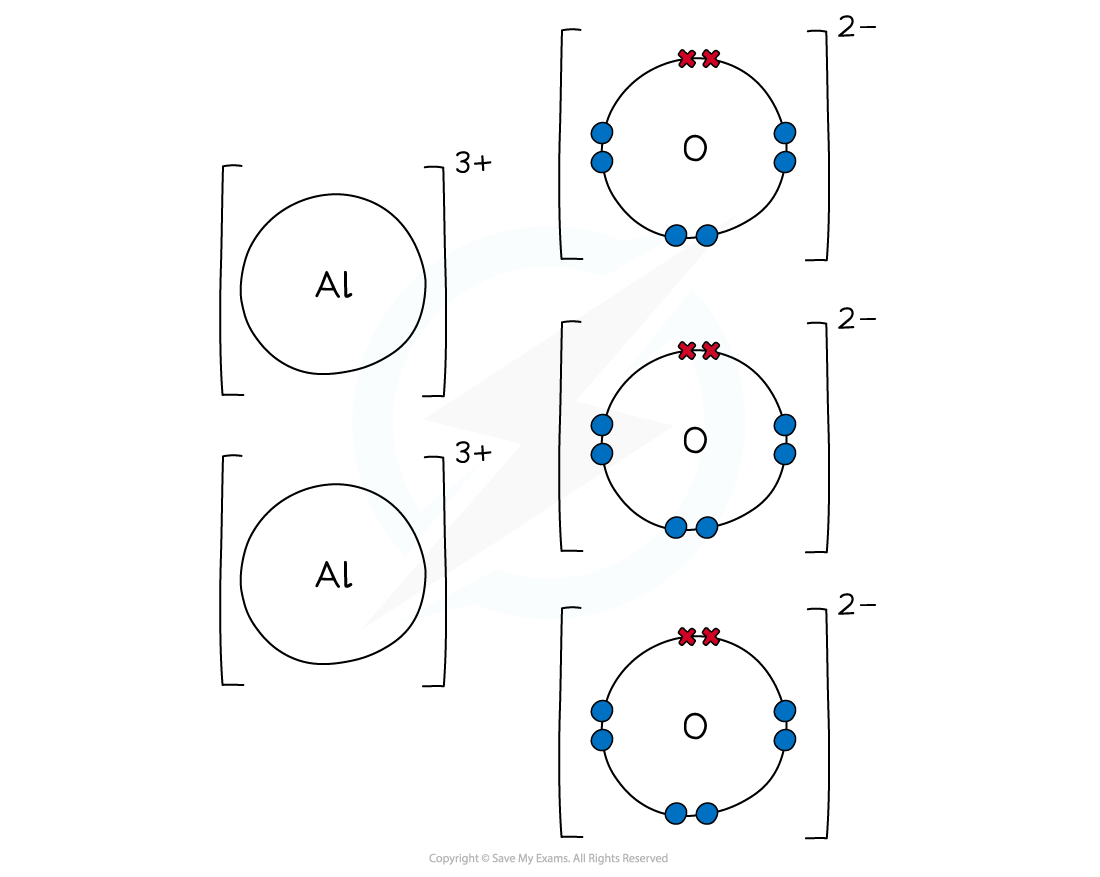
Worked Example Draw a dot cross diagram for aluminium oxide
Answer
Aluminium is a Group 3 metal
- It loses its outer electrons to form an aluminium ion with a +3 charge (Al3+)
- Oxygen is a Group 6 non-metal
- It gains 2 electrons to form an oxide ion with a -2 charge (O2-)
- To cancel out the negative and positive charges, 2 aluminium and 3 oxygen atoms are needed
- Aluminium oxide is made when 2 aluminium ions and 3 oxygen ions form ionic bonds
- The final ionic solid of Al2O3 is neutral in charge
Dot and cross diagram to show the ionic bonding in aluminium oxide
Was this revision note helpful?
Build on this topic