Organic Chemistry Techniques (Edexcel IAL Chemistry)
Reflux, Distillation & Boiling Point Determination
Spec point —
10.19
Heating under reflux
-
Organic reactions often occur slowly at room temperature
-
Therefore, organic reactions can be completed by heating under reflux to produce an organic liquid
-
This allows the mixture to react as fully as possible without the loss of any reactants, products or solvent
- In distillation, you are trying to separate a chemical or product from a mixture
- When heating under reflux, you aim to keep all the chemicals inside the reaction vessel
The Heating under Reflux Process:
-
Example reactions where heating under reflux could be used include:
- The production of a carboxylic acid from a primary alcohol using acidified potassium dichromate
- The production of an ester from an alcohol and acid in the presence of an acid catalyst
-
The reaction mixture is placed into a pear-shaped or round bottomed flask
-
Anti-bumping granules are, again, added to promote smooth boiling
-
The flask is placed in a heating mantle or it can be immersed in a water bath for heating
-
Quickfit apparatus is then set up with the condenser clamped vertically in place
- The joints of the Quickfit apparatus are commonly greased as with distillation
-
A steady and constant stream of water passes through the condenser in a 'water jacket' - it enters at the bottom of the condenser and the drainage pipe removes the water from the top of the condenser
-
The water is heated and the reaction mixture allowed to boil
-
The heated is stopped and the mixture allowed to cool back to room temperature
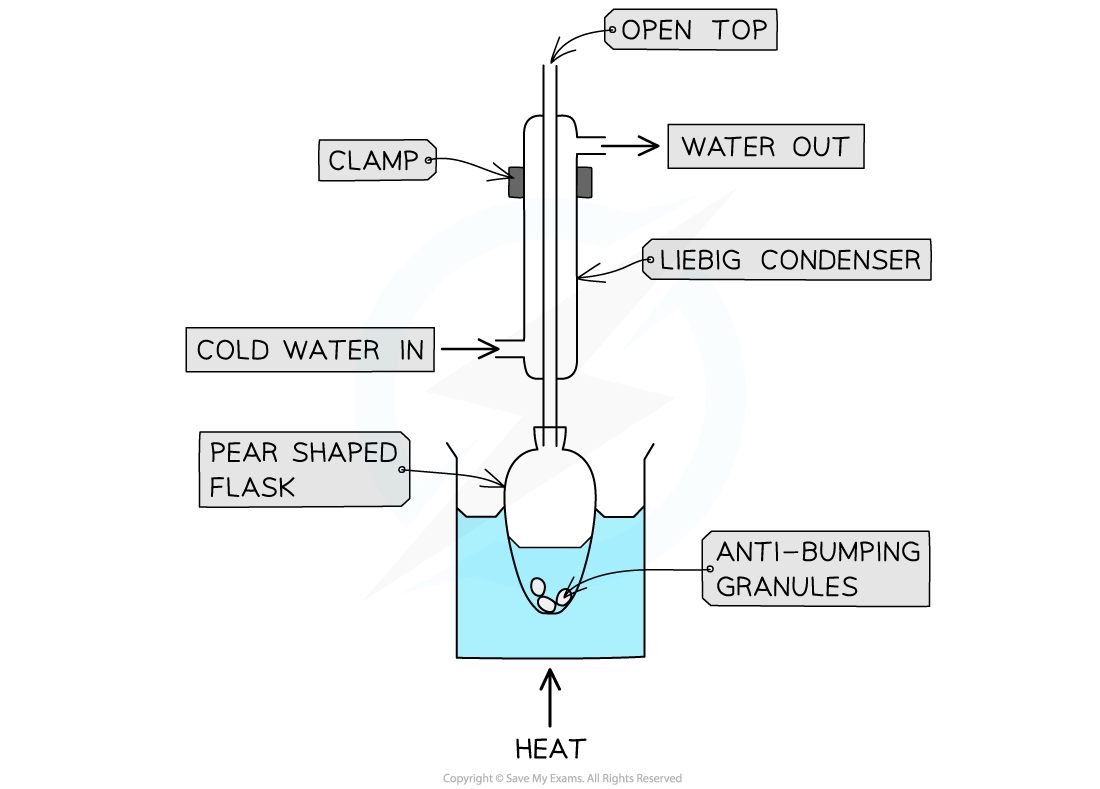
The preparation of ethyl ethanoate involves heating under reflux for about 15 minutes
Distillation
-
Distillation is a common practical completed in organic chemistry
-
Distillation is used as there are times that a reaction does not go to completion or there are other chemicals produced as well as the desired product
-
Distillation allows you to separate compounds by their boiling point
- Chemicals with the lowest boiling point will distill first
-
One of the most common distillation practicals is the oxidation of primary and secondary alcohol to aldehydes and ketones
The Distillation Process:
-
To produce an aldehyde from a primary alcohol, a reaction mixture containing the primary alcohol and acidified potassium dichromate solution is placed into a pear-shaped or round bottomed flask
-
Anti-bumping granules are added to promote smooth boiling
-
Quickfit apparatus is then set up, including a still head and condenser connected to the side
- The joints of the Quickfit apparatus are often have a thin layer of silicon grease smeared over them to give a better seal as well as to make it easier to disassemble the equipment afterwards
-
A Quickfit thermometer can be used, with the thermometer bulb sitting where the vapours will pass into the condenser
-
A steady and constant stream of water passes through the condenser in a 'water jacket' - it enters at the bottom of the condenser and the drainage pipe removes the water from the top of the condenser
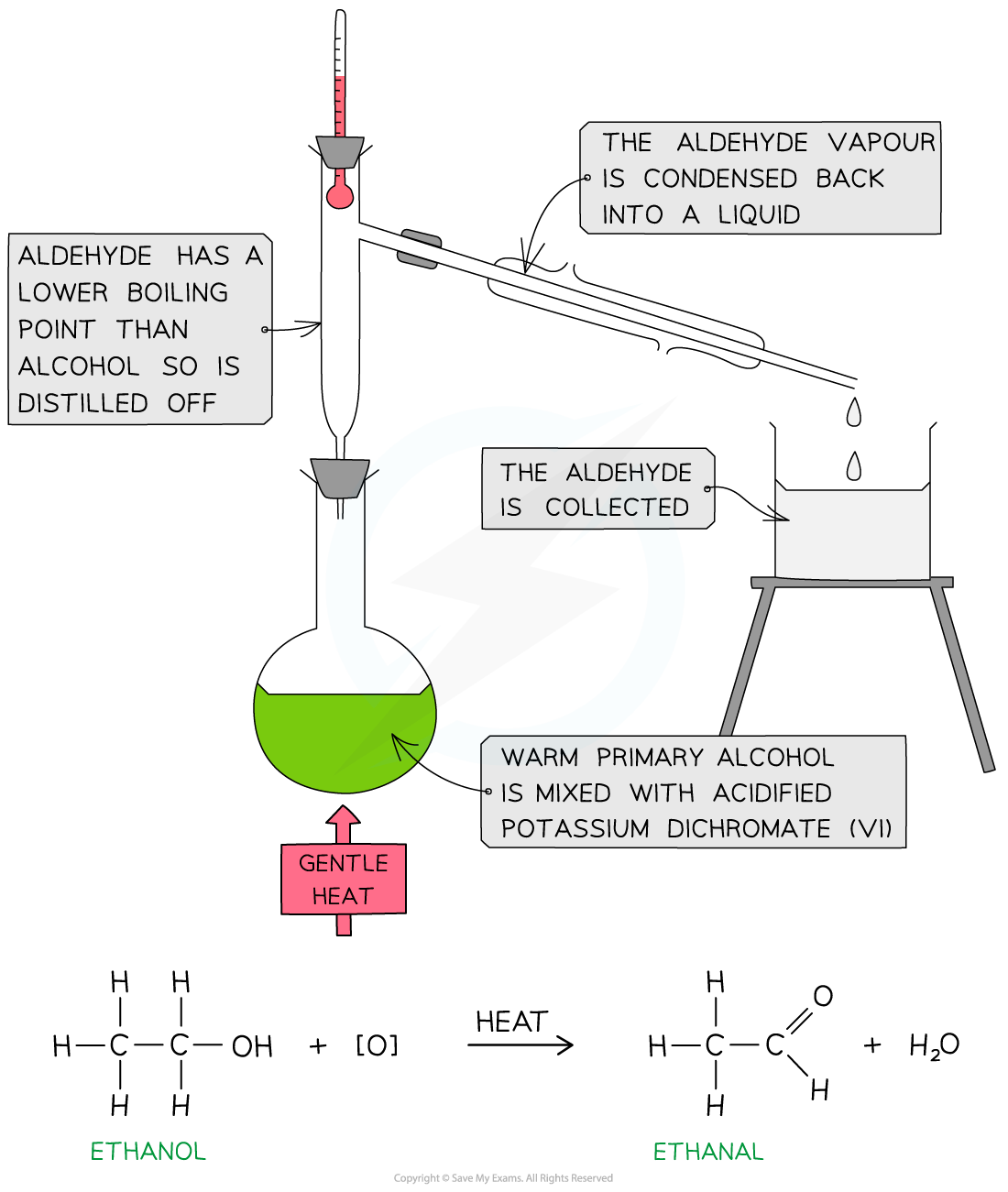
Heating under Distillation Apparatus
-
The reaction mixture is heated until it boils using a heating mantle
- Electric heating mantles are used for this because the temperature can be controlled, and because you are using chemicals which are flammable
-
The distillate which forms in the condenser drips directly into a receiving vessel
- The distillate which should be collected, is that which is given off at +/- 2 oC of the boiling point of the desired product
- Some distillate may be given off below this temperature - this needs to be discarded and a clean vessel used to collect the desired product
- Stop collecting the distillate if the temperature rises above +/- 2oC of the boiling point of the desired product
-
The aldehyde product has a lower boiling point than the alcohol (since it has lost the H-bonding) so it can be distilled off as soon as it forms
Exam Hint
These practicals give you the opportunity to discuss:
- The use of an electric heating mantles and water baths rather than a Bunsen burner
- The choice and setup of laboratory apparatus
- Health and safety considerations including the careful handling of different liquids, including those which are corrosive, irritant, flammable and toxic
Boiling point determination
-
The boiling point of a liquid is indicative of its purity and identity
-
Boiling point is determined by distillation
-
The sample is gently heated until it boils and this temperature is recorded
- This boiling point can then be compared against literature / database values
-
If the sample contains impurities:
- The boiling point may appear higher than the literature / database values
- The sample may boil over a range of temperatures instead of at a single temperature
Solvent Extraction & Drying
Spec point —
10.19
-
There are different methods to purify organic compounds, including:
- Solvent extraction / use of a separating funnel
- Use of drying agents
Solvent extraction / use of a Separating Funnel
-
When organic liquids are being prepared, water can often be obtained along with the organic product
-
The water will usually form an aqueous layer with the product in the organic layer
- It can sometimes be hard to identify which layer is the organic layer - this can be achieved by simply adding water and seeing which layer increases in volume
-
Other organic reactions may need to be neutralised before being purified, this can be achieved by adding sodium carbonate solution to the reaction vessel or separating funnel
- This can also be used to remove other impurities by washing
-
The contents of the reaction vessel are transferred to a separating funnel and a stopper added
-
The separating funnel is inverted and the stopcock opened to release the pressure - this is repeated 15-20 times
- If neutralisation has occurred then the stopcock is opened slowly to avoid losing any product
-
The two layers are allowed to separate
- In the following example, the aqueous layer is the bottom layer inside the separating funnel
-
The stop cock is opened so that the aqueous layer drains away and the organic layer can be drained into a clean beaker
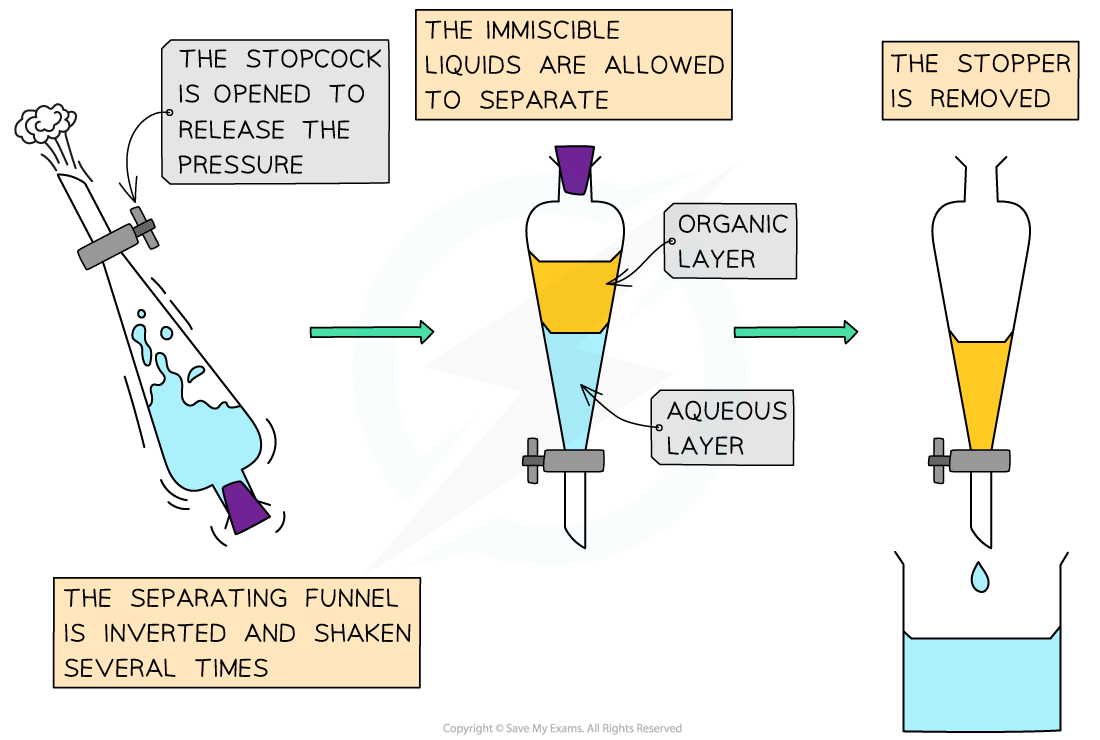
A separating funnel allows the product to be cleaned and isolated
Use of drying agents
-
Drying agents can be used to remove traces of water from an organic product
-
Drying agents are usually anhydrous inorganic salts that readily hydrate in the presence of water
- Anhydrous calcium chloride is commonly used to dry hydrocarbons
- Anhydrous calcium or magnesium sulfate are used as more general purpose drying agents
-
A spatula of drying agent is added into the organic product and swirled
- If the organic product has a low boiling point, a lid / stopped can be added to reduce the potential evaporation of any product
-
If the drying agent clumps together, then there is still water in the organic liquid
-
More drying agent is added until some remains dispersed in the organic liquid as a fine powder
-
The dry organic liquid can then be decanted or filtered
- If the organic liquid is dry then it should appear clear
Was this revision note helpful?