Racemates & Optical Activity (Edexcel IAL Chemistry)
Spec point —
15.3
Racemates & Optical Activity
Properties of optical isomers
-
The chemical properties of optical isomers are generally identical, with one exception
-
Optical isomers interact with biological sensors in different ways
- For example, one enantiomer of carvone smells of spearmint, while the other smells of caraway
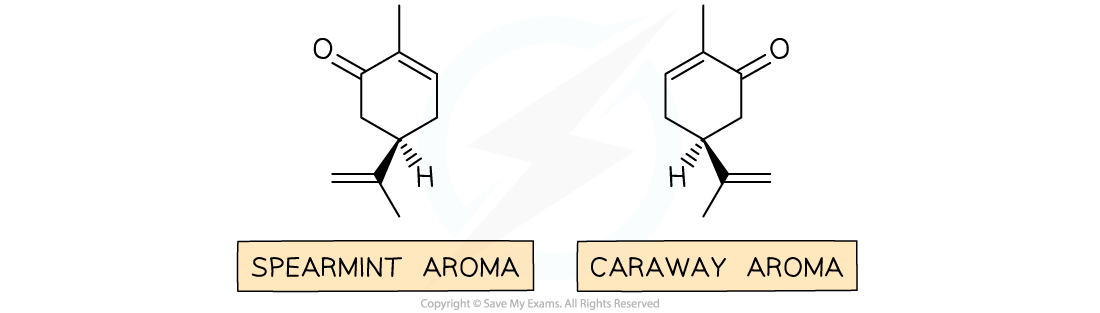
- For example, one enantiomer of carvone smells of spearmint, while the other smells of caraway
-
Carvone optical isomers have distinctive smells
-
Optical isomers have identical physical properties, with one exception
- Isomers differ in their ability to rotate the plane of polarised light
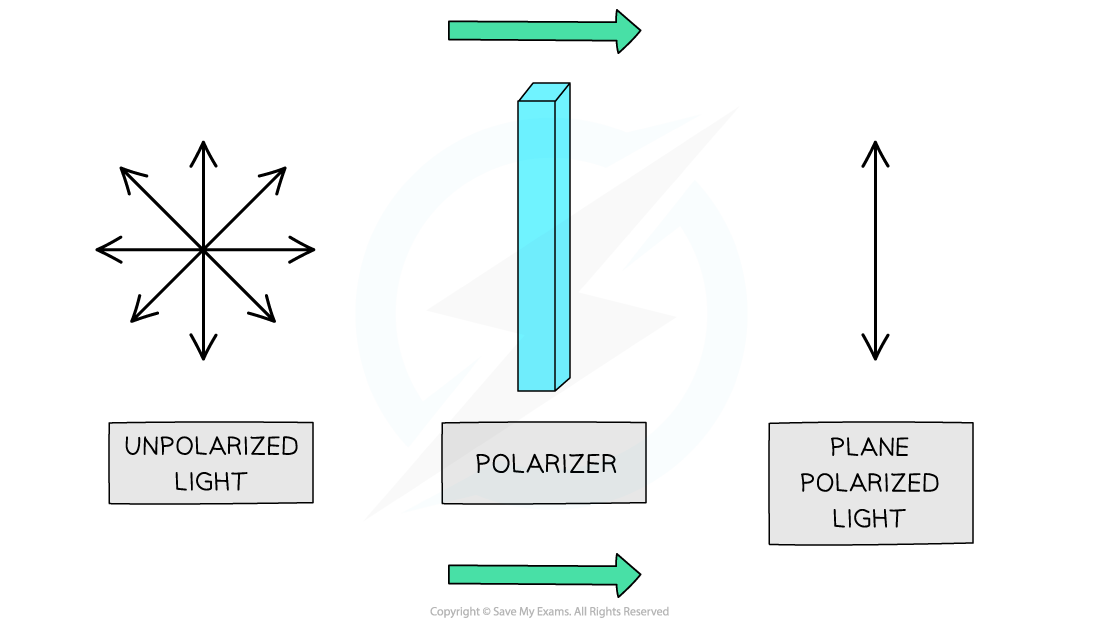
When unpolarised light is passed through a polariser, the light becomes polarised as the waves will vibrate in one plane only
-
The major difference between the two enantiomers is:
- One enantiomer rotates plane polarised light in a clockwise manner and the other in an anticlockwise fashion
- A common way to differentiate the isomers is to use (+) and (-), but there are other systems using d and l, D and L, or R and S
-
The rotation of plane polarised light can be used to determine the identity of an optical isomer of a single substance
- For example, pass plane polarised light through a sample containing one of the two optical isomers of a single substance
- Depending on which isomer the sample contains, the plane of polarised light will be rotated either clockwise or anti-clockwise by a fixed number of degrees
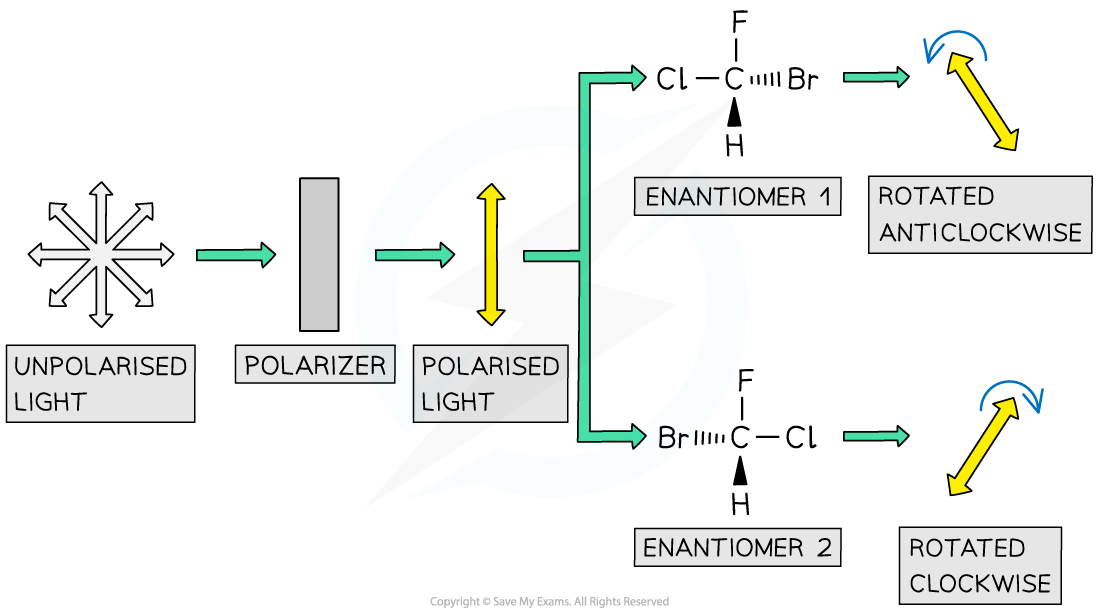
Each enantiomer rotates the plane of polarised light in a different direction
-
A racemic mixture(or racemate) is a mixture containing equal amounts of each enantiomer
- One enantiomer rotates light clockwise, the other rotates light anticlockwise
-
A racemic mixture is optically inactive as the enantiomers will cancel out each others effect
- This means that the plane of polarised light will not change
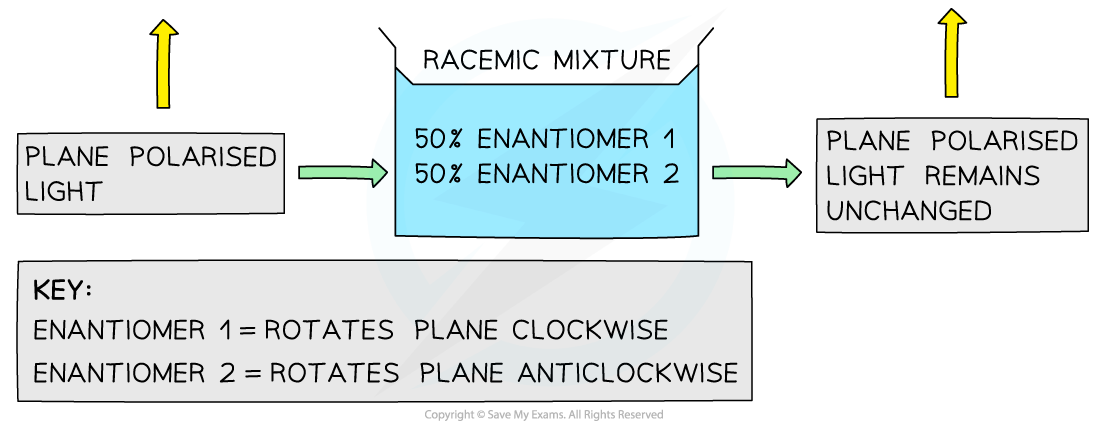
- This means that the plane of polarised light will not change
Racemic mixtures are optically inactive
Racemic mixtures and drugs
- In the pharmaceutical industry, it is much easier to produce synthetic drugs that are racemic mixtures than producing one enantiomer of the drug
- Around 56% of all drugs in use are chiral and of those 88% are sold as racemic mixtures
- Separating the enantiomers gives a compound that is described as enantiopure, it contains only one enantiomer
- This separation process is very expensive and time consuming, so for many drugs it is not worthwhile, even though only half the of the drug is pharmacologically active
- For example, the pain reliever ibuprofen is sold as a racemic mixture

The structure of ibuprofen showing the chiral carbon that is responsible for the racemic mixture produced in the synthesis of the drug
Was this revision note helpful?