Characteristic Behaviour of Amino Acids (Edexcel IAL Chemistry)
Spec point —
19.11
Characteristic Behaviour of Amino Acids
Acid / base properties of amino acids
-
Amino acids will undergo most reactions of amines and carboxylic acids including acid-base reactions of:
- Amines with acids
- Carboxylic acids with bases
-
However, they can also interact intramolecularly (within themselves) to form a zwitterion
-
A zwitterion is an ion with both a positive(-NH3+) and a negative(-COO-) charge
-
Because of these charges in a zwitterion, there are strong intermolecular forces of attraction between amino acids
- Amino acids are therefore soluble crystalline solids
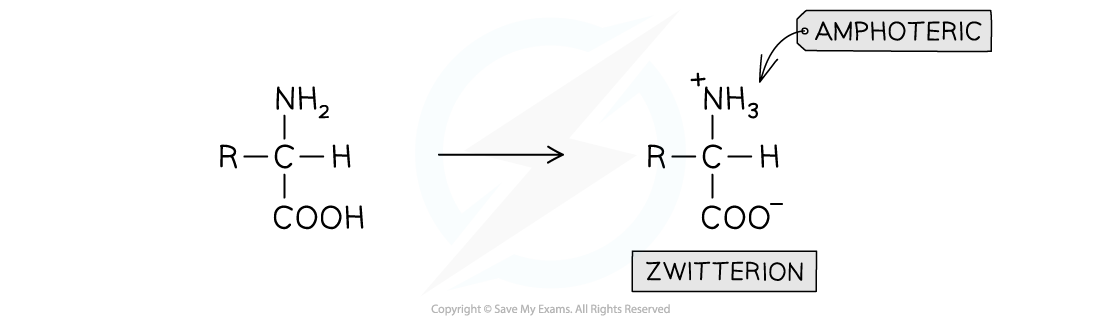
An amino acid molecule can interact within itself to form a zwitterion
Isoelectric point
-
A solution of amino acids in water will exist as zwitterions with both acidic and basic properties
-
They act as buffer solutions as they resist any changes in pH when small amounts of acids or alkali are added
-
If an acid is added (and thus the pH is lowered):
- The -COO- part of the zwitterion will accept an H+ ion to reform the -COOH group
- This causes the zwitterion to become a positively charged ion
-
If a base is added (and thus the pH is raised):
- The -NH3+ part of the zwitterion will donate an H+ ion to reform the -NH2 group
- This causes the zwitterion to become a negatively charged ion
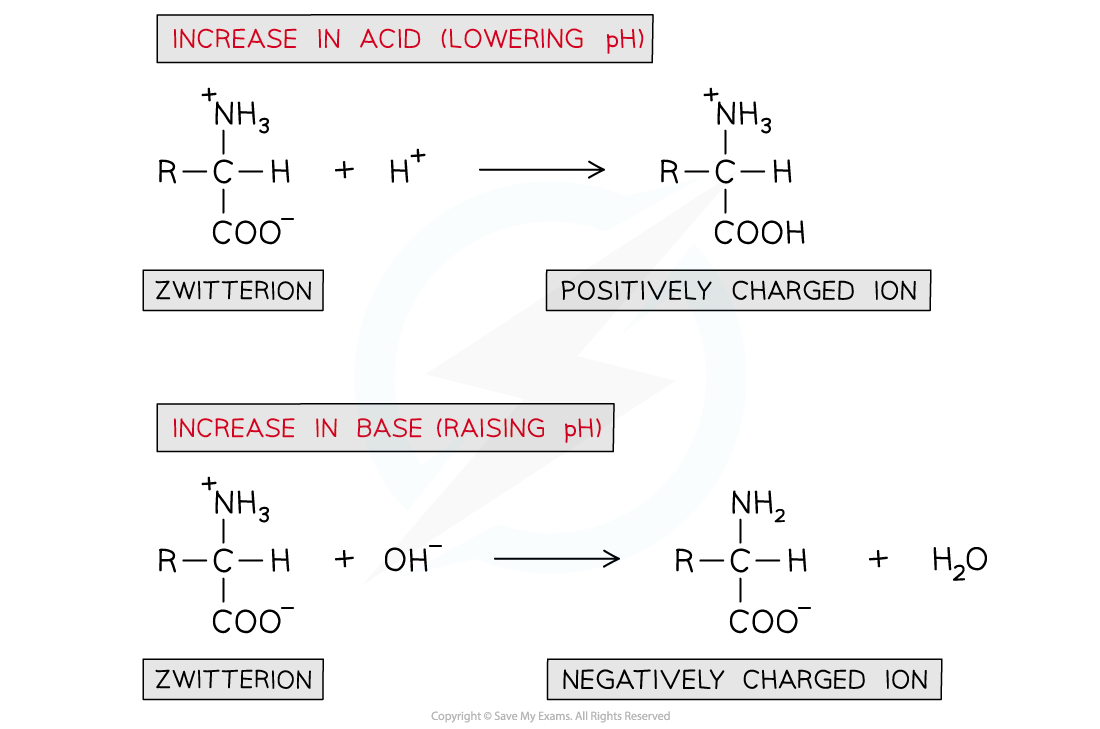
A solution of amino acids can act as a buffer solution by resisting any small changes in pH
-
The pH can be slightly adjusted to reach a point at which neither the negatively charged or positively charged ions dominate and the amino acid exists as a neutral zwitterion
- This is called the isoelectric point of the amino acid
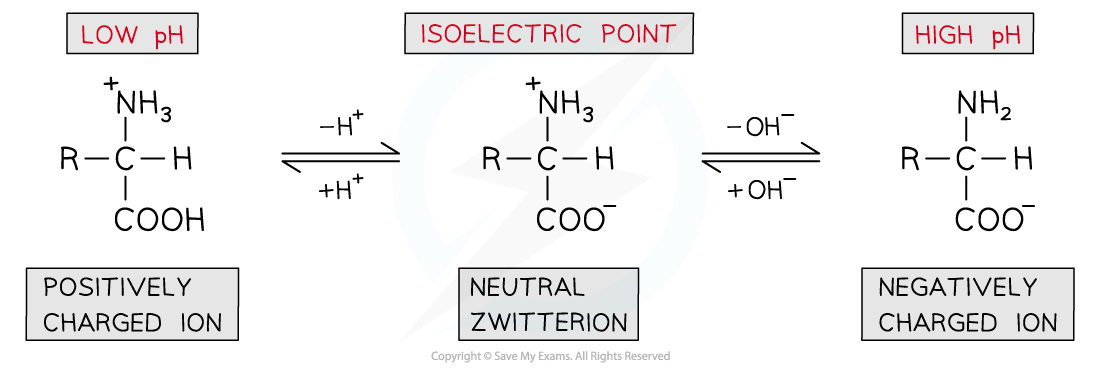
The isoelectric point of amino acids is the pH at which the amino acid exists as a neutral zwitterion
Reactions of the amine group
- The amine group is basic and reacts with acids to make salts
- For example, a general amino acid reacts with hydrochloric acid to form the ammonium salt:
H2NCHRCOOH + HCl ⇌ H3N+CHRCOOH + Cl-
Reactions of the carboxylic acid group
Reaction with aqueous alkalis
- An amino acid reacts with aqueous alkali such as sodium or potassium hydroxide to form a salt and water
- For example, a general amino acid reacts with sodium hydroxide to form a sodium salt:
H2NCHRCOOH + NaOH ⇌ H2NCHRCOO-Na++ H2O
Esterification with alcohols
- Amino acids, like carboxylic acids, can be esterified by heating with alcohol in the presence of concentrated sulfuric acid
- The carboxylic acid group is esterified whilst the basic amine group is protonated due to the acidic conditions:
H2NCHRCOOH + C2H5OH + H+⇌ H3N+CHRCOOC2H5+ H2O
Optical activity
-
Almost all 2-amino acids contain a chiral centre (the C of the CH group), and so are optically active
- The only exception is glycine, which has a CH2 group instead
-
Aqueous solutions of the enantiomers rotate the plane of polarisation of plane-polarised light
- Dextrorotatory (+)
- Laevorotatory (-)
-
If an amino acid is synthesised in the lab, a racemic mixture is formed
Peptide bonds
- Each amino acid contains an amine (-NH2) and carboxylic acid (-COOH) group
- The new amide bond between two amino acids is also called a peptide link or peptide bond
- The -NH2 group of one amino acid can react with the -COOH group of another amino acid in a condensation reaction to form a dipeptide
- Since this is a condensation reaction, a small molecule (in this case H2O) is eliminated
- The dipeptide still contains an -NH2 and -COOH group at each end of the molecule which can again participate in a condensation reaction to form a tripeptide
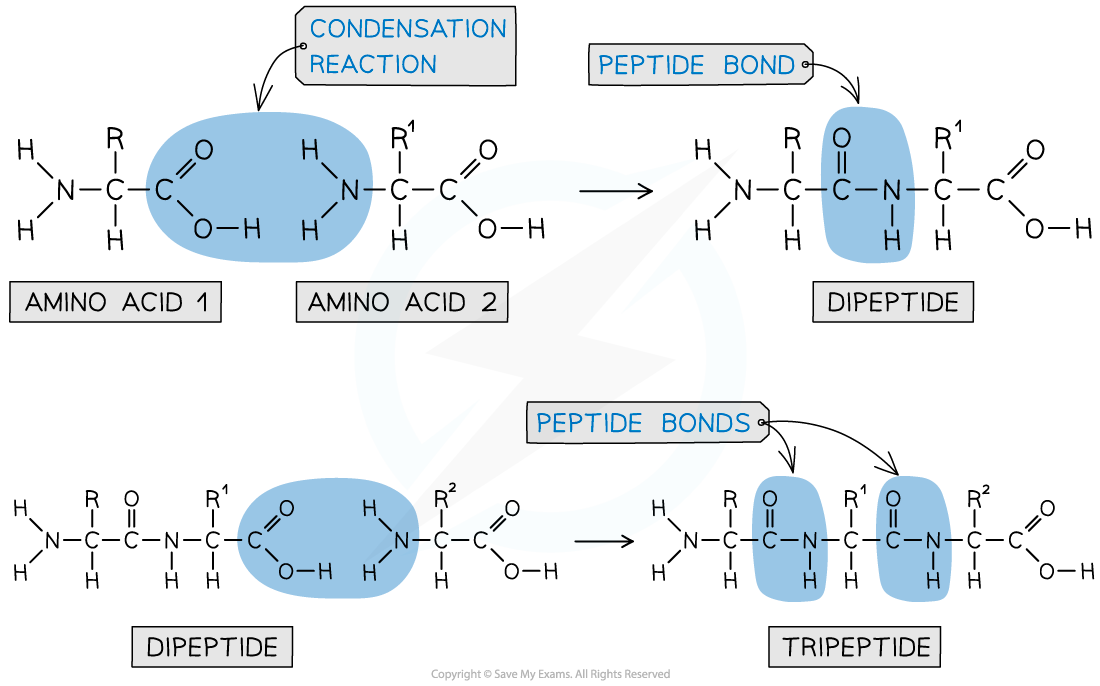
A peptide bond is an amide bond between two amino acids
- A polypeptide is formed when many amino acids join together to form a long chain of molecules
Was this revision note helpful?