Haemoglobin & Ligand Exchange (Edexcel IAL Chemistry)
Spec point —
17.17
Haemoglobin & Ligand Exchange
-
Haemoglobin is one of nature's complexes using a transition metal ion
-
The haem molecule is a complex with iron(II) at its centre
-
The haemoglobin complex contains a multidentate ligand made up of four haem groups
- These consist of mostly carbon and hydrogen atoms
- Each haem group has a nitrogen atom forming a dative covalent bond to the Fe2+ ion in a square planar complex
-
There is a fifth dative bond from the protein (globin) to the Fe2+ ion
-
Oxygen atoms form a dative covalent bond with the iron(II) which enables oxygen molecules to be transported around the body in the blood
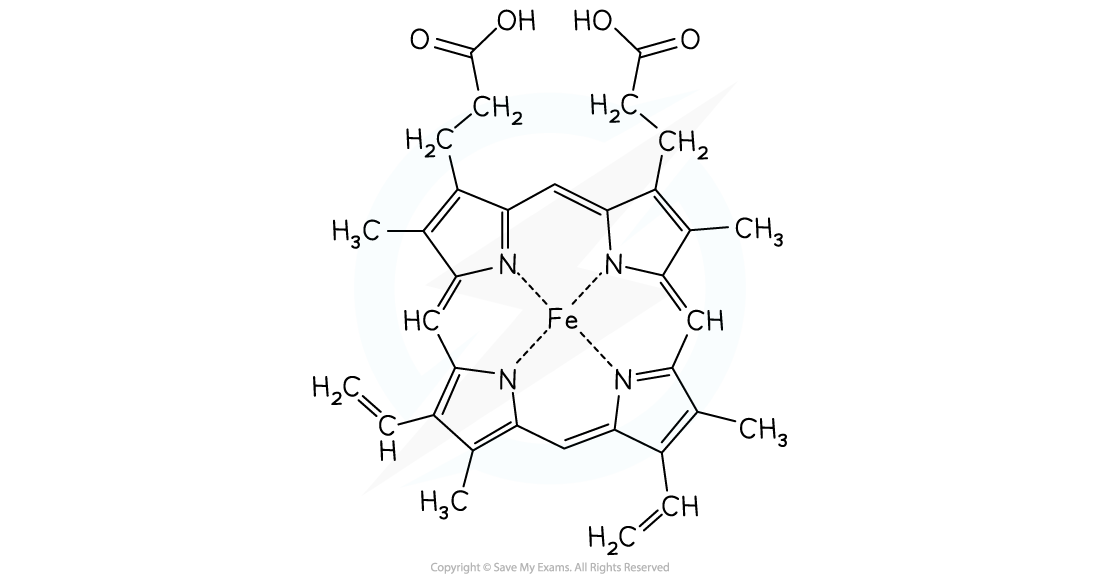
The haem molecule with iron(II) at its centre
- Oxygen molecules are not very good ligands and bond weakly to the iron(II)
- The weak bonds allows them to break off easily and be transported into cells
Exam Hint You do not need to be familiar with the structure of the haem group
-
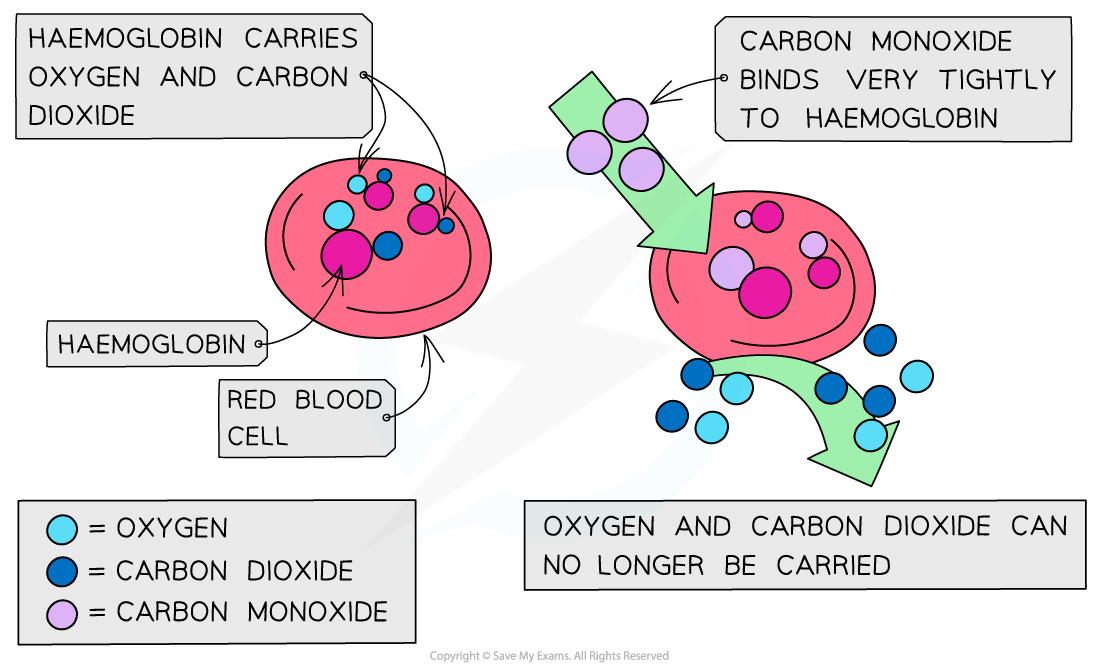
Carbon monoxide is toxic because it is a better ligand than oxygen and binds strongly to the iron(II) preventing oxygen from being carried to the cells
- The reason for the strength of the carbon monoxide binding more strongly to haemoglobin is that it forms stronger dative covalent bonds, although it can be displaced from heamoglobin
-
If oxygen attached to the haemoglobin (oxyhaemoglobin) is replaced by carbon monoxide (carboxyhaemoglobin), a darker red colour is produced in the haem complex
- This is a sign of carbon monoxide poisoning
-
The condition anaemia occurs when a person does not have enough haemoglobin in their blood due to a loss of blood or deficiency in iron
- Deficiency in iron can be restored by taking iron sulfate tables in the diet
Was this revision note helpful?