Periodicity - Thermal Trends (Edexcel IAL Chemistry)
Trends in Melting & Boiling Point
Spec point —
2.18
Melting point
- Period 2 and 3 elements follow the same pattern in relation to their melting points
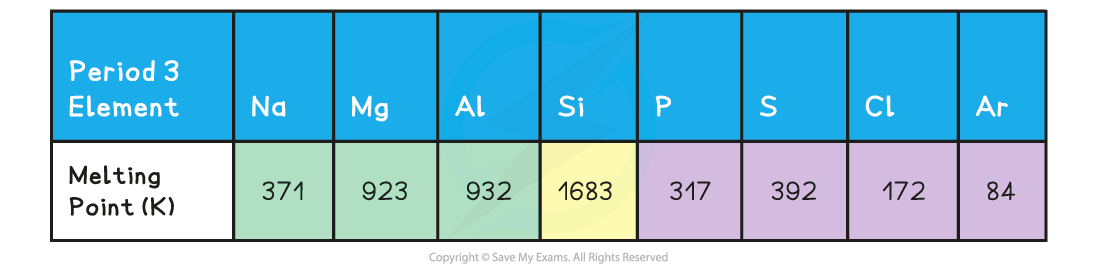
Melting Points of the Elements Across Period 3 Table
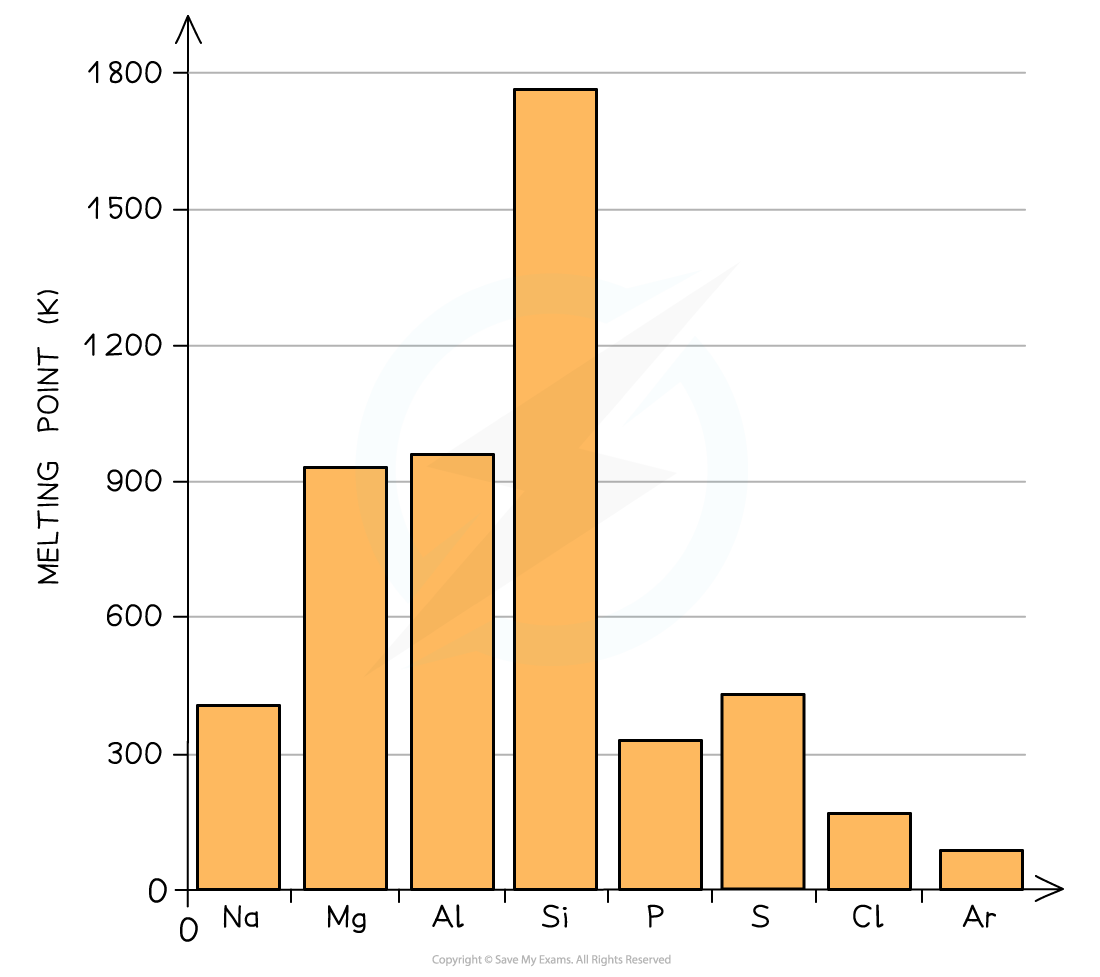
Melting points of the period 3 elements
-
A general increase in melting point for the Period 3 elements up to silicon is observed
-
Silicon has the highest melting point
-
After the Si element the melting points of the elements decreases significantly
-
The above trends can be explained by looking at the bonding and structure of the elements
Bonding & Structure of the Elements Table
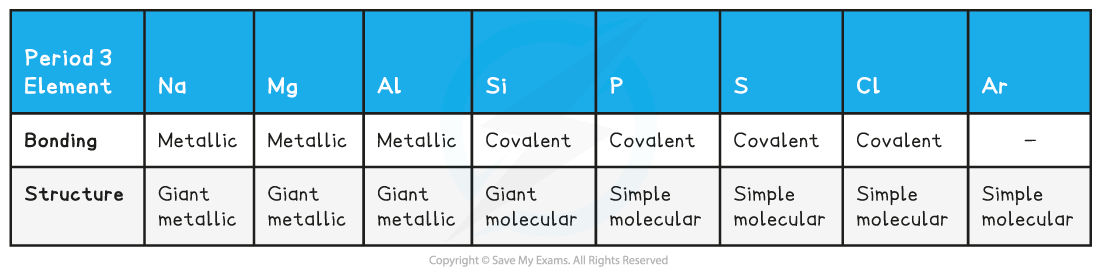
- The table shows that Na, Mg and Al are metallic elements which form positive ions arranged in a giant lattice in which the ions are held together by a 'sea' of delocalised electrons
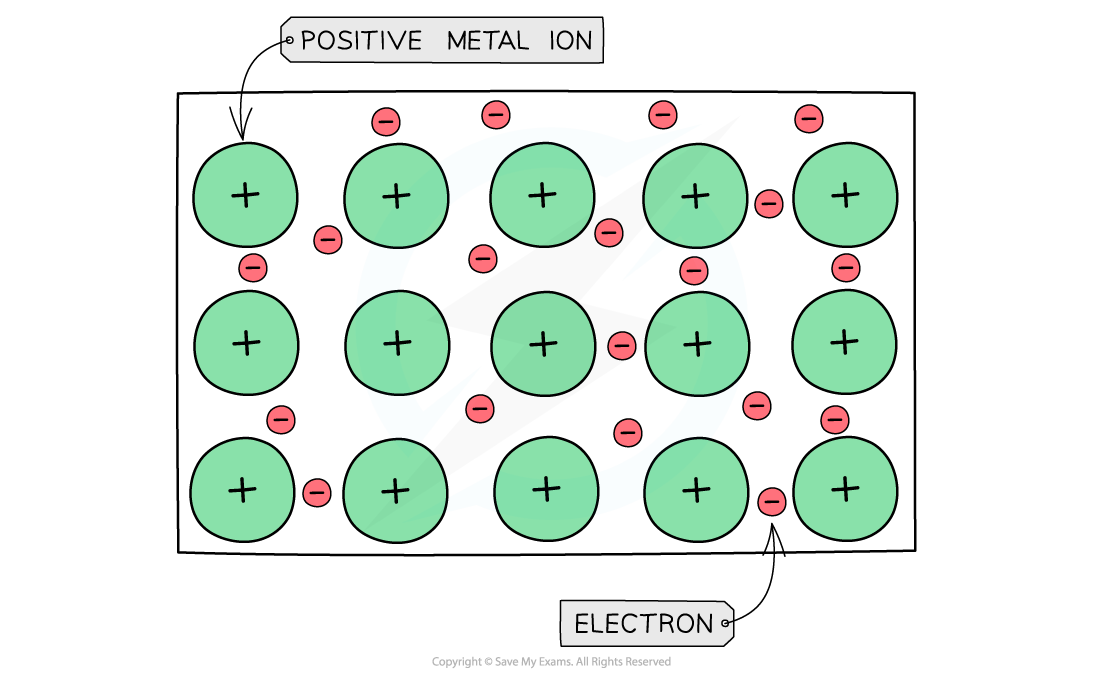
Metal cations form a giant lattice held together by electrons that can freely move around
Exam Hint
Remember: At room temperature and pressure, metals (except for mercury) are solid
This means that the lattice structure should:
- Have a regular arrangement of positive ions (rows and columns)
- Have the ions tightly packed / close together
The lattice structure should not:
Have large gaps between the positive ions
- This could lose marks in an exam as examiners may not be satisfied that a solid is being shown
Have a random arrangement of particles
- Examiners would consider a randomly arranged, close packed structure to be a liquid and penalise answers accordingly
The delocalised electrons do not have to be specifically shown
- The electrons in the ‘sea’ of delocalised electrons are those from the valence shell of the atoms
- Na will donate one electron into the ‘sea’ of delocalised electrons, Mg will donate two and Al three electrons
- As a result of this, the metallic bonding in Al is stronger than in Na
- This is because the electrostatic forces between a 3+ ion and the larger number of negatively charged delocalised electrons is much larger compared to a 1+ ion and the smaller number of delocalised electrons in Na
- Because of this, the melting points increase going from Na to Al
- Si has the highest melting point due to its giant molecular structure in which each Si atom is held to its neighbouring Si atoms by strong covalent bonds
- P, S, Cl and Ar are non-metallic elements and exist as simple molecules (P4, S8, Cl2 and Ar as a single atom)
- The covalent bonds within the molecules are strong, however, between the molecules, there are only weak instantaneous dipole-induced dipole forces
- It doesn’t take much energy to break these intermolecular forces
- Therefore, the melting points decrease going from P to Ar(note that the melting point of S is higher than that of P as sulphur exists as larger S8 molecules compared to the smaller P4 molecule)
Was this revision note helpful?