Ligand Exchange (Edexcel IAL Chemistry)
Exchanging Ligands
Spec point —
17.24
-
**Ligand exchange **(or ligand substitution) is when one ligand in a complex is replaced by another
-
Ligand exchange forms a new complex that is more stable than the original one
-
The ligands in the original complex can be partially or entirely substituted by others
-
The complex ion can change its charge or remain the same depending on the ligand involved
-
There are no changes in coordination number, or the geometry of the complex, if the ligands are of a** similar** size
-
But, if the ligands are of a different size, for example water ligands and chloride ligands, then a change in coordination number and the geometry of the complex will occur
-
Addition of a high concentration of chloride ions (from conc HCl or saturated NaCl) to an aqueous ion leads to a ligand substitution reaction.
-
The Cl- ligand is larger than the uncharged H2O and NH3 ligands so therefore ligand exchange can involve a change of co-ordination number
-
For example when concentrated hydrochloric acid is added slowly and continuously to a copper(II) sulfate solution the colour changes from blue to green then finally yellow
-
The equation for this reaction is
[Cu(H2O)6]2+ (aq) + 4Cl-(aq) ⇌ [CuCl4]2-(aq) + 6H2O (l)
-
We can see that all six water ligands have been replaced by four chloride ions
-
This reaction involves a change in coordination number from 6 to 4
-
Note that despite the charge on the complex changing from +2 to -2, there has been no change in oxidation number of the copper
-
We can also see that this reaction is reversible, which helps to explain the observed colour change
- The hexaaquacopper(II) ion is blue
- The tetrachlorocuprate(II) ion is yellow
- The green colour is due to a mixture of the blue and yellow complex ions
-
A similar reaction also takes place with cobalt resulting in a blue solution and a change in coordination number from 6 to 4
[Co(H2O)6]2+ (aq) + 4Cl-(aq) ⇌ [CoCl4]2-(aq) + 6H2O (l)
Exam Hint Be careful: If solid copper chloride (or any other metal) is dissolved in water it forms the aqueous [Cu(H2O)6]2+ complex and not the chloride [CuCl4 ]2- complex
Entropy & Stability
Spec point —
17.25
- The replacement of monodentate ligands with bidentate and multidentate ligands in complex ions is called the chelate effect
- It is an energetically favourable reaction, meaning that ΔGꝋ is negative
- The driving force behind the reaction is entropy
- The Gibbs equation reminds us of the link between enthalpy and entropy:
ΔG ꝋ = ΔHreactionꝋ – TΔSsystemꝋ
- Reactions in solution between aqueous ions usually come with relatively small enthalpy changes
- However, the entropy changes are always positive in chelation because the reactions produce a net increase in the number of particles
- A small enthalpy change and relative large positive entropy change generally ensures that the overall free energy change is negative
- For example, when EDTA chelates with aqueous cobalt(II) two reactants becomes seven product species
[Co(H2O)6 ]2+(aq) + EDTA4- (aq) → [CoEDTA]2-(aq) + 6H2O****(l)
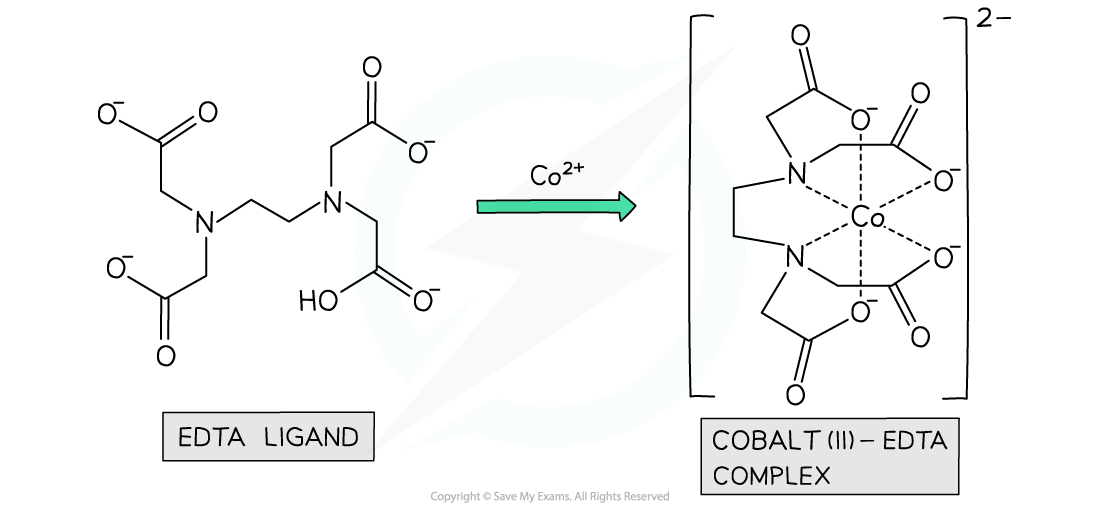
The ligand EDTA readily chelates with aqueous transition metal ions in an energetically favourable reaction
Was this revision note helpful?