Benzene - Electrophilic Substitution (Edexcel IAL Chemistry)
Spec point —
18.5
Benzene - Electrophilic Substitution
-
The main reactions which benzene will undergo include the replacement of one of the 6 hydrogen atoms from the benzene ring
- This is different to the reactions of unsaturated alkenes, which involve the double bond breaking and the electrophile atoms 'adding on' to the carbon atoms
-
These reactions are called electrophilic substitution reactions
- This is where at least one of the H atoms of benzene are substituted by the electrophile
-
You must be able to provide the mechanisms for specific examples of the electrophilic substitution of benzene
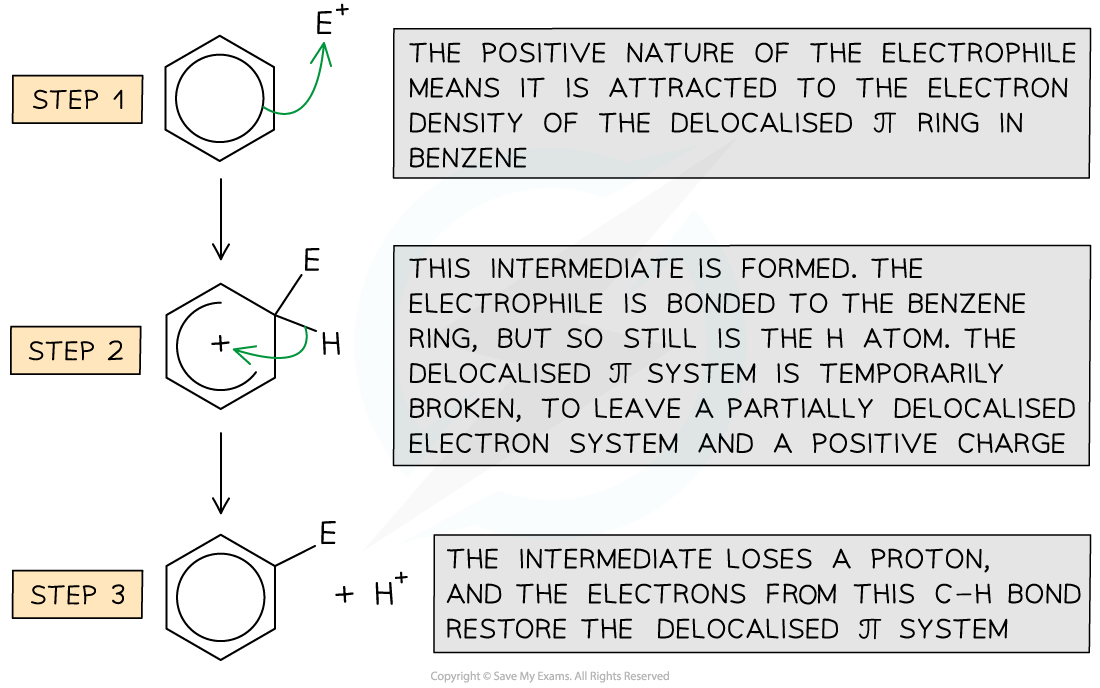
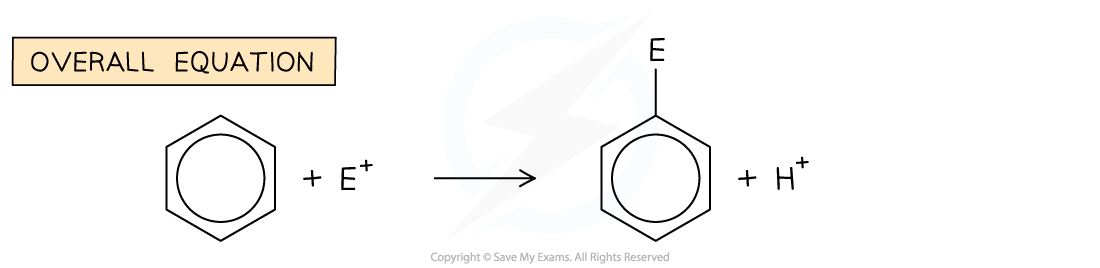
General Electrophilic Substitution Mechanism:
-
The delocalised π system is extremely stable and is a region of high electron density
-
Electrophilic substitution reactions involve an electrophile, which is either a positive ion or the positive end of a polar molecule
-
There are numerous electrophiles which can react with benzene
- However, they usually cannot simply be added to the reaction mixture to then react with benzene
- The electrophile has to be produced in situ, by adding appropriate reagents to the reaction mixture
-
The electrophilic substitution reaction in arenes consists of steps:
- Generation of an electrophile
- Electrophilic attack
- Regenerating aromaticity
Nitration of benzene mechanism
- One hydrogen atom is substituted by a nitro group - NO2
- The overall reaction is:
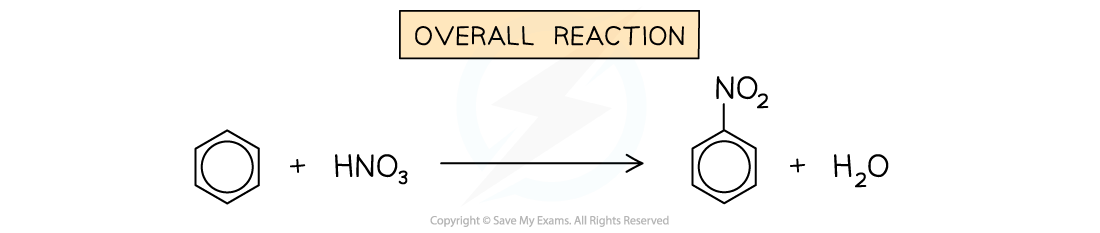
C6H6 + HNO3 → C6H5NO2 + H2O
- The reaction is conducted under reflux at 55 °C or 60 °C
Step 1: Electrophile generation
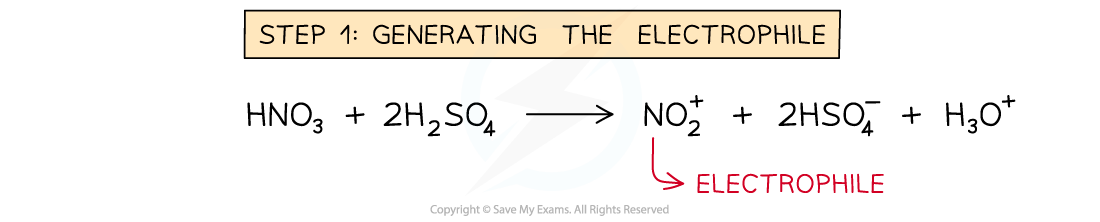
- The electrophile NO2+ion is generated by reacting concentrated nitric acid (HNO3) and concentrated sulfuric acid (H2SO4)
- The equation for the generation of the electrophile is:
Exam Hint There are 2 accepted equations for the formation of the eletrophile:
HNO3 + H2SO4 → NO2+ + HSO4− + H2O
OR
HNO3 + 2H2SO4 → NO2+ + 2HSO4- + H3O+
Step 2: Electrophilic attack
-
A pair of electrons from the benzene ring is donated to the electrophile to form a covalent bond
- This disrupts the aromaticity in the ring as there are now only four π electrons and there is a positive charge spread over the five carbon atoms

A pair of electrons from the benzene ring is donated to the nitronium ion electrophile forming a covalent bond and a loss in aromaticity
Exam Hint Examiners are looking for very specific points in an electrophilic substitution mechanism:
The initial arrow:
- The curly arrow must start from on or within the circle/hexagon of the benzene ring and point to the NO2+ electrophile.
- Do not forget to draw the + charge on the electrophile.
The horseshoe shape:
- The intermediate must be drawn with a 'horseshoe' (an incomplete circle) that faces the tetrahedral carbon, which is the carbon atom attached to the H and NO2 group.
Horseshoe size:
- The horseshoe must be large enough to cover at least 3 carbon atoms.
- Ideally it should cover the 5 carbon atoms that have not been substituted.
The charge:
- The positive charge (+) must be drawn inside the horseshoe
Step 3: Regenerating / restoring aromaticity
-
Aromaticity is restored by heterolytic cleavage of the C-H bond
- This means that the bonding pair of electrons goes into the benzene π bonding system

Exam Hint The curly arrow must start from the C–H bond and point to anywhere within the ring to show the reforming of the delocalised structure
Step 4: Regenerating the catalyst
- The H+ ion (released in Step 3) reacts to reform the original catalyst:
H+ + HSO4− → H2SO4
Halogenation of benzene mechanism
- One hydrogen atom is substituted by a halogen atom
- For bromine, the overall reaction is:
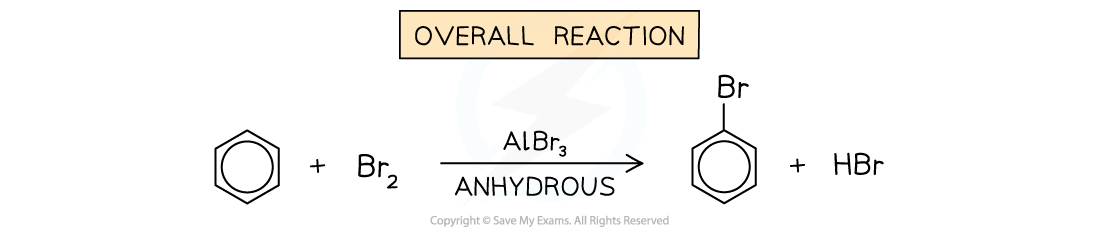
C6H6 + Br2 → C6H5Br + HBr
- The reaction is conducted using a halogen carrier catalyst and requires heat / heating under reflux
Step 1: Electrophile generation
-
The electrophile X+ion is generated by reacting the halogen with a halogen carrier
-
The common halogen carriers are:
- AlBr3
- AlCl3
- FeCl3 (or iron and bromine, which react to form FeBr3)
-
The halogen molecules form a dative bond with the halogen carrier by donating a lone pair of electrons from one of its halogen atoms into an empty 3p orbital of the halogen carrier
Mechanism step showing Br₂ reacting with AlBr₃ via a dative covalent bond to form Br⁺ electrophile and [AlBr₄]⁻ in electrophilic substitution
Exam Hint The halogen carrier used must correspond to the halogen that is involved in the substitution reaction:
Br-Br + AlBr3 → Br+ + [AlBr4]-
Cl-Cl + FeCl3 → Cl+ + [FeCl4]-
Step 2: Electrophilic attack
-
A pair of electrons from the benzene ring is donated to the electrophile to form a covalent bond
- This disrupts the aromaticity in the ring as there are now only four π electrons and there is a positive charge spread over the five carbon atoms

A pair of electrons from the benzene ring is donated to the bromine ion electrophile forming a covalent bond and a loss in aromaticity
Exam Hint Examiners are looking for similar specific points to the nitration mechanism:
The initial arrow:
- The curly arrow must start from on or within the circle/hexagon of the benzene ring and point to the Br+ or Cl+ electrophile.
- Do not forget to draw the + charge on the electrophile.
The horseshoe shape:
- The intermediate must be drawn with a 'horseshoe' (an incomplete circle) that faces the tetrahedral carbon, which is the carbon atom attached to the H and halogen atom.
Horseshoe size:
- The horseshoe must be large enough to cover at least 3 carbon atoms.
- Ideally it should cover the 5 carbon atoms that have not been substituted.
The charge:
- The positive charge (+) must be drawn inside the horseshoe
Step 3: Regenerating / restoring aromaticity
-
Aromaticity is restored by heterolytic cleavage of the C-H bond
- This means that the bonding pair of electrons goes into the benzene π bonding system
Diagram of step 3 electrophilic substitution: [AlBr4]– removes H from bromobenzene sigma complex, restoring benzene aromaticity and forming HBr and AlBr3
Step 4: Regenerating the catalyst
- The H+ ion (released in Step 3) reacts to reform the original catalyst:
H+ + [AlBr4]- → HBr + AlBr3
Friedel-Crafts acylation of benzene mechanism
- One hydrogen atom on the benzene ring is substituted by an acyl group (e.g., an ethanoyl group, −COCH3).
- For the reaction with ethanoyl chloride, the overall reaction is:
C6H6 + CH3COCl → C6H5COCH3 + HCl
- The reaction is conducted using an anhydrous aluminium chloride (AlCl3) catalyst and requires heating under reflux
Step 1: Electrophile generation
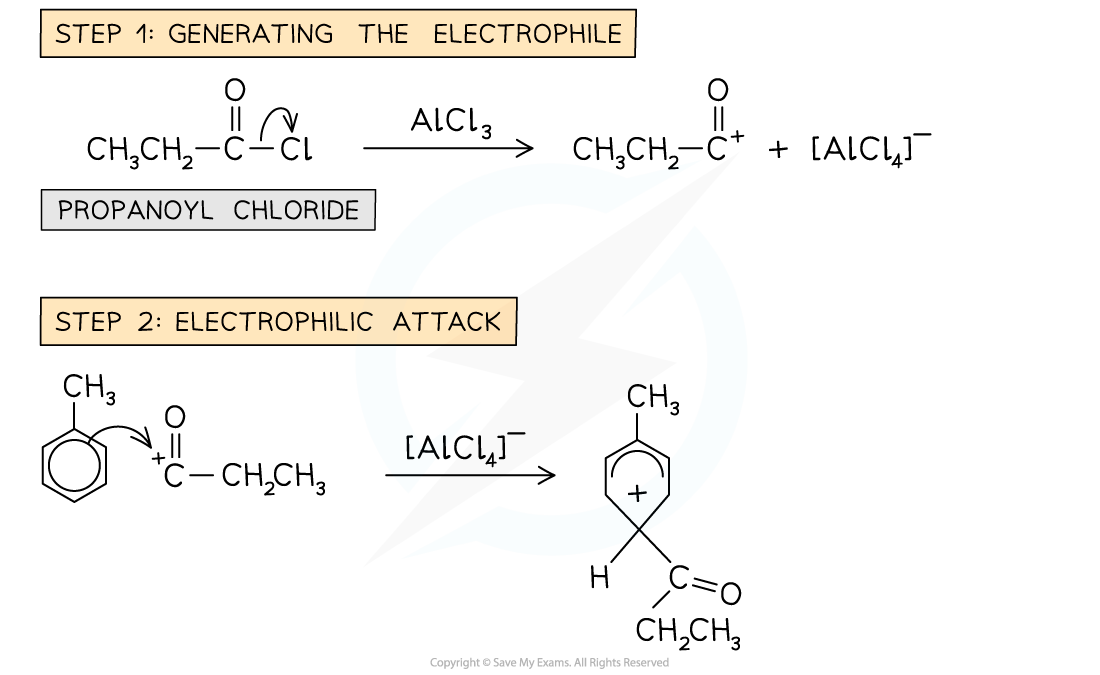
The electrophile is an acylium ion (e.g., CH3CO+).
It is generated by reacting the acyl chloride with the halogen carrier catalyst, which accepts a lone pair of electrons from the chlorine atom.
The equation for the generation of the electrophile is:
CH3COCl + AlCl3 → CH3CO+ + [AlCl4]−
-
In the Friedel-Crafts acylation reaction, an acyl group is substituted into the benzene ring
- An acyl group is an alkyl group containing a carbonyl, C=O group
Step 2: Electrophilic attack
-
A pair of electrons from the benzene ring is donated to the electrophile to form a covalent bond.
- This disrupts the aromaticity in the ring as there are now only four π electrons and there is a positive charge spread over the five carbon atoms.
Exam Hint Examiners are looking for similar specific points to the nitration mechanism:
The initial arrow:
- The curly arrow must start from on or within the circle/hexagon of the benzene ring and point to the positively charged carbon atom of the CH3CO+ electrophile.
- Do not forget to draw the + charge on the electrophile.
The horseshoe shape:
- The intermediate must be drawn with a 'horseshoe' (an incomplete circle) that faces the tetrahedral carbon, which is the carbon atom attached to the H and acyl group.
Horseshoe size:
- The horseshoe must be large enough to cover at least 3 carbon atoms.
- Ideally it should cover the 5 carbon atoms that have not been substituted.
The charge:
- The positive charge (+) must be drawn inside the horseshoe
Step 3: Regenerating / restoring aromaticity
-
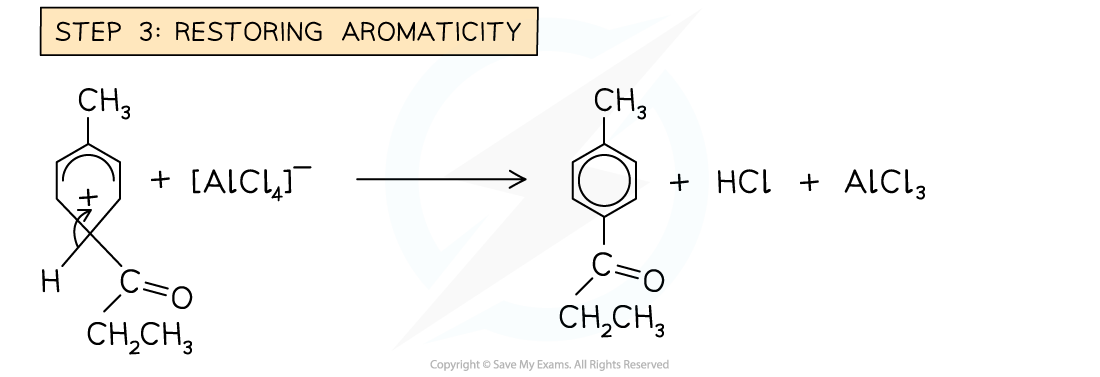
Aromaticity is restored by heterolytic cleavage of the C–H bond.
- This means that the bonding pair of electrons goes into the benzene π bonding system.
Step 4: Regenerating the catalyst
- The H+ ion (released in Step 3) reacts with the complex ion to reform the original catalyst and produce hydrogen chloride gas:
H+ + [AlCl4]− → HCl + AlCl3
Was this revision note helpful?
Build on this topic