Carbon Allotropes (Edexcel IAL Chemistry)
Spec point —
3.12
Carbon Allotropes
Covalent bonding & giant covalent lattice structures
-
Allotropes of carbon are substances that only contain carbon atoms but due to the differences in bonding arrangements they are physically completely different
-
Giant covalent lattices have very high melting and boiling points
- These compounds have a large number of covalent bonds linking the whole structure
- A lot of energy is required to break the lattice
-
The compounds can be hard or soft
- Graphite is soft as the forces between the carbon layers are weak
- Diamond and silicon(IV) oxide are hard as it is difficult to break their 3D network of strong covalent bonds
-
Most compounds are insoluble with water
-
Most compounds do not conduct electricity however some do
- Graphite has delocalised electrons between the carbon layers which can move along the layers when a voltage is applied
- Diamond and silicon(IV) oxide do not conduct electricity as all four outer electrons on every carbon atom are involved in a covalent bond so there are no freely moving electrons available
Graphite
-
Each carbon atom in graphite is bonded to three others forming layers of hexagons, leaving one free electron per carbon atom
-
These free electrons migrate along the layers and are free to move and carry charge, hence graphite can conduct electricity
-
The covalent bonds within the layers are very strong
- But, the layers are held together by weak van der Waals' forces of attraction, which are easily overcome
- This allows the layers to slide over each other, making graphite soft and slippery
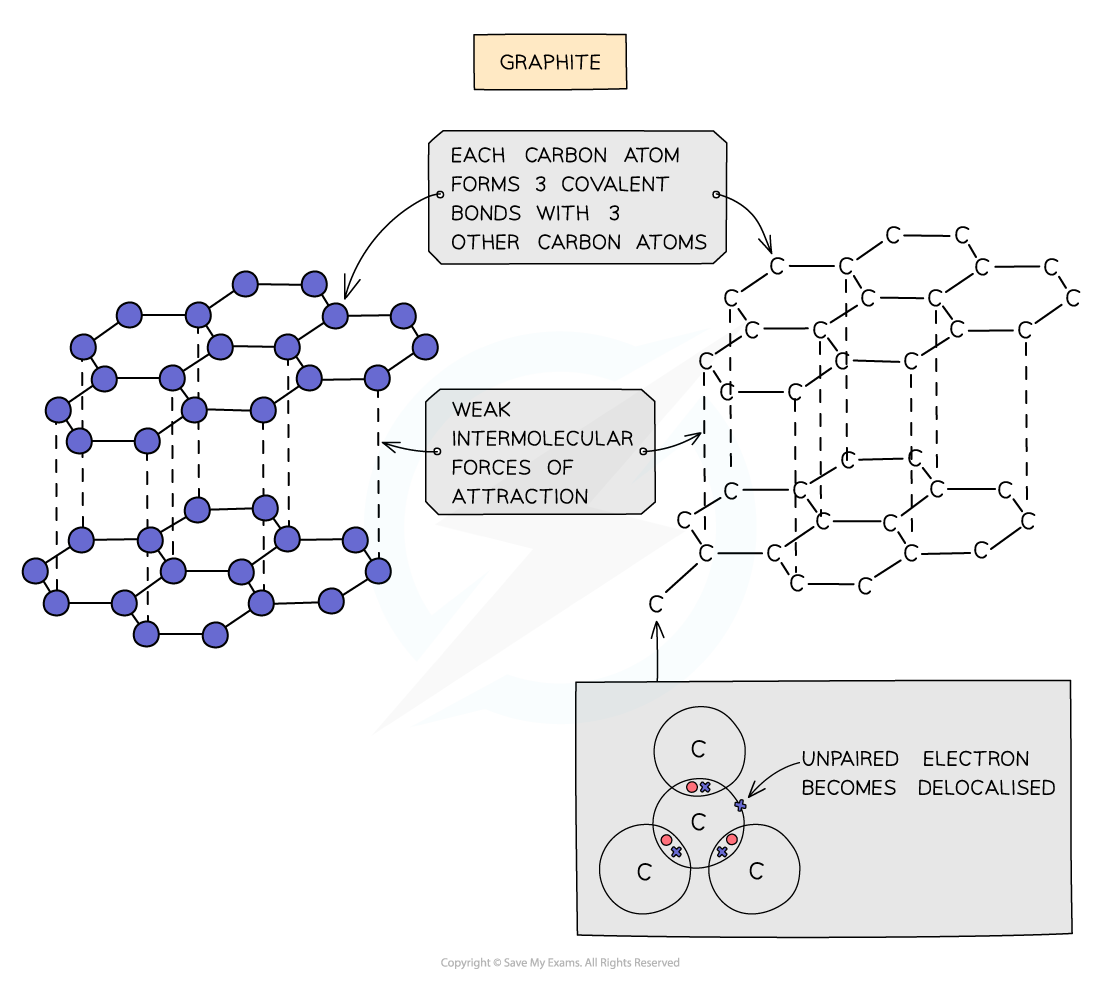
Diagram showing the structure and bonding arrangement in graphite
Diamond
- In diamond, each carbon atom bonds with four other carbons, forming a tetrahedron
- All the covalent bonds are identical, very strong and there are no intermolecular forces
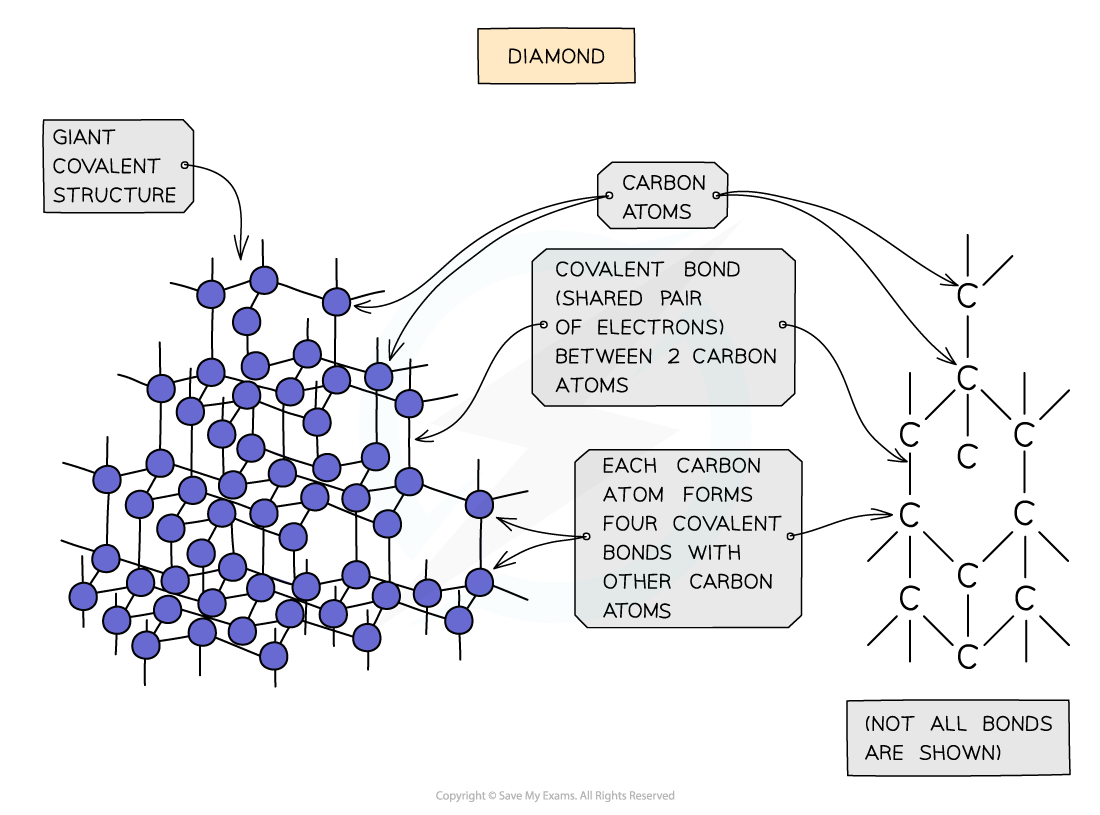
Diagram showing the structure and bonding arrangement in diamond
Graphene
- Graphene consists of a single layer of graphite which is a sheet of carbon atoms covalently bonded forming a continuous hexagonal layer
- It is essentially a 2D molecule since it is only one atom thick
- It has very unusual properties make it useful in fabricating composite materials and in electronics
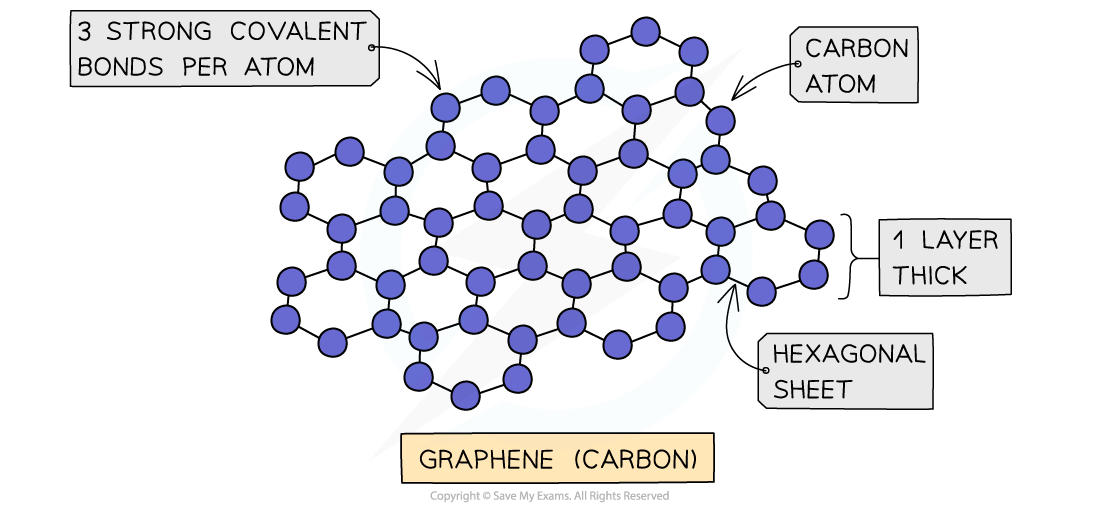
Graphene is a truly remarkable material that has some unexpected properties
Was this revision note helpful?
Build on this topic