11 markeasy
Which of these atoms has the most neutrons?
Choose your answer
14 questions · 85 marks · ≈ 1 hour · spans 9 of 72 topics
Assembled from the topic question banks — not an official Edexcel paperWhich of these atoms has the most neutrons?
Choose your answer
Geometric isomerism is shown by 2-chlorobut-2-ene.
What is the skeletal formula of E-2-chlorobut-2-ene?
(1 mark)
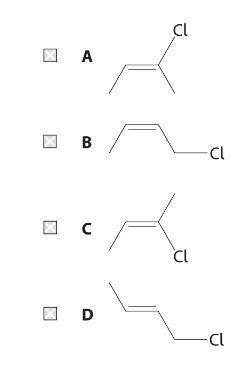
Choose your answer
What is the total number of sigma bonds in Z-2-chlorobut-2-ene?
Choose your answer
3
4
10
11
Cyclohexene may be prepared by the dehydration of cyclohexanol.
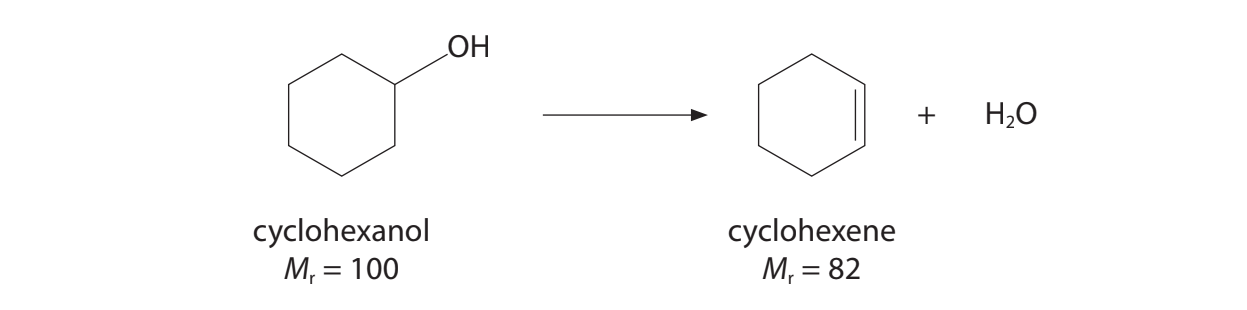
What mass of cyclohexene can be made from 12.5 g of cyclohexanol if the yield is 51.2%?
Choose your answer
5.25 g
6.40 g
7.80 g
10.25 g
Which ion has the electronic configuration 1s22s22p63s23p6 in its ground state?
Choose your answer
Al3+
Cl−
N3−
Na+
Which of these isoelectronic ions has the largest radius?
Choose your answer
Na+
Mg2+
O2−
F−
The hydrogen ion, H+, bonds to a water molecule forming an H3O+ ion.
For H3O+, what shape and H-O-H bond angle are predicted by the electron-pair repulsion theory?
Choose your answer
trigonal planar 120°
trigonal planar 117.5°
trigonal pyramidal 107°
trigonal pyramidal 104.5°
Which of these molecules can show geometric isomerism?
Choose your answer
CH2=CH2
CH2=CHCH3
(CH3)2C=CH2
CH3CH=CHCH3
Methane reacts with excess chlorine in UV light.
Which process occurs in the initiation step?
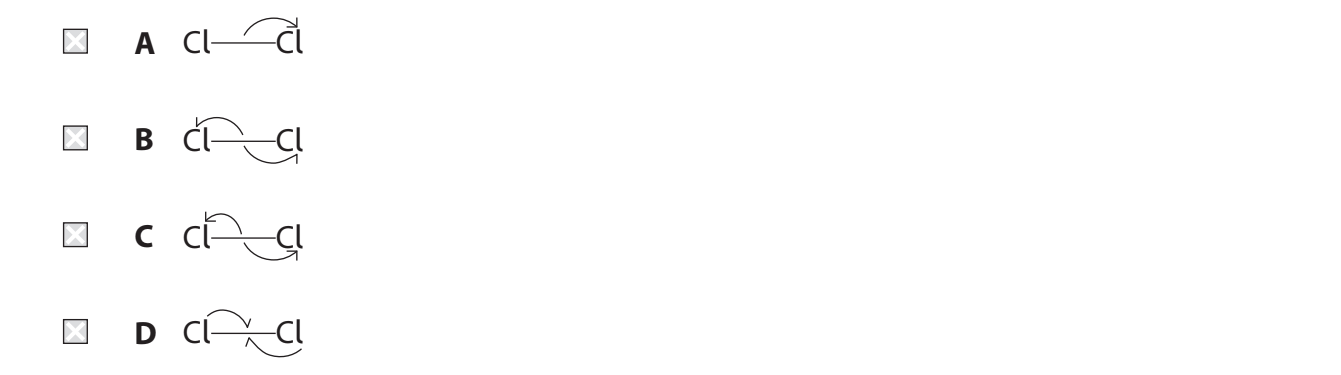
Choose your answer
Which of these molecules could not be formed in a termination step?
Choose your answer
C2H6
CH3Cl
CH2Cl2
HCl
This question is about the amount of water of crystallisation in hydrated magnesium sulfate, MgSO4 ·xH2O.
The value of x in the formula was determined in an experiment.
Procedure
| Step 1 | A crucible was weighed, a spatula measure of hydrated magnesium sulfate was added and the crucible was reweighed. |
|---|---|
| Step 2 | The crucible containing the hydrated magnesium sulfate was heated using the apparatus shown.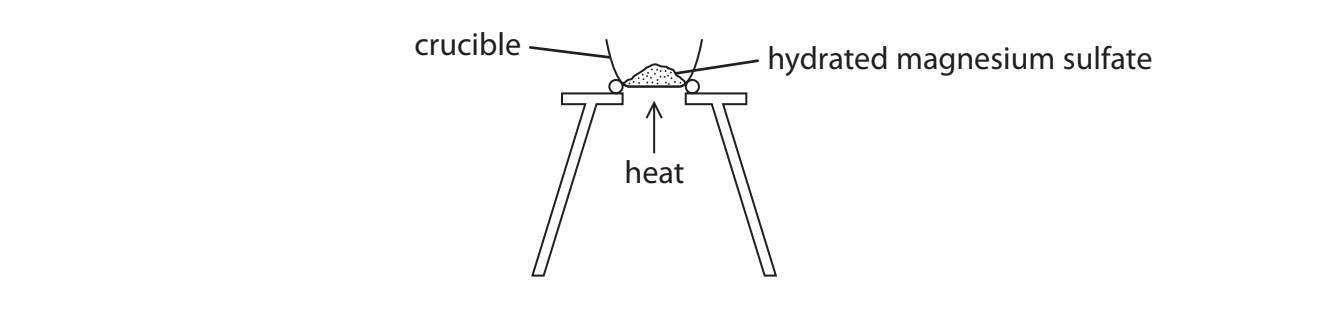 |
| Step 3 | After heating for two minutes, the crucible containing the magnesium sulfate was allowed to cool and was reweighed. |
i) Complete the table of results.
| Measurement | Mass / g |
|---|---|
| Mass of empty crucible | 21.21 |
| Mass of crucible and hydrated magnesium sulfate before heating | 26.71 |
| Mass of crucible and magnesium sulfate after heating for two minutes | 24.12 |
| Mass of magnesium sulfate after heating for two minutes | |
| Mass of water lost |
(1 mark)
ii) Use these results to calculate the value of x in MgSO4 ·xH2O.
Give your answer to the nearest whole number. [Ar values: H = 1.0 O = 16.0 Mg = 24.3 S = 32.1]
(4 marks)
The correct value of x is greater than the value calculated in (a)(ii).
Suggest a way of improving the method to obtain a more accurate result, using the same apparatus. Justify your answer.
This question is about the chemistry of alkanes and alkenes.
The compound P has the skeletal formula shown.

Give the systematic name of P.
i) Draw the displayed formula of two structural isomers of 2-methylbutane (C5H12), other than 2-methylbutane itself.
(2 marks)
ii) Pent-2-ene, CH3CH=CHCH2CH3, exhibits E/Z isomerism.
Explain why pent-2-ene exhibits E/Z isomerism.
(2 marks)
iii) Draw the displayed formulae of E-pent-2-ene and Z-pent-2-ene, clearly labelling each.
(2 marks)
When 2-methylbutane reacts with chlorine in the presence of ultraviolet (UV) light, the major product is 2-chloro-2-methylbutane, formed by free radical substitution at the tertiary carbon.
Write equations to show the mechanism for this free radical substitution. Curly arrows are not required.
Your answer must include:
(4 marks)
State one reason why this reaction has limited use for synthesising pure 2-chloro-2-methylbutane in a laboratory.
(1 mark)
Propene reacts with hydrogen bromide, HBr, via an electrophilic addition mechanism.
Give the mechanism for this reaction. Include curly arrows, and relevant lone pairs and dipoles.
Assume the major product is formed.
(4 marks)
The major product of the reaction between propene and HBr is 2-bromopropane (not 1-bromopropane).
Explain why 2-bromopropane is the major organic product.
Propene can be polymerised to form poly(propene).
i) Draw the structure of poly(propene) showing two repeat units.
(1 mark)
ii) State one environmental problem caused by the disposal of poly(propene), and one method used to reduce this problem.
(2 marks)
The hydride of arsenic, arsine, is a toxic gas used in the production of semiconductors.
Draw a dot‐and‐cross diagram for arsine, AsH3.
Arsine is a reducing agent and reacts with cerium(IV) sulfate solution, forming arsenic.
The data from an experiment are shown.
Volume of arsine gas = 350 cm3 at 115000 Pa and 20 °C
Volume of cerium(IV) sulfate solution = 488 cm3
Concentration of cerium(IV) sulfate solution = 0.102 mol dm−3
i) Complete the half‐equation.
(1 mark)
AsH3 → As
ii) Calculate the final oxidation state of the cerium ion formed in the reaction.
(6 marks)
Aluminium is an abundant metal with many uses.
The first four ionisation energies of aluminium are shown.
| Ionisation number | Energy / kJ mol−1 |
|---|---|
| 1 | 578 |
| 2 | 1820 |
| 3 | 2750 |
| 4 | 11600 |
Explain how this information shows that aluminium is in Group 3 of the Periodic Table.
The graph shows the first ionisation energies for the elements in Period 3.
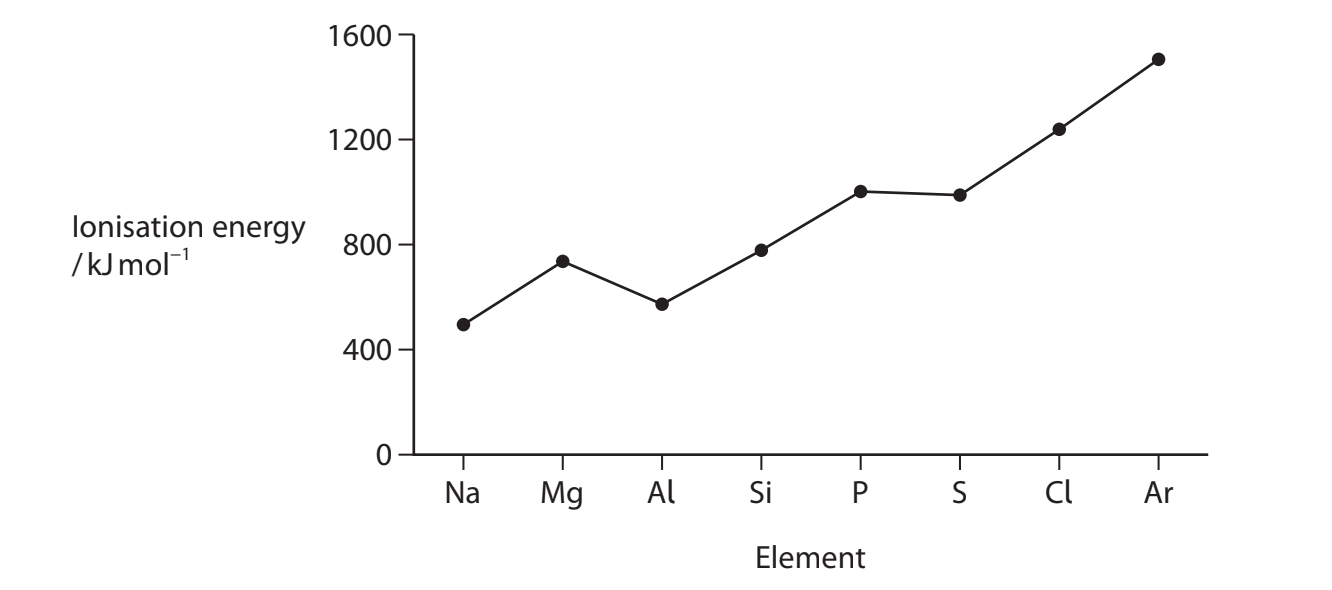
i) Explain the general increase in the first ionisation energy from sodium to argon.
(2 marks)
ii) Explain why the first ionisation energy of aluminium is less than the first ionisation energy of magnesium.
(2 marks)
i) Describe the bonding in aluminium metal.
(2 marks)
ii) Give two possible reasons why aluminium is used for overhead power cables.
(2 marks)
New uses for waste aluminium cans are being investigated. One possible use is to make nanoparticle alloys to produce hydrogen for fuel.
i) Aluminium nanoparticles react with water to produce aluminium oxide and hydrogen.
Complete the following equation. State symbols are not required.
(1 mark)
.................... Al + ............... H2O → .................. + ..................
ii) Give two possible reasons for producing hydrogen from aluminium rather than from fossil fuels.
(2 marks)
This question is about the elements in Period 3 of the Periodic Table, and some of their compounds.
The atomic radii of six of the elements are given.
| Symbol | Na | Mg | Al | Si | P | S | Cl | Ar |
|---|---|---|---|---|---|---|---|---|
| Atomic number | 11 | 12 | 13 | 14 | 15 | 16 | 17 | 18 |
| Atomic radius / nm | 0.191 | 0.160 | 0.130 | 0.102 | 0.099 | 0.095 |
i) Plot a graph of atomic radius against atomic number.
(2 marks)

ii) Use the graph to estimate the atomic radius of silicon, Si.
(1 mark)
iii) Suggest an explanation for the decrease in atomic radius as atomic number increases across a period.
(3 marks)
The melting temperatures of sodium, sodium chloride and chlorine are given in the table.
Complete the table to show the type of structure, the type of bond or force broken on melting and the particles involved.
| Substance | Sodium | Sodium chloride | Chlorine |
|---|---|---|---|
| Melting temperature / °C | 98 | 801 | −101 |
| Type of structure | giant | simple molecular | |
| Type of bond or force broken on melting | |||
| Particles involved | chlorine molecules |
Solid phosphorus(V) chloride contains PCl4+ ions.
i) Draw a dot-and-cross diagram of a PCl4+ ion.
Show only outer shell electrons.
(1 mark)
ii) Predict the shape of a PCl4+ ion.
Justify your answer.
(3 marks)
Shape
............................................................................................
Justification
This question is about the structure and bonding of Group 5 chlorides.
Nitrogen trichloride, NCl3, has a molecular structure.
The displayed formula of a molecule of NCl3 is shown.

Complete the table for this molecule.
| Number of bond pairs around N atom | |
|---|---|
| Number of lone pairs around N atom | |
| Cl-N-Cl bond angle | |
| Name of shape of molecule |
Under standard conditions, phosphorus(V) chloride (PCl5) is a solid made up of PC cations and PC anions.
Antimony(V) chloride (SbCl5) is a liquid made up of SbCl5 molecules.
i) Explain why PCl5 has a higher melting temperature than SbCl5.
(2 marks)
ii) Draw a dot-and-cross diagram to show the bonding in a molecule of SbCl5. Use dots (•) to represent the Sb electrons, and crosses (x) to represent the Cl electrons. Show outer electrons only.
(2 marks)
At low temperatures, SbCl5 converts to Sb2Cl10 which contains dative covalent bonds.
i) State what is meant by the term dative covalent bond.
(1 mark)
ii) Complete the diagram to show the dative covalent bonds in Sb2Cl10 .
(1 mark)
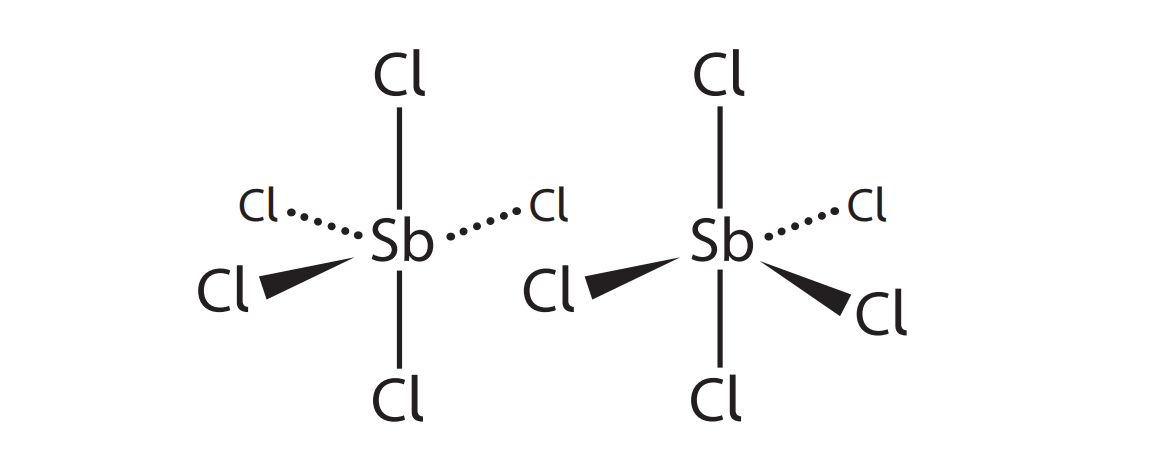
Arsenic also forms a pentachloride with the formula AsCl5.
Give one possible reason why nitrogen is the only Group 5 element that does not form a pentachloride.