11 markmedium
An oxide of lead contains 90.7% by mass of lead.
What is the formula of this oxide?
[Ar values: O = 16.0 Pb = 207.2]
Choose your answer
PbO
PbO2
Pb2O3
Pb3O4
15 questions · 72 marks · ≈ 72 min · spans 10 of 72 topics
Assembled from the topic question banks — not an official Edexcel paperAn oxide of lead contains 90.7% by mass of lead.
What is the formula of this oxide?
[Ar values: O = 16.0 Pb = 207.2]
Choose your answer
PbO
PbO2
Pb2O3
Pb3O4
The repeat unit of an addition polymer is shown.

What is the monomer used to make this polymer?
Choose your answer
CF2=CF2
CF3–CF3
CH2=CF2
CHF=CHF
10.00 g of hydrated magnesium sulfate, MgSO4•7H2O, is heated to remove the water of crystallisation.
What mass of anhydrous magnesium sulfate, MgSO4, is formed?
[Molar mass of MgSO4•7H2O = 246.4 g mol−1 ]
Choose your answer
2.84 g
4.89 g
5.11 g
7.16 g
How many protons, neutrons and electrons are present in a 81Br- ion?
| Protons | Neutrons | Electrons | |
|---|---|---|---|
| A | 35 | 81 | 36 |
| B | 35 | 46 | 36 |
| C | 36 | 45 | 35 |
| D | 35 | 46 | 35 |
Choose your answer
Several factors may affect ionisation energies:
I) the number of protons increases
II) the outer electron is further from the nucleus
III) the amount of shielding increases
IV) the number of unpaired outer electrons increases
Which factors explain the decrease in ionisation energy as Group 1 is descended?
Choose your answer
I and II
II and III
III and IV
I, II, III and IV
The Period 2 element with the highest melting temperature is
Choose your answer
aluminium
boron
carbon
silicon
What is the formula of magnesium nitride?
Choose your answer
MgN
MgN2
Mg2N3
Mg3N2
Which of these molecules is the most polar?
Choose your answer
HF
OF2
BF3
CF4
The displayed formula of a compound is shown.

Which functional group is present in the compound shown?
Choose your answer
Aldehyde
Ketone
Carboxylic acid
Ester
A single molecule of decane, C10H22 , is cracked.
Which of these mixtures could not be formed?
Choose your answer
pentene and pentane
ethene, butene and butane
propene, propane and butene
hexene and propane
An organic compound, X, contains only the elements carbon and hydrogen.
When 0.560 g of X is completely combusted in excess oxygen, 1.760 g of carbon dioxide and 0.720 g of water are produced.
Calculate the empirical formula of X. You must show all your working.
The relative molecular mass, Mr, of X is 56.
Deduce the molecular formula of X.
When X is added to bromine water, the orange colour decolourises.
i) Name the functional group in X responsible for this reaction.
(1 mark)
ii) Given that X has the C=C double bond at the end of the carbon chain, draw the displayed formula of X.
(1 mark)
Compound X has other structural isomers with molecular formula C4H8.
Draw the displayed formulae of two other structural isomers of C4H8 (other than X), and give the systematic name of each.
(4 marks)
Alkanes and alkenes are obtained from crude oil.
Describe how a sample of octadecane can be obtained from a mixture of alkanes.
i) Octadecane can be cracked to produce butene and one other product. Complete the equation. State symbols are not required.
C18H38 → 2C4H8 +
(1 mark)
ii) One of the products of this cracking reaction is but-1-ene.
Give the skeletal formulae for the other three alkene isomers of C4H8
(2 marks)
iii) Some reactions of but-1-ene are shown.
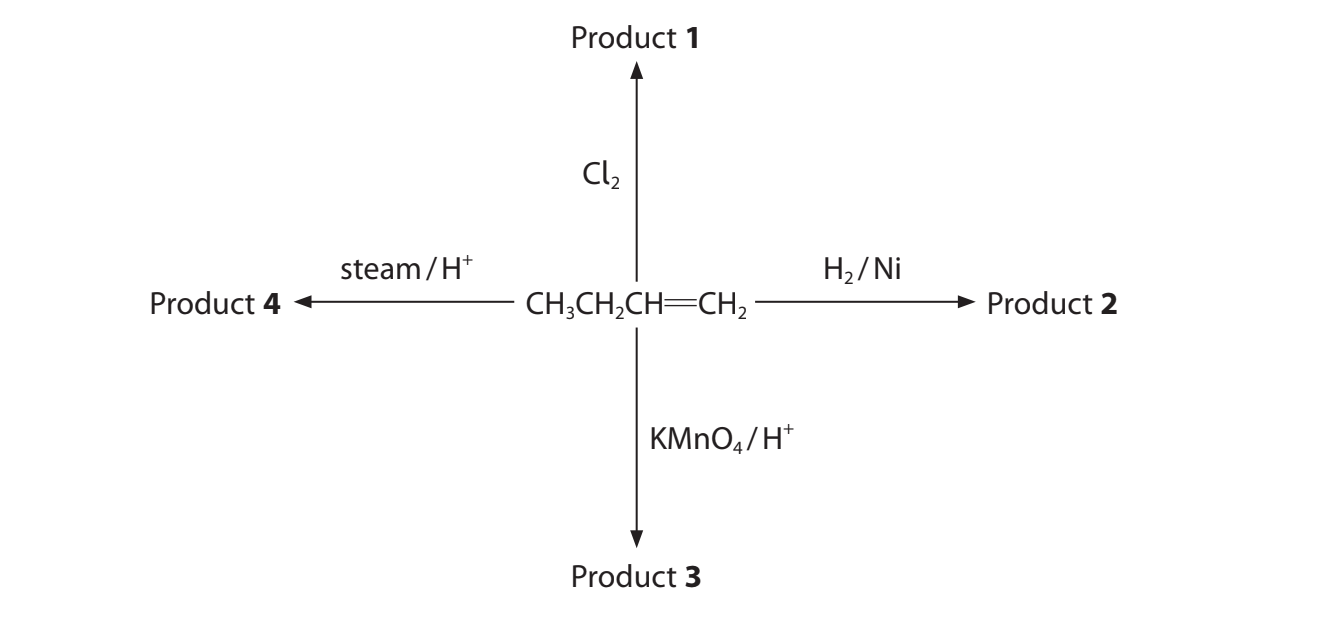
Give the name and structural formula of each of the products.
(4 marks)
| Product | Name | Structural formula |
|---|---|---|
| 1 | ||
| 2 | ||
| 3 | ||
| 4 |
Draw the displayed formula of poly(but-1-ene) showing two repeat units.
State one advantage and one disadvantage of using incineration for the disposal of polymers, other than the effect on climate.
i) Butane is used as a fuel.
The equation for the complete combustion of butane is shown.
2C4H10(g) + 13O2(g) → 8CO2(g) + 10H2O(l)
35.0 cm3 butane is completely burned in 300 cm3 oxygen.
Calculate the final total volume of gas in cm3.
All volumes are measured at the same temperature and pressure.
(3 marks)
ii) Explain the main hazard when using butane as a fuel in a portable heater in an enclosed space.
(2 marks)
A 0.210 g sample of a volatile organic liquid C is injected into a gas syringe and heated in an oven. At 100 kPa and 358 K, the syringe contains 72.5 cm3 of gas.
Calculate the molar mass of C. [pV = nRT R = 8.31 J mol−1 K−1 ]
The organic liquid C is a hydrocarbon. Give a possible name or formula for C, using your answer in (a).
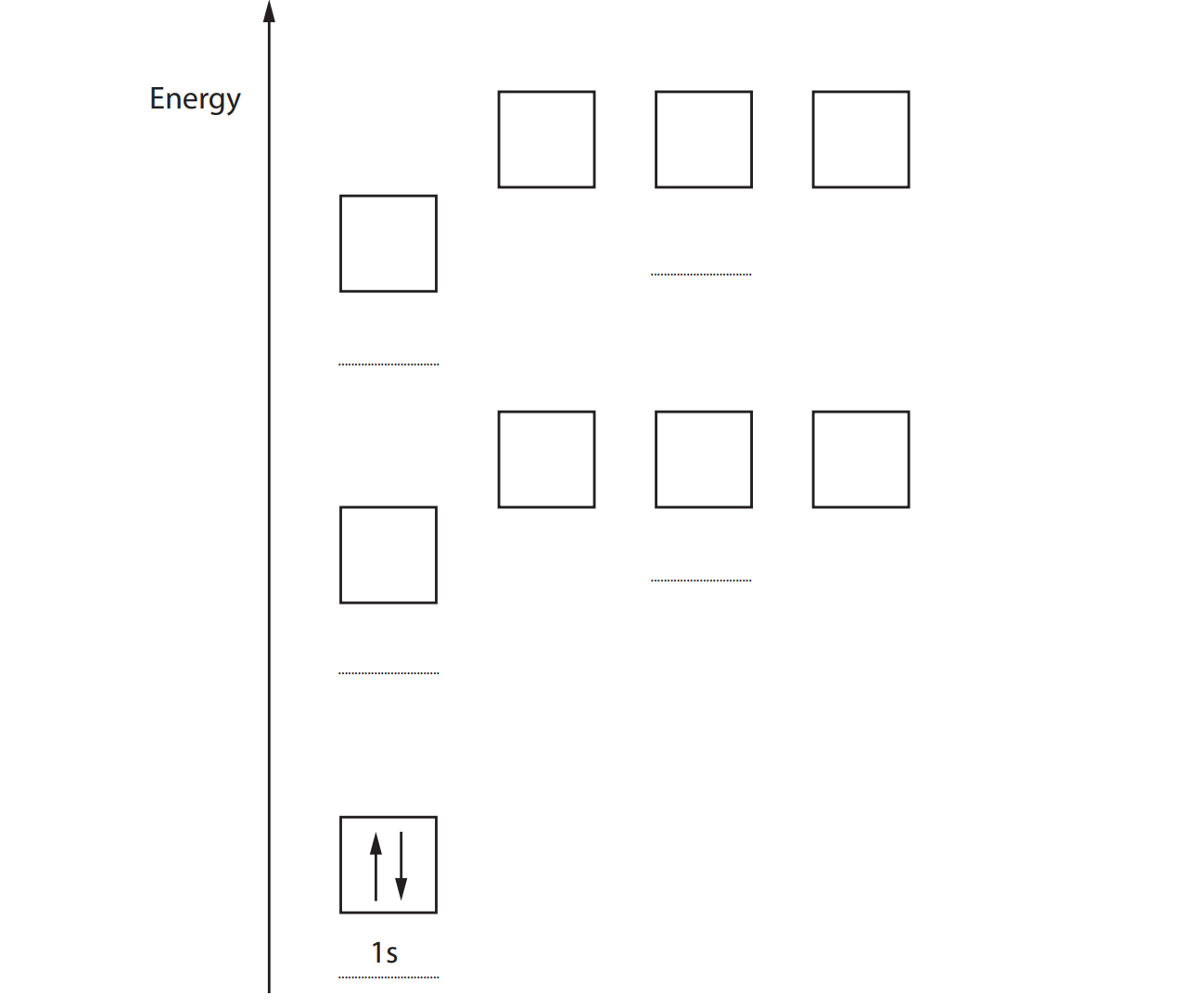
This question is about the element sulfur.
Complete the diagram to show the electronic configuration for a sulfur atom in the ground state. Include labels for each subshell.
Write an equation for the first ionisation energy of sulfur. Include state symbols.
Explain why the first ionisation energy of sulfur is less than the first ionisation energies of both phosphorus and chlorine.
A sample of sulfur contains four isotopes.
| Isotope | 32S | 33S | 34S | 36S |
|---|---|---|---|---|
| Percentage abundance | 94.88 | 0.83 | 4.27 | 0.02 |
i) State what is meant by the term isotopes, in terms of subatomic particles.
(2 marks)
ii) Calculate the relative atomic mass of sulfur in this sample. Give your answer to two decimal places.
(2 marks)
The mass spectrum of a sample of sulfur with 32S as the only isotope is shown.
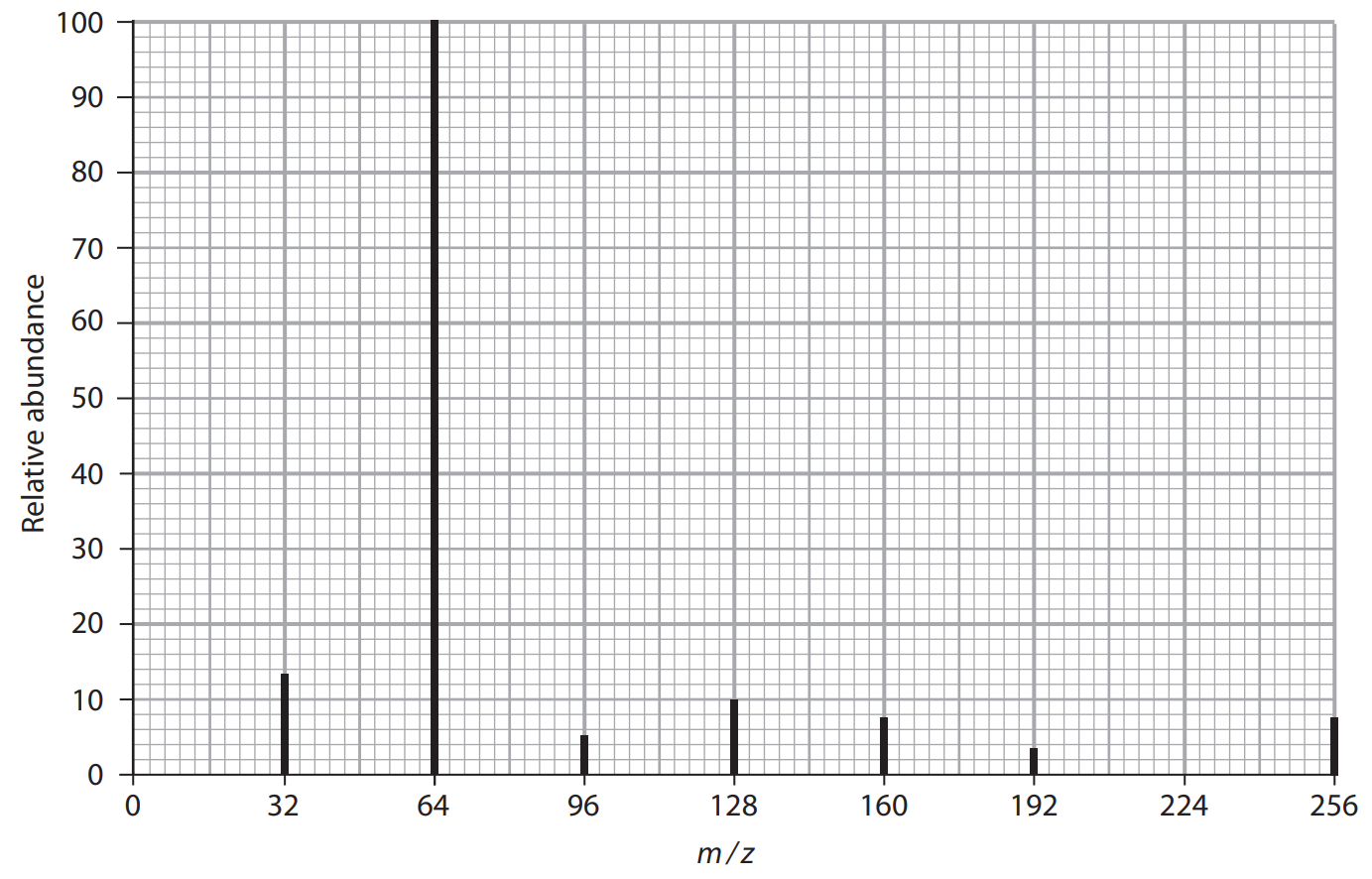
i) Calculate the number of sulfur atoms in the molecular ion. You must show your working.
(1 mark)
ii) Suggest the formula of the most stable ion shown by this spectrum.
(2 marks)
This question is about copper and its compounds.
Complete the electronic configurations of Cu and Cu2+.
Cu [Ar].....................................................................................................
Cu2+ [Ar].....................................................................................................
A sample of copper contains the isotopes 63Cu and 65Cu.
i) Complete the table to show the numbers of subatomic particles in the atoms of these two isotopes of copper.
(2 marks)
| Isotope | Protons | Neutrons | Electrons |
|---|---|---|---|
| 63Cu | |||
| 65Cu |
ii) Explain the term isotopes, using the information in the table.
(2 marks)
iii) State why the two isotopes of copper have the same chemical reactions.
(1 mark)
iv) The relative atomic mass of copper in this sample is 63.4. Calculate the percentage abundances of the isotopes 63Cu and 65Cu in this sample. You must show your working.
(2 marks)
Copper(II) sulfate, CuSO4, can be made by reacting solid copper(II) carbonate with dilute sulfuric acid.
i) Write an equation for the reaction that occurs. State symbols are not required.
(1 mark)
ii) An experiment was carried out to produce pure, dry crystals of hydrated copper(II) sulfate, CuSO4 •5H2O. Copper(II) carbonate was mixed with 50.0 cm3 of 1.00 mol dm–3 sulfuric acid until no more reacted. The mass of CuSO4 •5H2O obtained was 10.87g.
Calculate the percentage yield for this reaction, giving your answer to an appropriate number of significant figures. [Molar mass of CuSO4 •5H2O = 249.6 g mol−1 ]
(4 marks)