11 markeasy
What is the electronic configuration of a chromium atom?
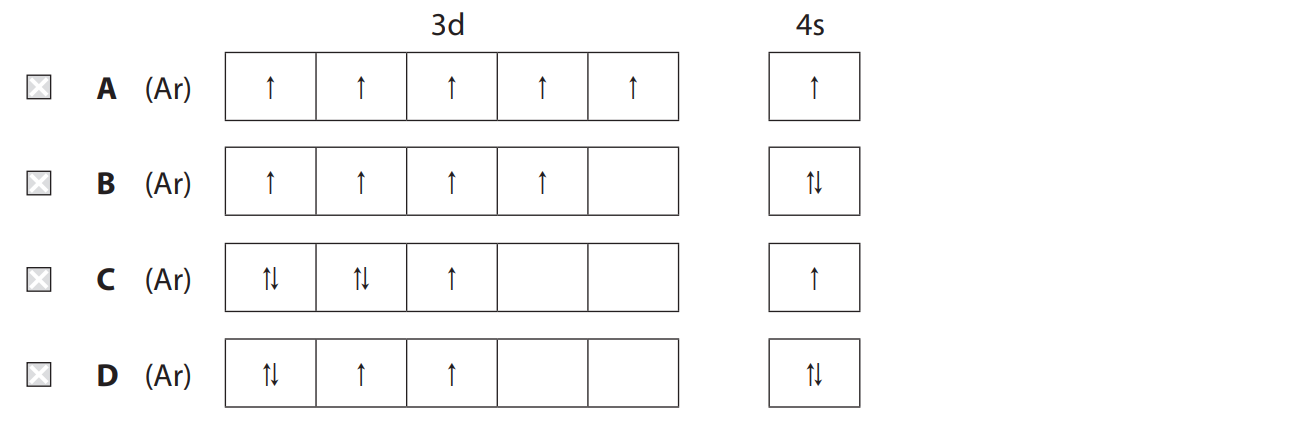
Choose your answer
18 questions · 21 marks · ≈ 21 min
What is the electronic configuration of a chromium atom?
Choose your answer
A ligand must be an
Choose your answer
electron-pair donor
electron-pair donor and negatively charged
electron-pair acceptor
electron-pair acceptor and negatively charged
Nickel is classified as a transition metal. This is because nickel
Choose your answer
is a d block element
has partially filled d orbitals
forms stable ions with partially filled d orbitals
forms stable compounds in which it has different oxidation states
Cobalt chloride is used as a test for the presence of water.
This test depends on the fact that
Choose your answer
anhydrous cobalt(II) chloride is blue and hydrated cobalt(II) chloride is pink
anhydrous cobalt(II) chloride is pink and hydrated cobalt(II) chloride is blue
cobalt(II) chloride is blue and cobalt(III) chloride is pink
cobalt(II) chloride is pink and cobalt(III) chloride is blue
What is the oxidation state of platinum in the complex ion [PtCl4]2-?
Choose your answer
−2
+2
+4
+6
What is the coordination number of the nickel(II) ion in the complex [Ni(EDTA)]2-?
Choose your answer
1
2
4
6
Which of the following aqueous ions appears colourless in solution?
Choose your answer
[Cu(H2O)6]2+
[Fe(H2O)6]2+
[Fe(H2O)6]3+
[Zn(H2O)6]2+
This question is about transition metal complexes.
The bonding within the complex [Cu(NH3)4(H2O)2]2+ is
Choose your answer
covalent, dative covalent and ionic
covalent and dative covalent only
covalent only
dative covalent only
Which complex is tetrahedral?
Choose your answer
[Pt(NH3)2Cl2]
[Cu(H2O)4(OH)2]
[Cu(NH3)4(H2O)2]2+
[CoCl4]2−
Which complex contains a bidentate ligand?
Choose your answer
[Co(NH2CH2CH2NHCH2CH2NH2)2]3+
[Cu(NH3)4(H2O)2]2+
[Ni(NH2CH2CH2NH2)3]2+
[Mn(EDTA)]2−
In which of the following pairs does the metal have different oxidation numbers?
Choose your answer
V2O5 and
and VO2+
Which of the following statements best explains carbon monoxide poisoning?
Choose your answer
carbon monoxide binds irreversibly to haemoglobin
carbon monoxide forms stronger dative covalent bonds with haemoglobin than oxygen does
the formation of carboxyhaemoglobin leads to a large increase in the entropy of the system
carbon monoxide has a triple bond whereas oxygen has a double bond
Diamminecopper(I) ions are not coloured because
Choose your answer
the d orbitals in copper(I) cannot be split
the energy difference between the split d orbitals is outside the visible region of the spectrum
d—d transitions are not possible because the d orbitals are fully occupied
copper(I) complexes are readily oxidised
Which of these has the greatest number of unpaired electrons in each of its atoms?
Choose your answer
chromium
iron
manganese
vanadium
Copper(II) ions form a complex with 1,2-diaminoethane (symbol ‘en’) with the formula Cu(en)3 2+.
What type of ligand is 1,2-diaminoethane, and what is the coordination number of copper(II) in the complex?
| Type of ligand | Coordination number | ||
|---|---|---|---|
| □ | A | bidentate | 3 |
| □ | B | bidentate | 6 |
| □ | C | tridentate | 3 |
| □ | D | tridentate | 6 |
Choose your answer
Some nickel(II) complex ions are formed by the addition of complexing agents to nickel(II) ions, [Ni(H2O)6]2+, in aqueous solution.
On formation, which of these leads to the most positive increase in ΔSsystem?
Choose your answer
[NiCl4]2–
[Ni(EDTA)]2–
[Ni(C2O4)2 ]2–
[Ni(H2NCH2CH2NH2)3]2+
Platinum forms a complex with the formula Pt(NH3)2Cl2 and chromium forms a complex with the formula CrCl4–.
What are the shapes of these complexes?
Choose your answer
both complexes are square planar
both complexes are tetrahedral
Pt(NH3)2Cl2 is tetrahedral and CrCl4– is square planar
Pt(NH3)2Cl2 is square planar and CrCl4– is tetrahedral
What is the bonding between the ligands and the central atom in these complexes?
Choose your answer
the bonding in both complexes is ionic
the bonding in both complexes is dative covalent
the bonding in Pt(NH3)2Cl2 is dative covalent and in CrCl4– is ionic
the bonding in Pt(NH3)2Cl2 is ionic and in CrCl4– is dative covalent
Which of these gives the correct electronic configuration of the Cu+ ion?
Choose your answer
[Ar] 3d8 4s2
[Ar] 3d9 4s1
[Ar] 3d10
[Ar] 3d10 4s1
The element zinc is not classified as a transition metal. This is because
Choose your answer
zinc only forms one stable ion
the 3d subshell of a zinc atom is full
neither zinc nor zinc ions show catalytic properties
the only stable zinc ion has the electronic configuration [Ar]3d10
Which of the following transition metal complexes has a square planar shape?
Choose your answer
[Ag(NH3)2]+
[CuCl4]2-
[Cu(NH3)4(H2O)2]2+
[Pt(NH3)2Cl2]