Anaerobic Respiration (Edexcel IAL Biology)
Spec point —
7.5
Anaerobic Respiration
-
Sometimes cells experience conditions with little or no oxygen
-
There are several consequences when there is not enough oxygen available for respiration:
- There is no final acceptor (oxygen)of electrons from the electron transport chain
- The electron transport chain stops functioning
- No more ATP is produced via oxidative phosphorylation
- Reduced NAD and FAD aren’t oxidised by an electron carrier
- No oxidised NAD and FAD are available for dehydrogenation in the Krebs cycle
- The Krebs cycle stops
- The link reaction also stops
-
However, there is still a way for cells to produce some ATP in low oxygen conditions through anaerobic respiration
Anaerobic pathways
-
Some cells are able to oxidise the reduced NAD produced during glycolysis so it can be used for further hydrogen transport
-
This means that glycolysis can continue and small amounts of ATP are still produced
-
Different cells use different pathways to achieve this
- Yeast and microorganisms use ethanol fermentation
- Other microorganisms and mammalian muscle cells use lactate fermentation
Lactate fermentation
- In this pathway reduced NAD transfers hydrogen to pyruvate to form lactate
- NAD can now be reused in glycolysis
- Pyruvate is reduced to lactate by enzyme lactate dehydrogenase
- Pyruvate is the hydrogen acceptor
- The final product lactate can be further metabolised
- A small amount of ATP is produced
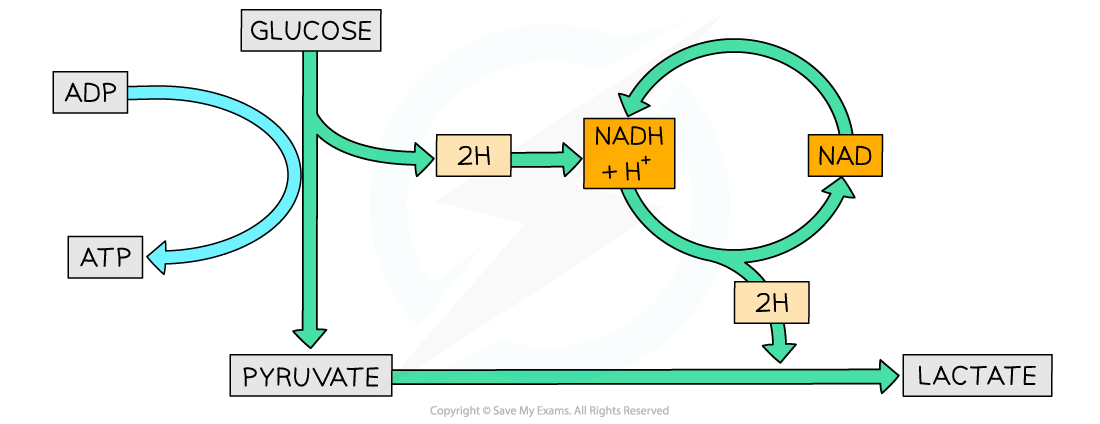
The pathway of lactate fermentation
Processing Lactate
-
Lactate (lactic acid) can build up in the cells after a period of time
-
After lactate is produced two things can happen:
- It can be oxidised back to pyruvate which is then channelled into the Krebs cycle for ATP production
- It can be converted into glucose by the liver cells for use during respiration or for storage (in the form of glycogen)
-
The oxidation of lactate back to pyruvate needs extra oxygen
- This extra oxygen is referred to as an oxygen debt
- It explains why animals breathe deeper and faster after exercise
Ethanol fermentation
-
In this pathway reduced NAD transfers its hydrogens to ethanal to form ethanol
-
In the first step of the pathway pyruvate is decarboxylated to ethanal
- Producing CO2
-
Then ethanal is reduced to ethanol by the enzyme alcohol dehydrogenase
-
Ethanal is the hydrogen acceptor
-
Ethanol cannot be further metabolised; it is a waste product
-
Ethanol fermentation occurs in yeast and plant cells
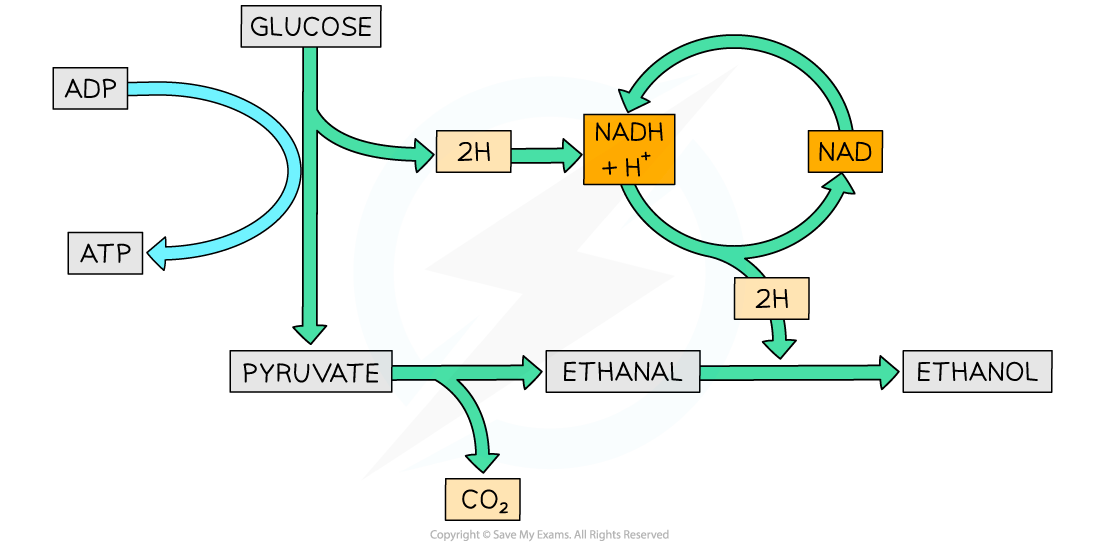
The pathway of ethanol fermentation
Exam Hint Note that ethanol fermentation is a two-step process (lactate fermentation is a one-step process). Carbon dioxide is also produced alongside the waste ethanol. This waste ethanol is what makes yeast vital in producing alcoholic drinks like beer!
Was this revision note helpful?