Saccharides (Edexcel IAL Biology)
Types of Saccharide
Spec point —
1.2
-
Carbohydrates are one of the main carbon-based compounds in living organisms
-
All molecules in this group contain C,H and O
-
Carbon atoms are key to the structure of organic compounds because
-
Each carbon atom can form covalent bonds; this makes the compounds very stable
- Covalent bonds are so strong they require a large input of energy to break them
-
Carbon atoms can form covalent bonds with oxygen, nitrogen and sulfur
-
Carbon atoms can bond to form straight chains, branched chains, or rings
-
-
-
Carbon compounds can form small, single subunits, or monomers, that bond with many repeating subunits to form large molecules, or polymers
- This is a process called polymerisation
-
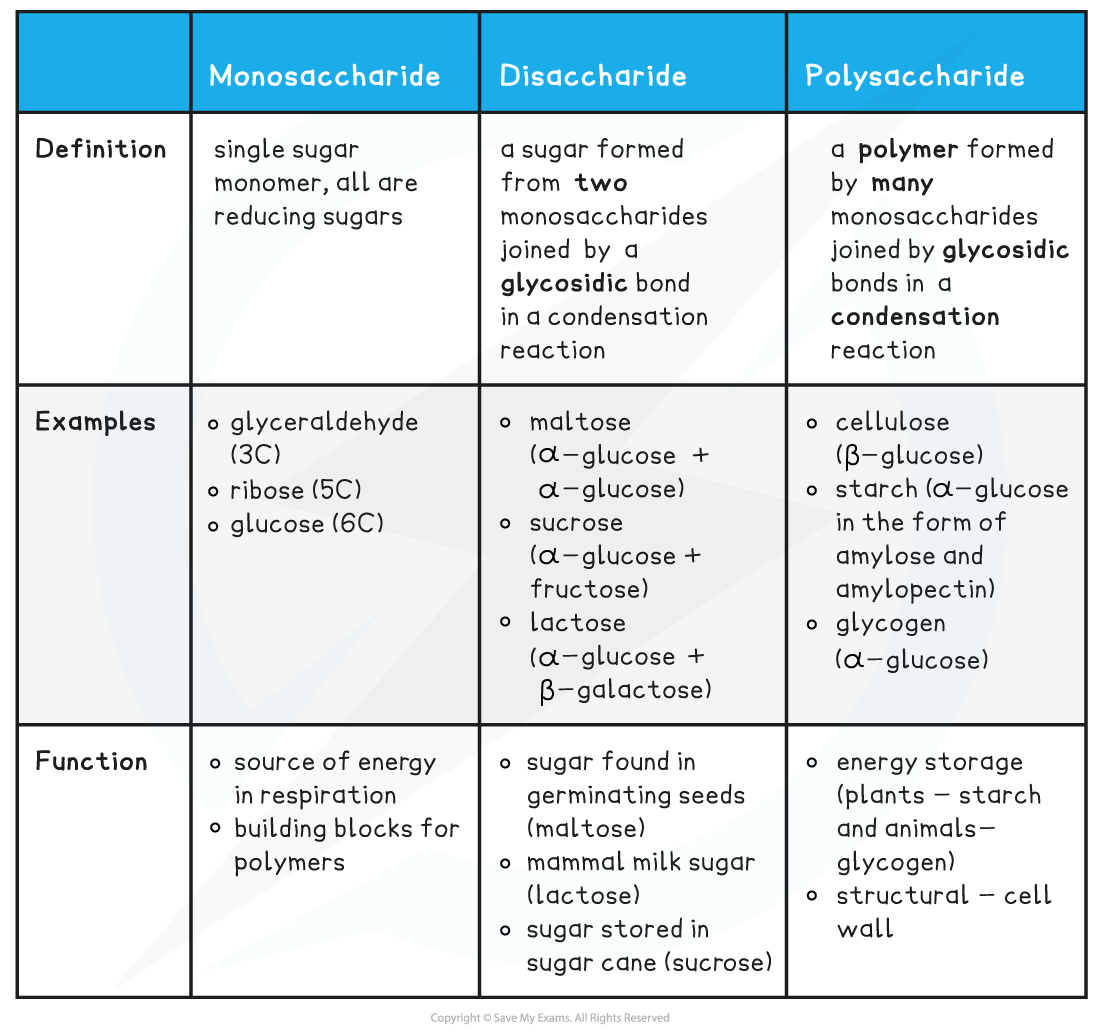
The three types of carbohydrates are:
-
monosaccharides
- The monomers of carbohydrates; they can join together to make carbohydrate polymers
- Monosaccharides are simple carbohydrates
- Monosaccharides are sugars, e.g. triose (3C) sugars, pentose (5C) sugars and hexose (6C) sugars
-
disaccharides
- Two monosaccharides can join together via condensation reactions to form disaccharides
- Examples include lactose and maltose
-
polysaccharides
- Polysaccharides are carbohydrate polymers; repeated chains of many monosaccharides
- Starch (including amylose and amylopectin), glycogen, and cellulose are examples of polysaccharides
-
Exam Hint Although cellulose is an important polysaccharide you do not need to know about it in this topic.
Saccharide Structure & Function
Spec point —
1.2
Monosaccharides
Monosaccharide structure
-
Glucose is a well known example of a monosaccharide
-
Glucose is a hexose sugar
-
The six carbons that make up glucose form a ring structure
- Carbons 1-5 form a ring, while carbon 6 sticks out above the ring
-
-
Glucose comes in two forms; alpha () and beta()
-
The forms of glucose are almost identical; they differ only in the location of the H and OH groups attached to carbon 1
-
Alpha glucose has the H above carbon 1 and the OH group below
- Remember = alpha has the H above
-
Beta glucose has the H below carbon 1 and the OH group above
- Remember = beta has the H below
-
-

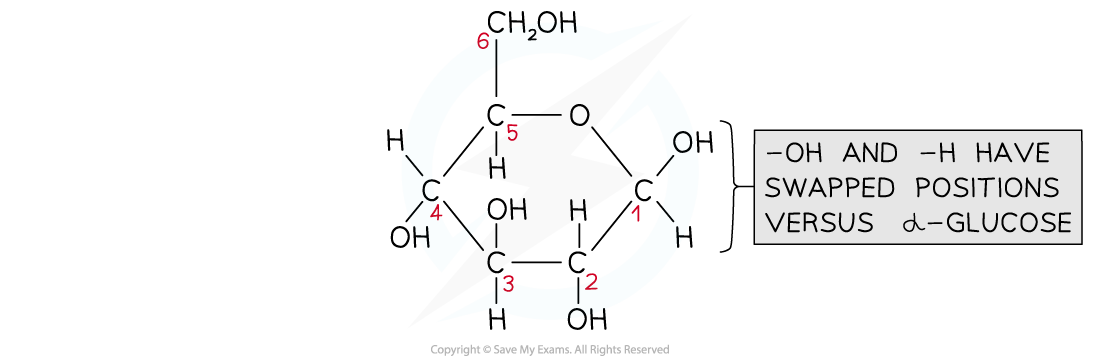
Alpha glucose (top) has the hydrogen above carbon 1 and the OH group below, while beta glucose (bottom) has the hydrogen below carbon 1 and the OH group above
Monosaccharide function
-
The main function of monosaccharides is to store energy within their bonds
- When the bonds are broken during respiration, energy is released
-
The structure of glucose is related to its function as the main energy store for animals and plants
- It is soluble so can be transported easily
- It has many covalent bonds which store energy
-
Monosaccharides can combine through condensation reactions to form larger carbohydrates
-
Some monosaccharides are used to form long, structural fibres, which can function as cellular support in some cell types
Disaccharides
Disaccharide structure
-
Common examples of disaccharides include
-
Maltose
- Contains two molecules of glucose linked by a 1,4 glycosidic bond
- This means that the glycosidic bond is located between carbon 1 of one monosaccharide and carbon 4 of the other
-
Sucrose
- Contains a molecule of glucose and a molecule of fructose linked by a 1,2 glycosidic bond
- This means that the glycosidic bond is located between carbon 1 of one monosaccharide and carbon 2 of the other
-
Lactose
- Contains a molecule of glucose and a molecule of galactose linked by a 1,4 glycosidic bond
-
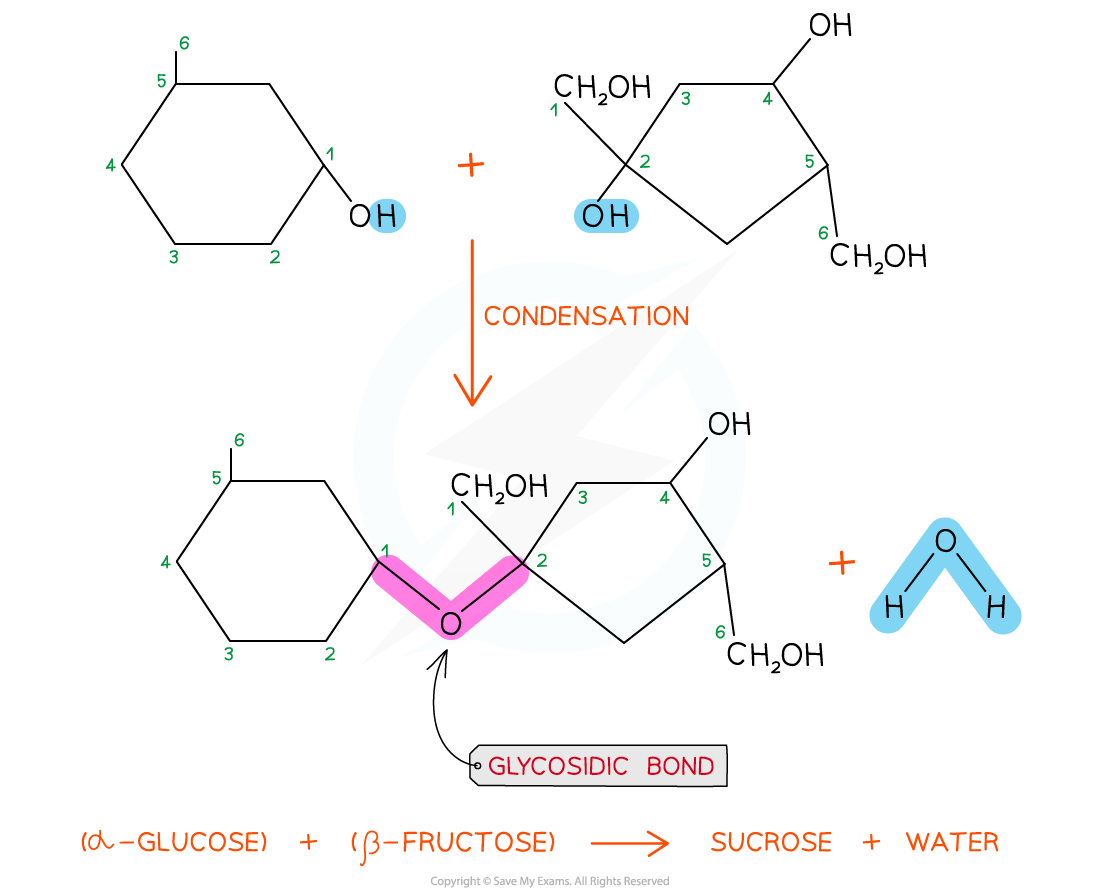
Sucrose is a disaccharide formed from a molecule of glucose (left) and a molecule of fructose (right) joined together by a 1,2 glycosidic bond
Disaccharide function
-
The function of disaccharides is to provide the body with a quick-release source of energy
- Disaccharides are made up of two sugar molecules so they're easily broken down by enzymes in the digestive system into their respective monosaccharides and then absorbed into the bloodstream
-
Due to the presence of a large number of hydroxyl groups, disaccharides are easily soluble in water
- These hydroxyl groups form hydrogen bonds with the water molecules when dissolved in aqueous solutions
-
Just like monosaccharides they are sweet in taste
- Sucrose, also known as table sugar, is an example
Polysaccharides
Starch: structure
-
Starch is constructed from two different polysaccharides
-
Amylose
-
Unbranched helix-shaped chain with 1,4 glycosidic bonds between α-glucose molecules
- A helix is a spiral shape
-
The helix shape enables it to be more compact and thus more can be stored
-
-
Amylopectin
- A branched molecule containing 1,4 glycosidic bonds between α-glucose molecules and 1,6 glycosidic bonds
- The branches result in many terminal glucose molecules that can be easily hydrolysed for use during cellular respiration or added to for storage
-
-
Both forms of starch are insoluble, so they do not dissolve and won't alter the water potential of cells
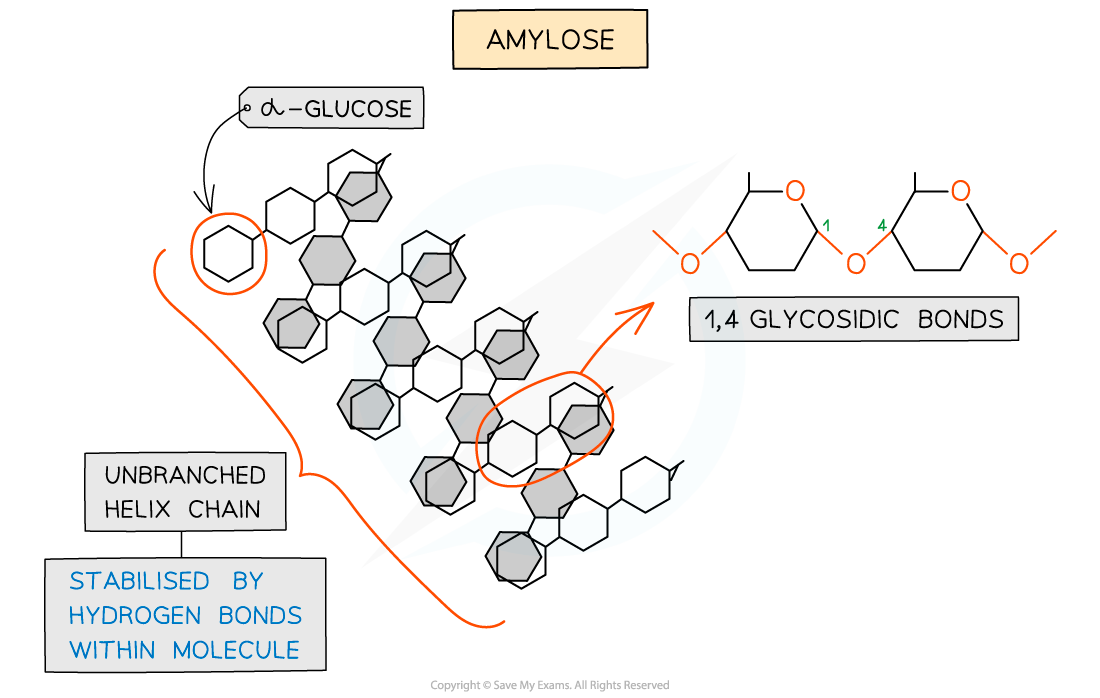
Amylose is a helix-shaped polysaccharide found in starch, the storage polysaccharide in plants
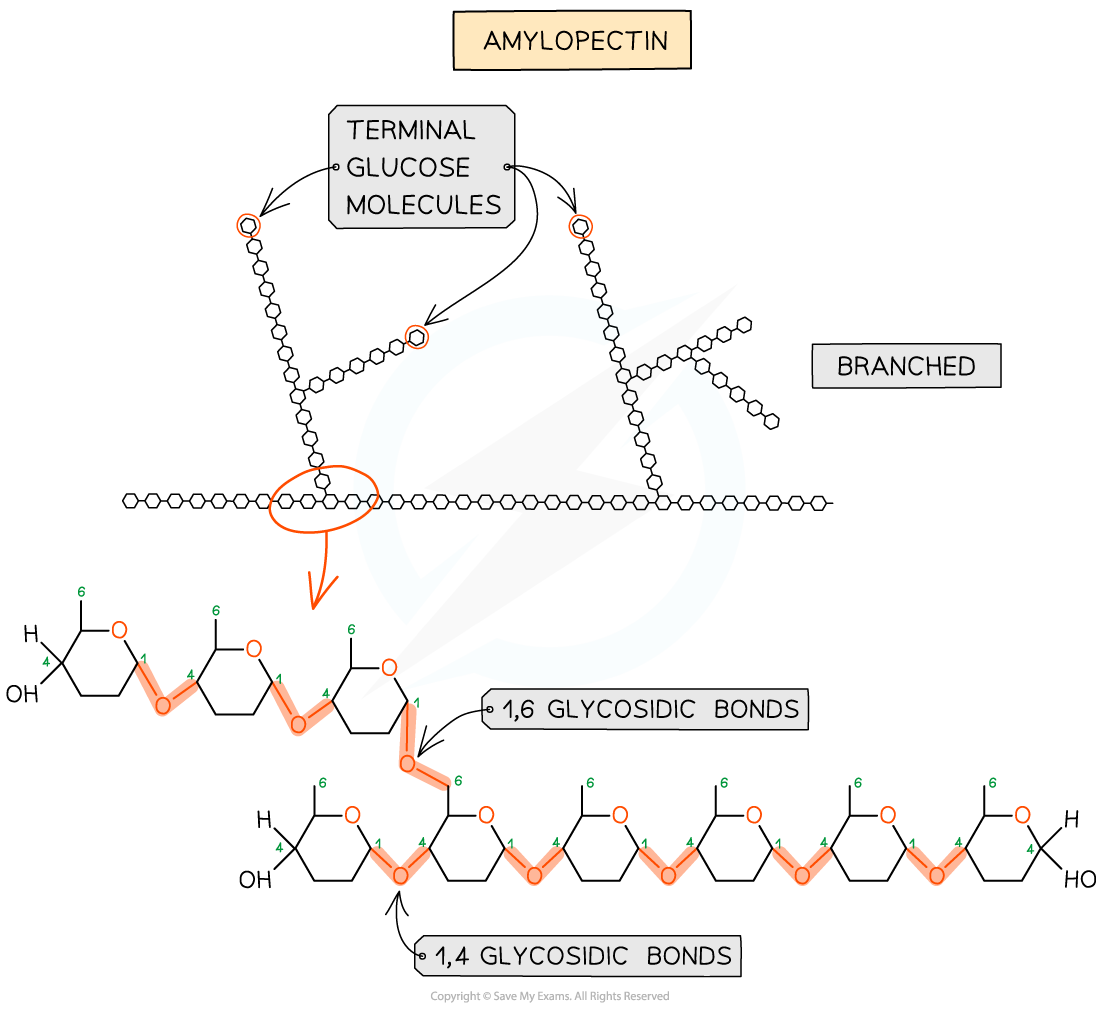
Amylopectin is a branched polysaccharide found in starch
Starch: function
-
Starch is the storage polysaccharide of plants; it is stored as granules in plastids
-
Plastids are membrane-bound organelles that can be found in plant cells
- They have a specialised function, e.g. amyloplasts store starch grains and chloroplasts carry out photosynthesis
-
-
The amylose in starch has a helical structure which makes it very compact, meaning that much can be stored in a small space
-
The amylopectin in starch has branches that provide many terminal glucose molecules that can be easily hydrolysed for use during cellular respiration or added for storage
Glycogen: structure
-
Glycogen contains both 1,4 and 1,6 glycosidic bonds
-
Glycogen is more branched than amylopectin
-
The branching provides more terminal glucose molecules which can either be added to or removed by hydrolysis; this allows the quick storage or release of glucose to suit the demands of the cell
- This is essential in animal cells as animals are very metabolically active
-
-
Glycogen is compact, which means that much can be stored in a small space
- Liver and muscles cells have a high concentration of glycogen, present as visible granules; this enables a high cellular respiration rate
-
Glycogen is insoluble
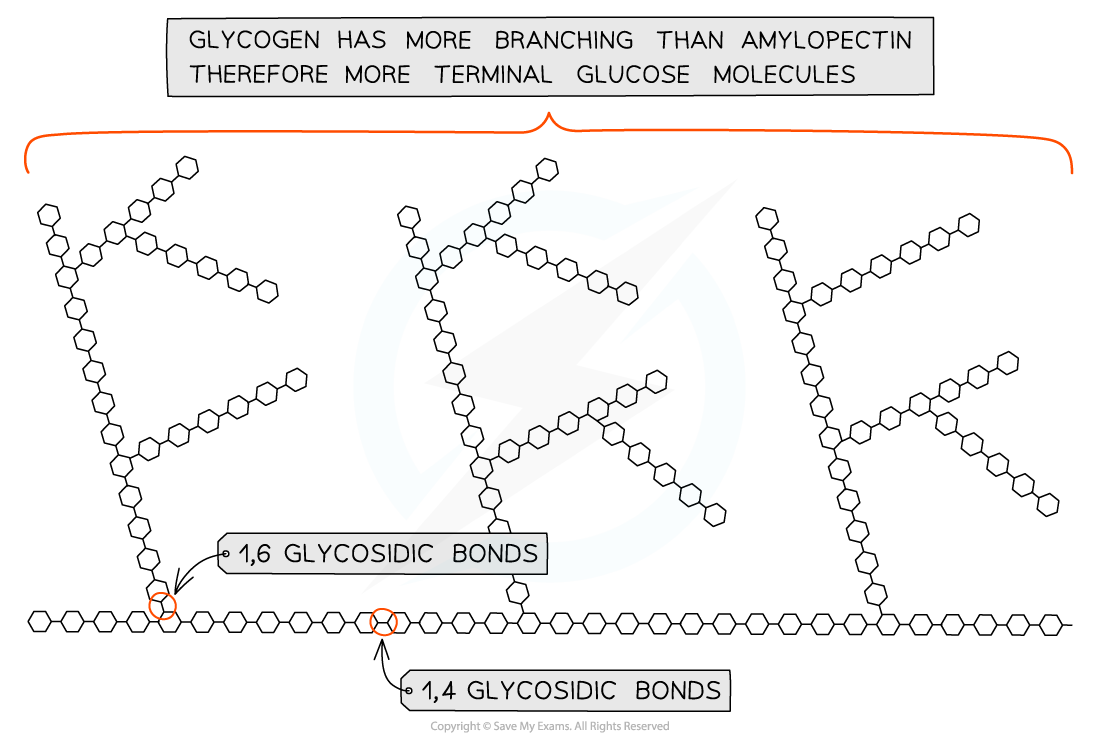
Glycogen is a highly branched molecule used as a storage polysaccharide in animals and fungi
Glycogen: function
-
Glycogen is the storage polysaccharide of animals and fungi
-
Glycogen is more branched than amylopectin
-
The branching provides more terminal glucose molecules which can either be added to or removed by hydrolysis; this allows the quick storage or release of glucose to suit the demands of the cell
- This is essential in animal cells as animals are very metabolically active
-
-
Glycogen is compact which means that much can be stored in a small space
- Liver and muscles cells have a high concentration of glycogen, present as visible granules; this enables a high cellular respiration rate
Summary of Storage Polysaccharides Table
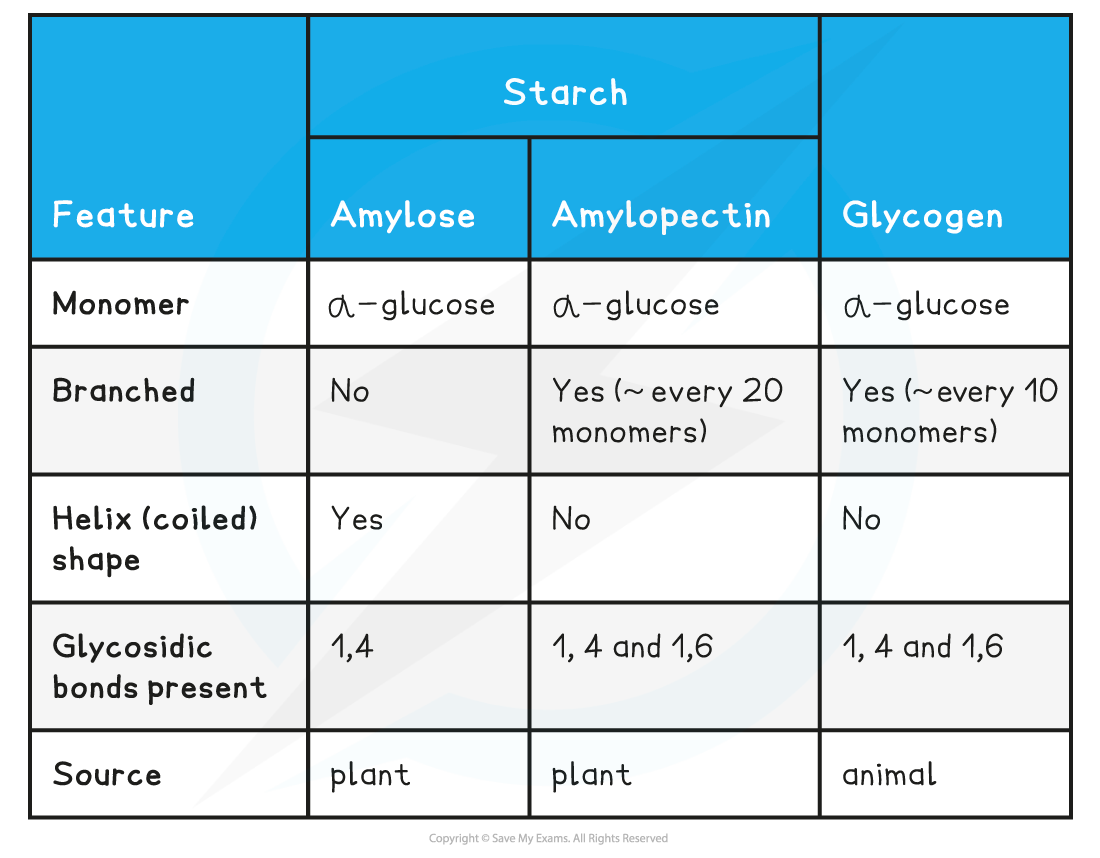
Types of Carbohydrate Summary Table
Was this revision note helpful?