Polymerase Chain Reaction (Edexcel IAL Biology)
Spec point —
6.17
Polymerase Chain Reaction
-
Every person, with the exception of identical twins, has a unique DNA sequence which can be used to create a DNA profile
-
This is very useful in forensic science as it provides a way to identify individuals
-
DNA profiling can also be used to determine the genetic relationships between different organisms e.g.
- Paternity and maternity testing
- Ancestry kits
- Determining evolutionary relationships between different species
-
-
DNA profiles can be created using the following steps
- Isolating a sample of DNA e.g. from saliva, skin, hair, or blood
- Producing more copies of the DNA fragments in the sample using the polymerase chain reaction (PCR)
- Carrying out gel electrophoresis on the DNA produced by PCR
- Analysing the resulting pattern of DNA fragments
The polymerase chain reaction
-
PCR is a common molecular biology technique used in most applications of gene technology e.g.
- DNA profiling
- Genetic engineering
-
It can be described as an in vitro method of DNA replication
-
PCR produces many copies of a piece of DNA; this can be referred to as DNA amplification
- It is used to produce large quantities of specific fragments of DNA or RNA from very small quantities; even just one molecule of DNA or RNA is enough to run PCR
- By using PCR scientists can produce billions of identical copies of the DNA or RNA sample within a few hours
- In each PCR cycle the DNA is doubled, so in a standard run of 20 cycles a million DNA molecules are produced.
-
The process is carried out in a PCR machine, or thermal cycler, which automatically provides the optimal temperature for each stage and controls the length of time spent at each stage
-
Each PCR reaction requires
-
DNA or RNA to be amplified
-
Primers
- These are short sequences of single-stranded DNA that have base sequences complementary to the 3’ end of the DNA or RNA being copied; they define the region that is to be amplified, identifying where the DNA polymerase enzyme needs to bind
-
DNA polymerase
-
The enzyme used to build the new DNA or RNA strand.
-
The most commonly used polymerase is Taq polymerase, which comes from thermophilic bacterium Thermus aquaticus
- Taq polymerase does not denature at the high temperature required during the first stage of the PCR reaction
- The optimum temperature of Taq polymerase is high enough to prevent annealing of the DNA strands that have not been copied yet
-
-
Free nucleotides
- Enable the construction of new DNA or RNA strands
-
Buffer solution
- Ensures the optimum pH for the reactions to occur in
-
-
There are three main stages of the PCR reaction
-
Denaturation
- The double-stranded DNA is heated to 95 °C which breaks the hydrogen bonds that hold the two DNA strands together
-
Annealing
- The temperature is decreased to 50-60 °C so that primers can anneal to the ends of the single strands of DNA
-
Elongation / Extension
- The temperature is increased to 72 °C, as this is the optimum temperature for Taq polymerase to build the complementary strands of DNA to produce the new identical double-stranded DNA molecules
-
-
These three stages make up a single PCR cycle, and many cycles can be completed
- Each PCR cycle doubles the amount of DNA
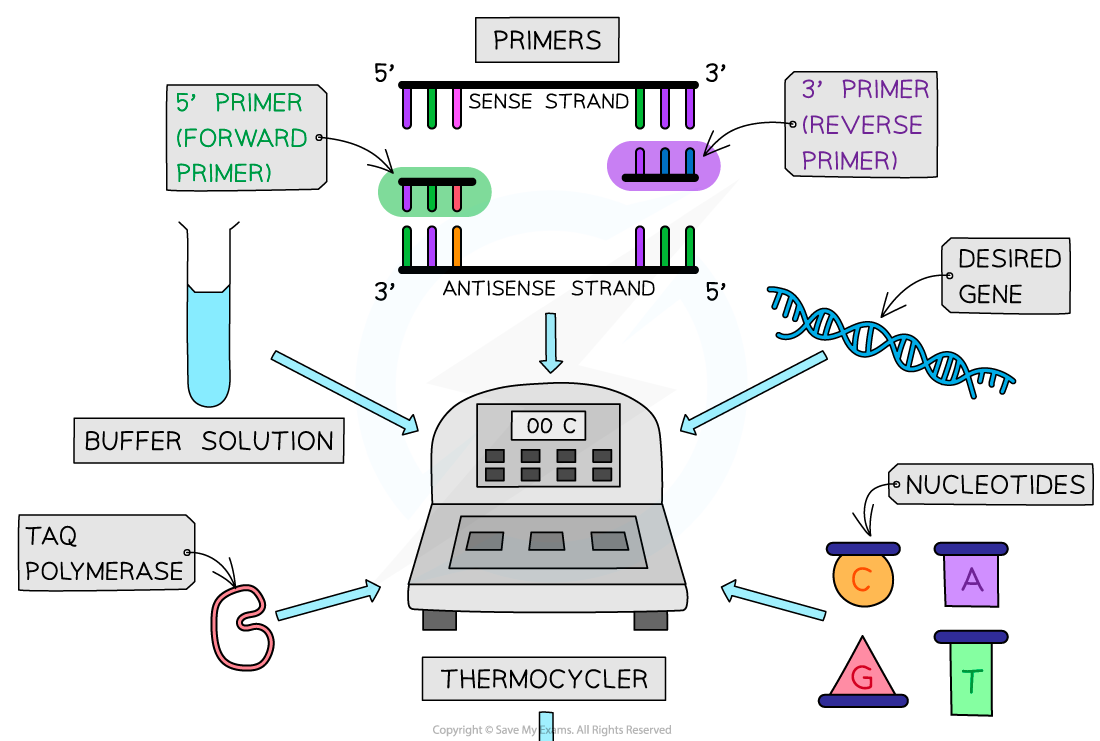
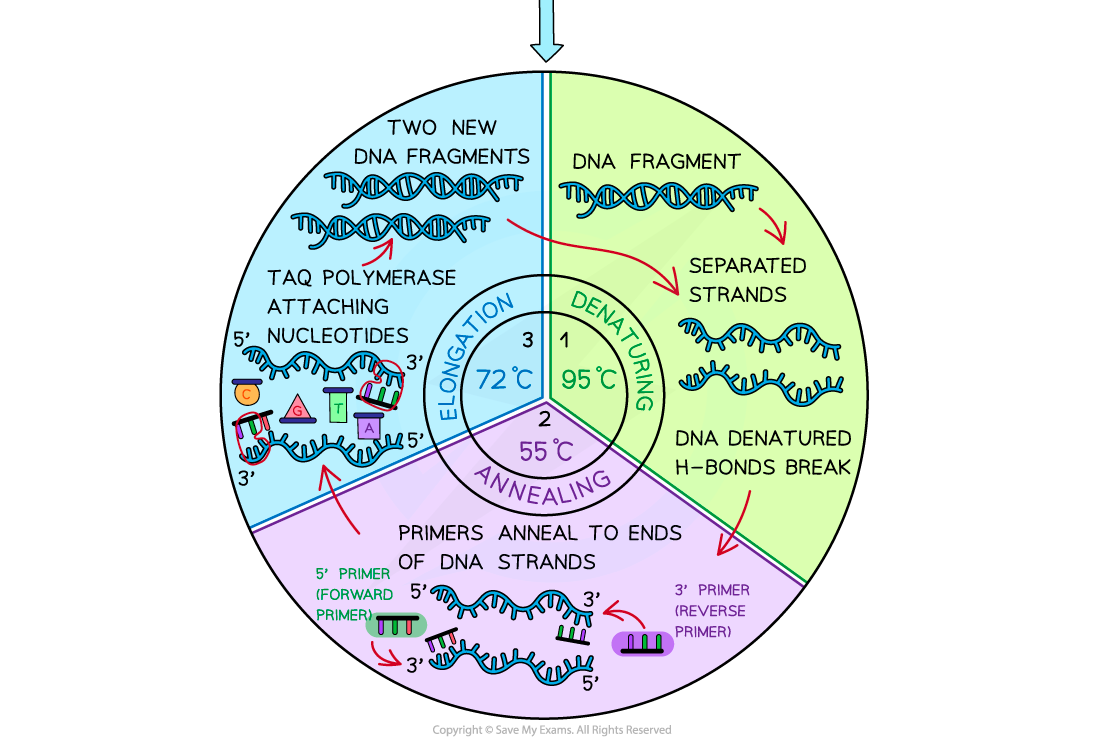
PCR can be used to amplify a fragment of DNA. Note that you don't need to know about forward and reverse primers
-
After PCR is completed the DNA is treated with *restriction endonuclease enzymes and a fluorescent tag can be added; both in preparation for gel electrophoresis
- Restriction endonucleases break the DNA up into fragments of different length
- Fluorescent tags enable the DNA fragments to be seen under UV light
Was this revision note helpful?