Convection (Cambridge International IGCSE Science)
Convection
-
Convection is the main way that heat travels through liquids and gases
- Convection only occurs in fluids
- Convection cannot happen in solids
-
In convection, the fluid near to the heat source is heated first
- This heated fluid then rises and is replaced by cooler fluid
-
The cooler fluid is, similarly, heated and then rises, being replaced by cold fluid
- In this way, a convection current is formed and the entirety of the fluid is heated
Explaining convection
Extended Tier Only
Density & convection
-
Descriptions of convection currents always need to refer to changes in temperature causing changes in density
-
The temperature may fall or rise, both can create a convection current
-
When a liquid (or gas) is heated (for example by a radiator near the floor):
-
The heated molecules vibrate and push each other apart, making the liquid/gas expand
- This makes the hot liquid/gas less dense than the surroundings
- The hot liquid/gas rises, and the cooler (surrounding) liquid/gas moves in to take its place
- Eventually the hot liquid/gas cools and contracts, increasing in density, and sinks back down again
- The resulting motion is called a convection current
Simple convection current diagram
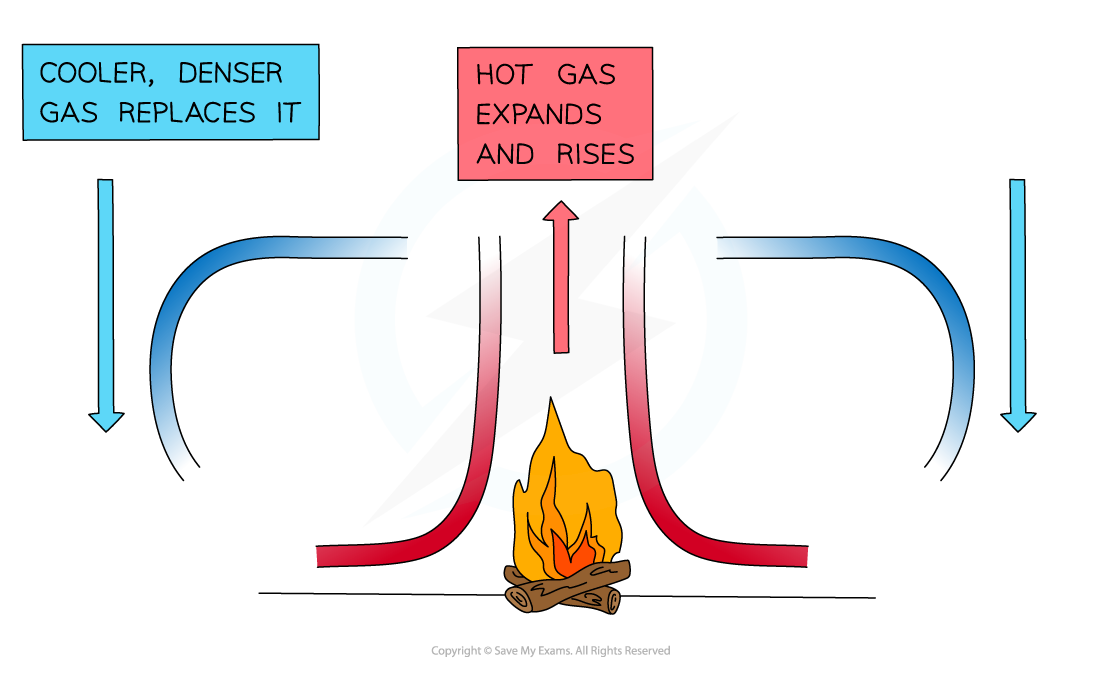
When a liquid or gas is heated, it becomes less dense and rises
-
When a liquid (or gas) is cooled (for example by an A.C. unit high up on a wall):
- The molecules lose energy and collide less, making the liquid/gas contract
- This makes the cold liquid/gas more dense than the surroundings
- The cold liquid/gas falls, so that warmer, less dense, liquid or gas can move into the space created
- The warmer liquid/gas gets cooled and also contracts and falls down
- The resulting motion is called a convection current
Exam Hint If a question on heat mentions liquids or gases the answer will probably be about convection.
Heat does not rise - it is the hot gases or liquids which rise due to the change in density when they were heated.
Video of Explaining convection
Was this revision note helpful?
Build on this topic