Reflection of Light (Cambridge International IGCSE Science)
The law of reflection
-
In optics, a normal line is defined as: An imaginary line drawn at right angles to the boundary between two media
-
A medium is a transparent material
-
Media is more than one transparent material
-
As shown in the diagram in reflection, angles are measured between the ray (showing the wave direction) and the normal line
- The normal is an imaginary line drawn at a right angle to the boundary
- The angle of the wave approaching the boundary is called the **angle of incidence (i)
- The angle of the wave leaving the boundary is called the** angle of reflection (r)
-
When drawing a ray diagram an arrow is used to show the direction the wave is travelling
- An incident ray has an arrow pointing towards the boundary
- A reflected ray has an arrow pointing away from the boundary
Ray diagram of reflection
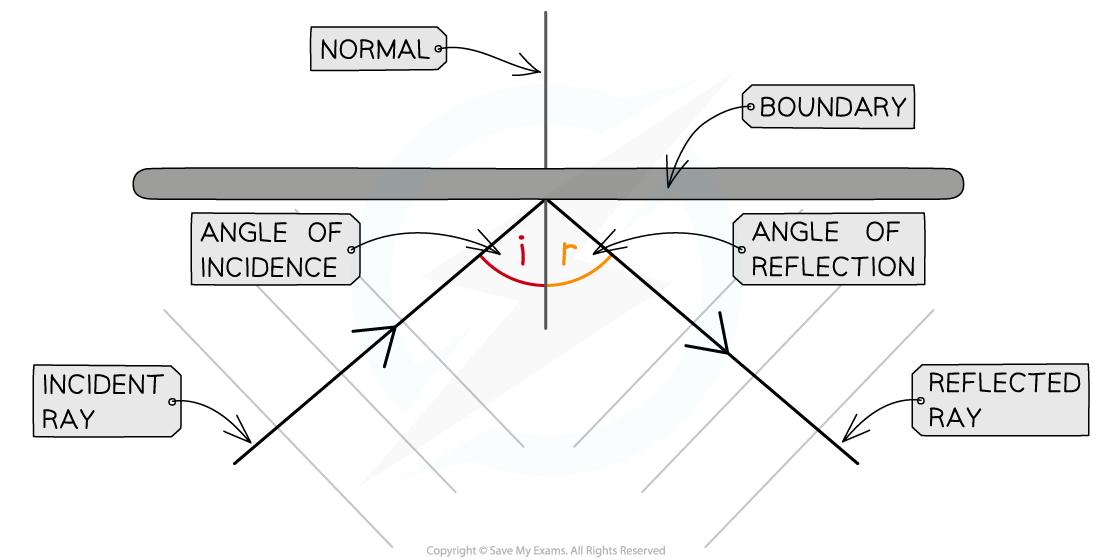
A ray diagram for light reflecting at a boundary, showing the normal, angle of incidence and angle of reflection
- For reflection, the law of reflection states that the angle of incidence is equal to the angle of reflection:
Angle of incidence (i) = Angle of reflection (r)
Reflection in a plane mirror
-
When an object is placed in front of a vertical plane mirror, an image of that object can be seen in the mirror
-
The image will be:
- The same size as the object
- The same distance behind the mirror as the object is in front of it
- Laterally inverted where the left and right sides of the image appear to be the opposite of those of the object
-
A plane mirror defines a flat, smooth and polished surface
Exam Hint When drawing light waves being reflected take care to get the angle about right.
If they are slightly out it won’t be a problem, but if there is an obvious difference between the angle of incidence and the angle of reflection then you will probably lose a mark.
Formation of an optical image
Spec point —
P4.2.1
Extended Tier Only
- When an object is placed in front of a plane mirror, a virtual image of that object can be seen in the mirror
- The formation of this virtual image can be understood by drawing a ray diagram
Ray diagram showing reflection in a plane mirror
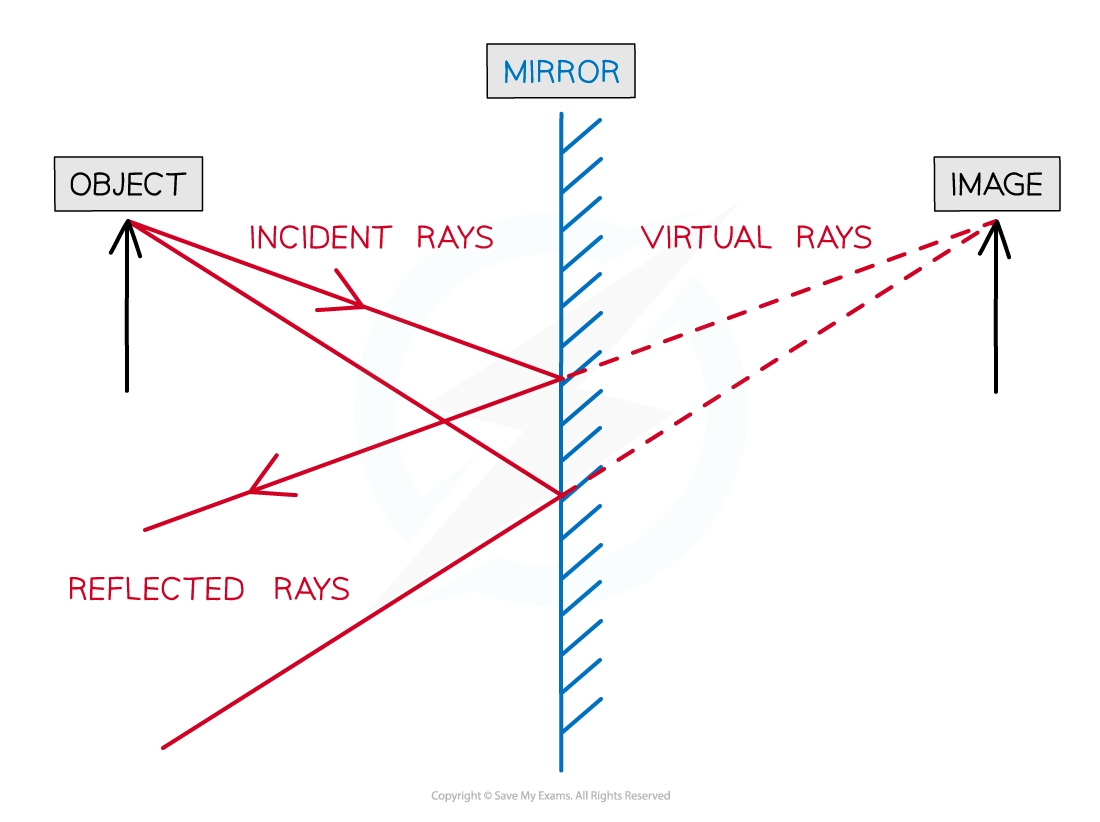
Diagram showing the formation of an image in a mirror by the reflection of light
-
Each incident ray on the diagram above can be drawn following these steps:
- Light from the object hits the mirror, reflecting from it (i=r)
- To an observer, the reflected ray appears to have come from behind the mirror
- The reflected ray can be traced back in this same direction behind the mirror, forming a virtual ray
- This process is repeated for another ray travelling in a slightly different direction
-
An image of the object will appear where these two virtual rays cross
-
The type of image formed in the mirror is called a virtual image because of the divergence of the rays from the image
- It cannot be projected onto a piece of paper (because the rays don’t go through the image)
Video of Reflection
Was this revision note helpful?
Build on this topic