Electrolysis of Molten Compounds (Cambridge International IGCSE Science)
Exam board Cambridge International · IGCSEUpdated 2025-12-22
Electrolysis of molten lead(II) bromide
Spec point — Identify the products formed at the electrodes and describe the observations made during the electrolysis of: molten lead(II) bromide
Electrolysis of molten lead(II) bromide
Method:
- Add lead(II) bromide into a beaker and heat it so it will turn molten, allowing ions to be free to move and conduct an electric charge
- Add two graphite rods as the electrodes and connect this to a power pack or battery
- Turn on the power pack or battery and allow electrolysis to take place
- Negative bromide ions move to the positive electrode (anode) and each loses one electron to form bromine molecules. There is bubbling at the anode as brown bromine gas is given off
- Positive lead ions move to the negative electrode (cathode) and gain electrons to form a grey lead metal which deposits on the surface of the electrode
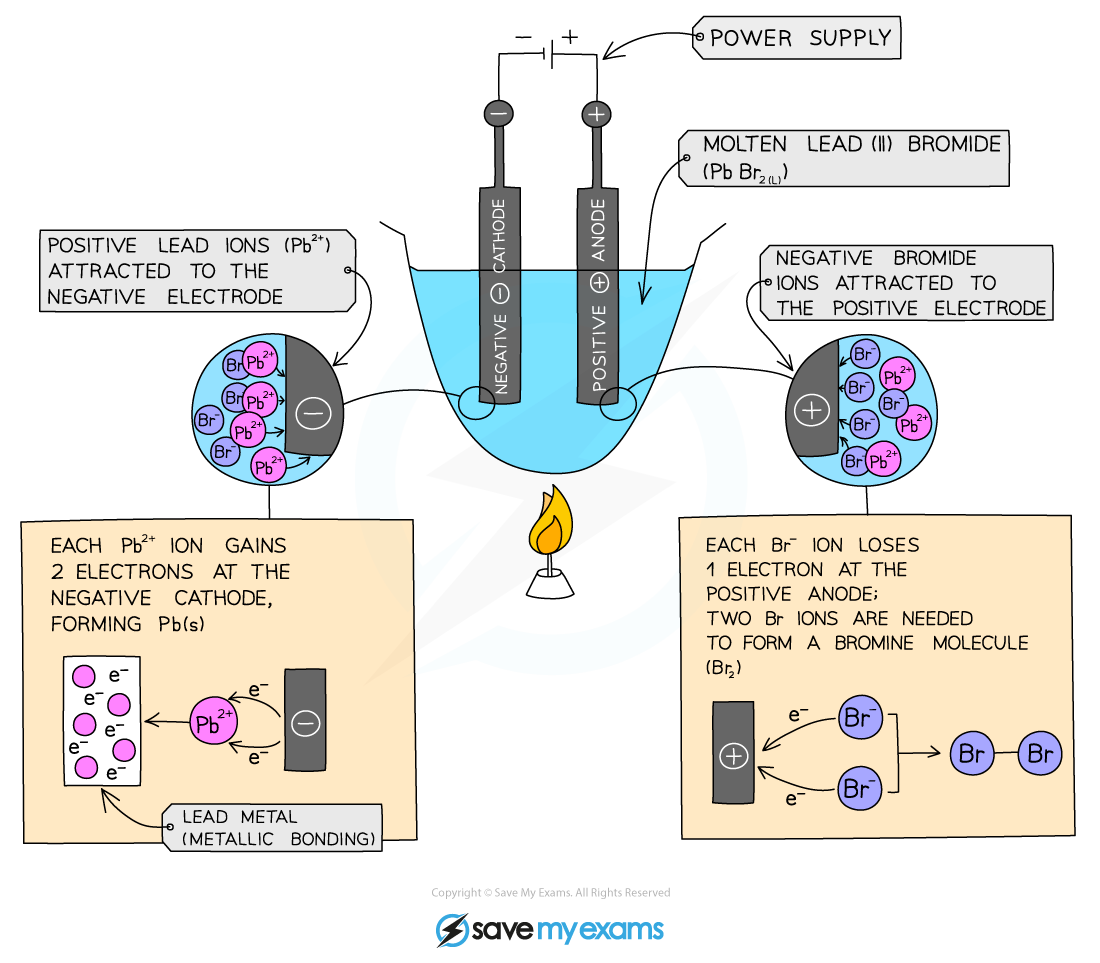
Diagram showing the electrolysis of lead(II) bromide
Exam Hint Remember: Electrodes need to be inert such as graphite or platinum so that they don’t participate in a side reaction with the electrolyte.
Predicting the products
Spec point — Predict the identity of the products at each electrode for the electrolysis of a binary compound in the molten state
- A binary ionic compound is one consisting of just two elements joined together by ionic bonding
- When these compounds undergo electrolysis, they always produce their corresponding elements
- To predict the products made at each electrode, first identify the ions
- The positive ion will migrate towards the cathode and the negative ion will migrate towards the anode
- Therefore, the cathode product will always be the metal, and the product formed at the anode will always be the non-metal
Worked Example Identify the product formed at the anode and cathode during the electrolysis of molten potassium chloride.
Answer:
- The ions present are potassium (K+) and chloride (Cl-)
- The chloride ions are attracted to the anode and form chlorine gas
- The potassium ions are attracted to the cathode and form potassium metal
Was this revision note helpful?
Build on this topic