Preparing Soluble Salts (Cambridge International IGCSE Science)
Spec point — Describe the preparation, separation and purification of soluble salts by reaction of an acid with: an alkali by titration excess metal excess insoluble base excess insoluble carbonate
Preparing soluble salts
How to name a salt
-
The name of salt has two parts:
- The first part comes from the metal, metal oxide or metal carbonate used in the reaction
- The second part comes from the acid
-
The name of the salt can be determined by looking at the reactants
- For example, hydrochloric acid always produces salts that end in chloride and contain the chloride ion, Cl-
-
Other examples:
- Sodium hydroxide reacts with hydrochloric acid to produce sodium chloride
- Zinc oxide reacts with sulfuric acid to produce zinc sulfate
What is a salt?
-
A salt is a compound that is formed when the hydrogen atom in an acid is replaced by a metal or ammonium ion
- For example, replacing H in HCl with potassium gives potassium chloride, KCl
-
Salts have many uses including:
- Fertilisers
- Batteries
- Cleaning products
- Healthcare products
- Fungicides
-
The method used depends on:
- The solubility of the salt being prepared
- Whether the base is insoluble or soluble (alkali)
Preparing soluble salts
-
There are two main methods of preparing a soluble salt:
-
Method A: Using excess solid reactant
-
This includes three reactions:
- Using excess metal
- Using excess insoluble base
- Using excess insoluble carbonate
-
-
Method B: Using an alkali (by titration)
- This is for soluble bases such as sodium hydroxide
-
The method used depends on:
- Whether the base is insoluble or soluble (alkali)
- Whether a metal is used
Method A: Using excess solid reactant
This method is used when the reactant is a solid in excess. Any unreacted solid is removed by filtration, then the salt is crystallised.
Method A1: Using excess metal
- This is for metals that react with dilute acids
- Add dilute acid to a beaker
- Add the metal in small pieces while stirring until no more reacts
- This means that the metal is in excess
- Filter the mixture to remove the excess metal
- Transfer the filtrate (salt solution) to an evaporating basin
- Heat the evaporating basin gently until the solution is concentrated
- Check the solution is saturated by dipping a cold, glass rod into the solution and seeing if crystals form on the end
- Leave the basin in a warm place to crystallize
- If necessary, decant any excess liquid
- Dry the crystals with filter paper
Example reaction - preparing magnesium sulfate crystals:
magnesium + sulfuric acid → magnesium sulfate + hydrogen
Mg (s) + H2SO4(aq) → MgSO4(aq) + H2(g)
Method A2: Using excess insoluble base
- This is for insoluble bases such as metal oxides
- Warm dilute acid gently in a beaker
- Add the insoluble base slowly while stirring until no more reacts
- This means that the insoluble base is in excess
- Filter the mixture to remove the excess insoluble base
- Transfer the filtrate (salt solution) to an evaporating basin
- Heat the evaporating basin gently until the solution is concentrated
- Check the solution is saturated by dipping a cold, glass rod into the solution and seeing if crystals form on the end
- Leave the basin in a warm place to crystallize
- If necessary, decant any excess liquid
- Dry the crystals with filter paper
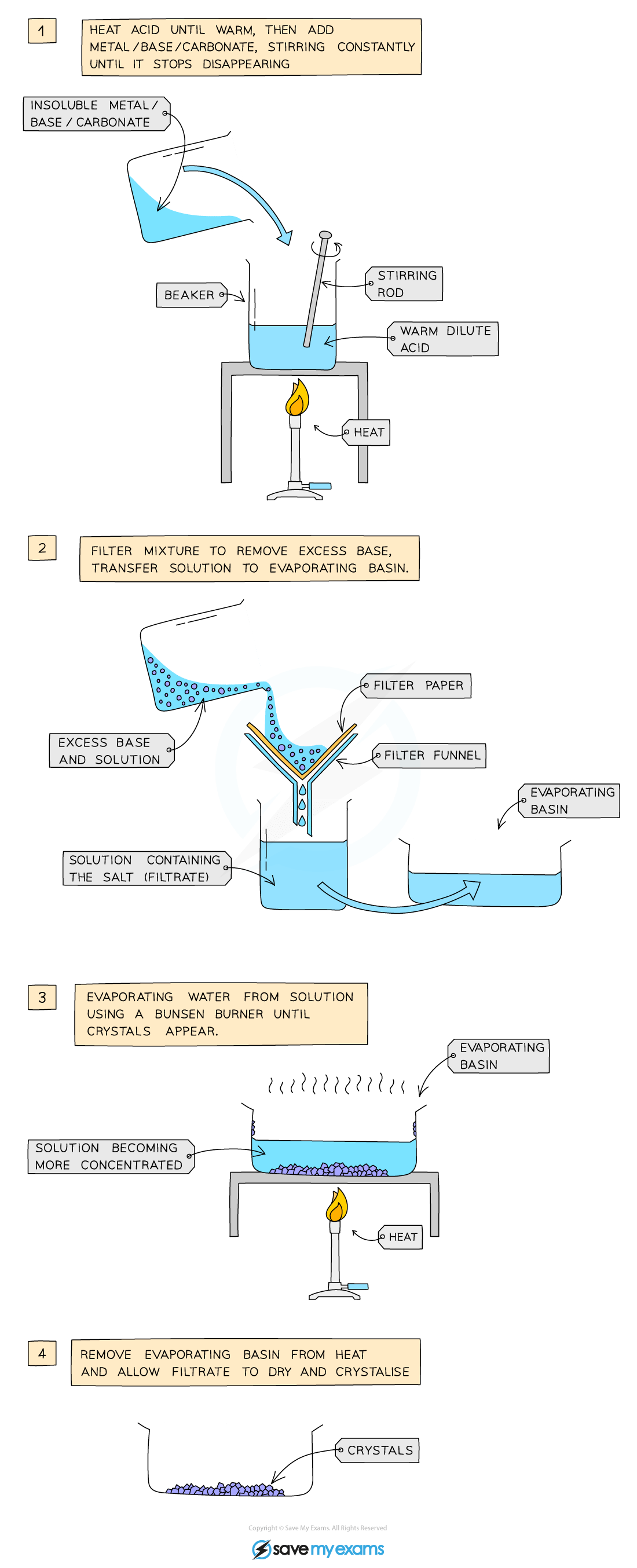
*Diagram showing the preparation of soluble salts *
- Example reaction - preparing copper(II) sulfate:
copper(II) oxide + sulfuric acid → copper(II) sulfate + water
CuO (s) + H2SO4(aq) → CuSO4(aq) + H2O (l)
Method A3: Using excess insoluble carbonate
-
This is for metal carbonates that do not dissolve in water
-
The method is exactly the same as using excess insoluble base:
- Warm dilute acid gently in a beaker
- Add the insoluble carbonate slowly while stirring until no more reacts (carbonate in excess)
- Filter to remove the excess insoluble carbonate
- Transfer the filtrate (salt solution) to an evaporating basin
- Heat the evaporating basin gently until the solution is concentrated
- Leave to crystallize, decant any excess liquid, and dry the crystals
-
Example reaction - preparing calcium chloride:
calcium carbonate + hydrochloric acid → calcium chloride + carbon dioxide + water
CaCO3(s) + 2HCl (aq) → CaCl2(aq) + CO2(g) + H2O (l)
Method B: Using an alkali (by titration)
- This is for soluble bases such as sodium hydroxide
- Use a pipette to place alkali in a conical flask
- Add a few drops of indicator (e.g. phenolphthalein)
- Fill a burette with the acid and record the starting volume
- Add the acid slowly while swirling until the indicator changes colour (end point)
- Record the final volume
- Repeat the titration without indicator, using the same measured volume of acid
- Heat the neutral solution in an evaporating basin until concentrated
- Check the solution is saturated by dipping a cold, glass rod into the solution and seeing if crystals form on the end
- Leave the basin in a warm place to crystallize
- If necessary, decant any excess liquid
- Dry the crystals with filter paper
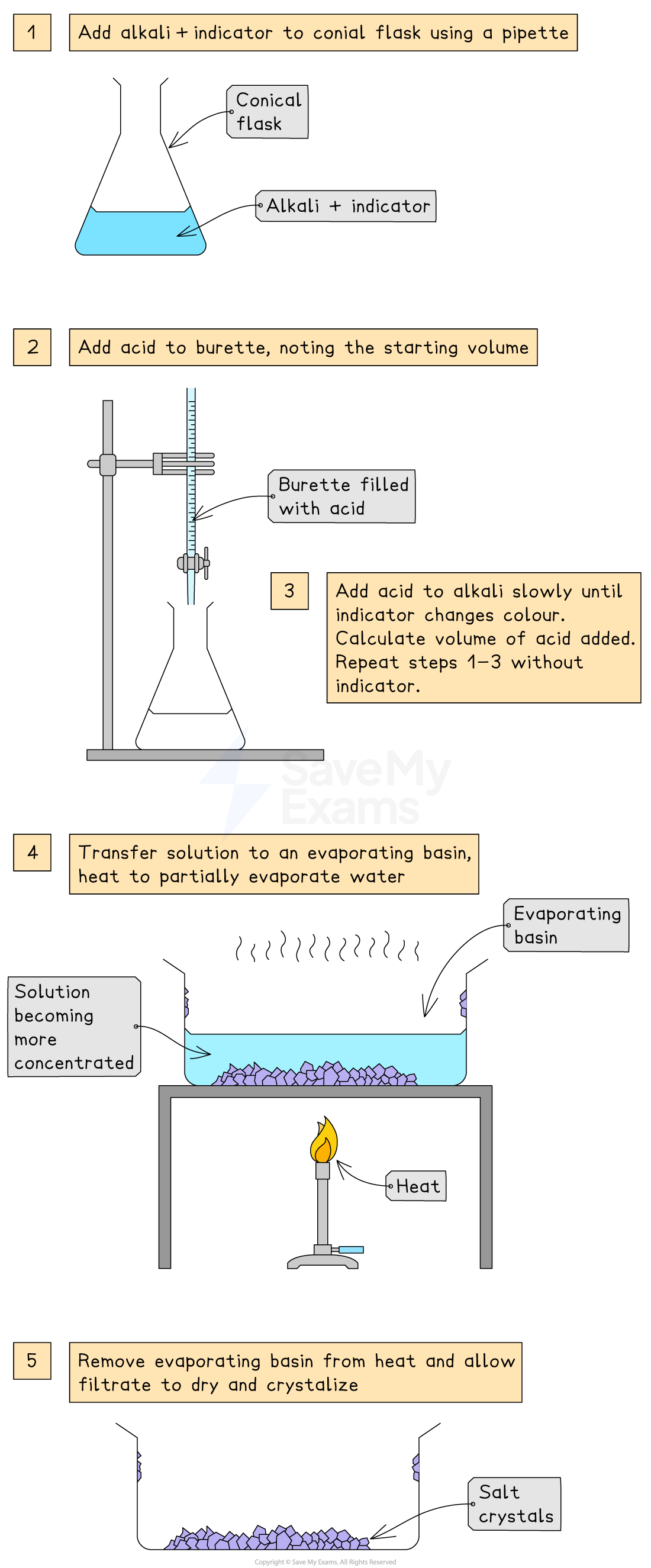
Diagram showing the apparatus needed to prepare a salt by titration
- Example reaction - preparing sodium chloride crystals:
sodium hydroxide + hydrochloric acid → sodium chloride + water
NaOH (aq) + HCl (aq) → NaCl (aq) + H2O (l)
Exam Hint Use Method B (titration) if the base is soluble (alkali)
Use Method A (excess solid) if adding a solid in excess, then filtering and crystallising:
- A1 for excess metal
- A2 for excess insoluble base
- A3 for excess insoluble carbonate
Was this revision note helpful?
Build on this topic