Properties of Metals (Cambridge International IGCSE Science)
Physical properties of metals & non-metals
-
The Periodic Table contains over 100 different elements
-
They can be divided into two broad types:
- Metals
- Non-metals
-
Most of the elements are metals and a small number of elements display properties of both types
- These elements are called metalloids or semimetals
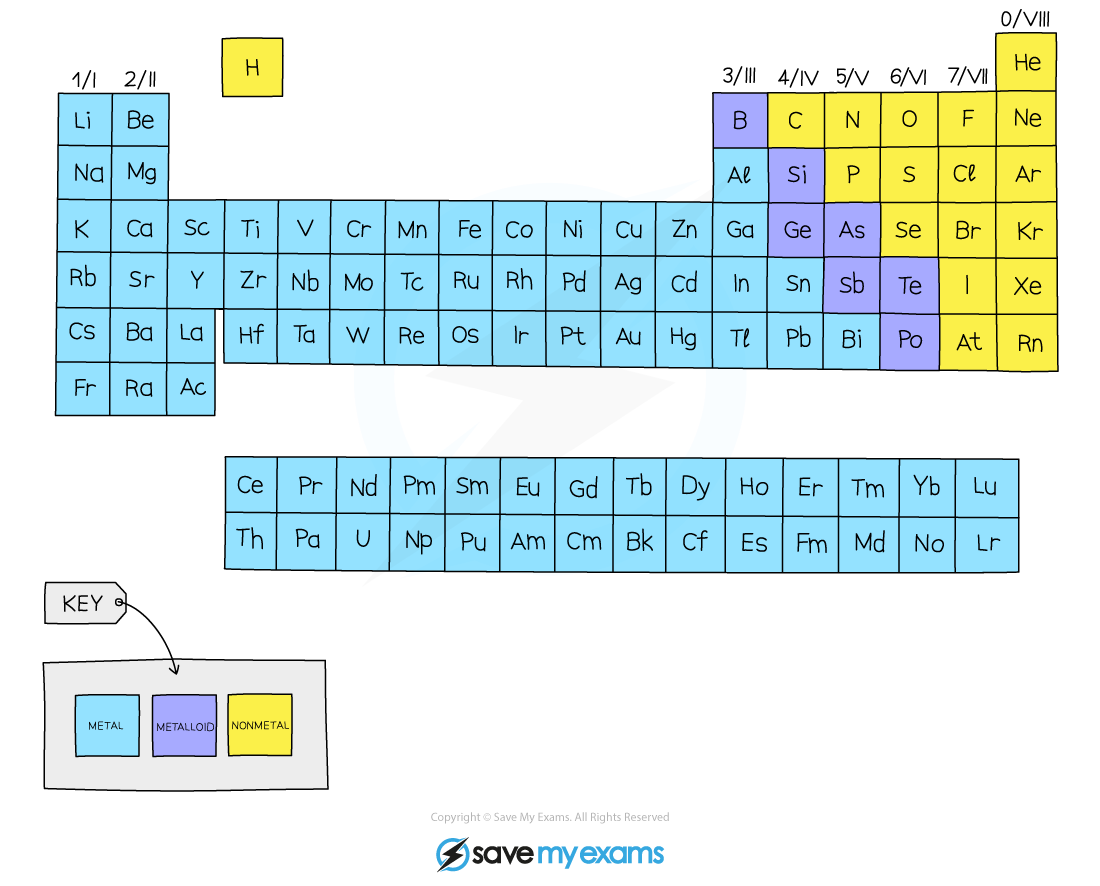
The metallic character diminishes moving left to right across the Periodic Table
Properties of metals
-
Conduct heat and electricity
- This is because metals have delocalised electrons that are able to move through the metal structure
-
Are malleable (can be hammered and made into different shapes) and ductile (can be drawn into wires)
- This is because the layers of positive metal ions, in the metal structure, are able to slide over each other
-
Usually have high melting and boiling points
- This is because there is a strong electrostatic attraction between the positive metal ions and delocalised electrons (metallic bond)
- This strong attraction / bond requires lots of energy to break
Properties of non-metals
-
Do not conduct heat and electricity
- This is because all of the electrons are involved in covalent bonding
- One exception to this is graphite (it conducts electricity)
-
Are brittle when solid and easily break up
- They are not malleable or ductile
- One exception to this is graphite
-
Low melting and boiling points
- Many non-metals are gases at room temperature
- This is because they have weak forces between molecules
- These weak intermolecular forces do not require a lot of energy to overcome
- Exceptions to this include diamond
Chemical properties of metals
- The chemistry of metals is studied by analysing their reactions with water, dilute acid and oxygen
- Based on these reactions, a reactivity series of metals can be produced
Reactions of metals with water
- Some metals react with water, either cold water or with steam
- Metals that react with cold water form a metal hydroxide and hydrogen gas
metal + water → metal hydroxide + hydrogen
- For example, calcium:
Ca (s) + 2H2O (l) → Ca(OH)2(aq) + H2(g)
- Metals that react with steam form a metal oxide and hydrogen gas
metal + water → metal oxide + hydrogen
- For example, zinc:
Zn (s) + H2O (g) → ZnO (s) + H2(g)
Reactions of metals with acids
- Most metals react with acids, such as HCl
- When acids and metals react, the hydrogen atom in the acid is replaced by the metal atom to produce a salt and hydrogen gas
metal + acid → salt + hydrogen
- For example, iron:
Fe (s) + 2HCl (aq) → FeCl2(aq) + H2(g)
Was this revision note helpful?
Build on this topic