Group VII Properties (Cambridge International IGCSE Science)
Group VII properties & trends
Spec point — Describe the Group VII halogens, chlorine, bromine and iodine, as diatomic non-metals with general trends down the group, limited to: increasing density decreasing reactivity State the appearance of the halogens at r.t.p. as: chlorine, a pale yellow-green gas bromine, a red-brown liquid iodine, a grey-black solid
Group VII properties & trends
-
These are the Group VII non-metals that are poisonous and include fluorine, chlorine, bromine, iodine and astatine
-
Halogens are diatomic
- This means that they form molecules containing two atoms
-
The formulae of the halogens are:
- Fluorine = F2
- Chlorine = Cl2
- Bromine = Br2
- Iodine = I2
- Astatine = At2
-
All halogens have seven electrons in their outer shell
- They form halide ions by gaining one more electron to complete their outer shells
-
Fluorine is not allowed in schools so observations and experiments tend to only involve chlorine, bromine and iodine
Properties of the halogens
Physical state, colour and density
-
At room temperature (20 °C), the physical state of the halogens changes as you go down the group
- Chlorine is a pale yellow-green gas
- Bromine is a red-brown liquid
- Iodine is a grey-black solid
-
This demonstrates that the density of the halogens increases as you go down the group:
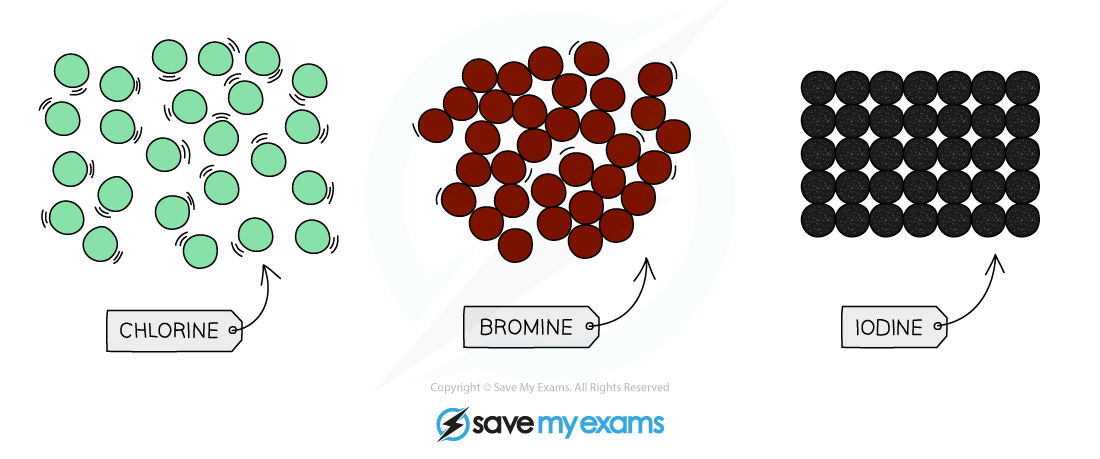
The physical state of the halogens at room temperature
Exam Hint Solid iodine, iodine in solution and iodine vapour are different colours.
- Solid iodine is dark grey-black
- Iodine vapour is purple
- Aqueous iodine is brown.
Reactivity
-
The reactivity of Group 7 elements decreases as you go down the group
- This is the opposite trend to Group 1
-
When a halogen reacts, it needs to gain one outer electron to achieve a full outer shell of electrons
-
As you go down Group 7, the number of electron shells increases
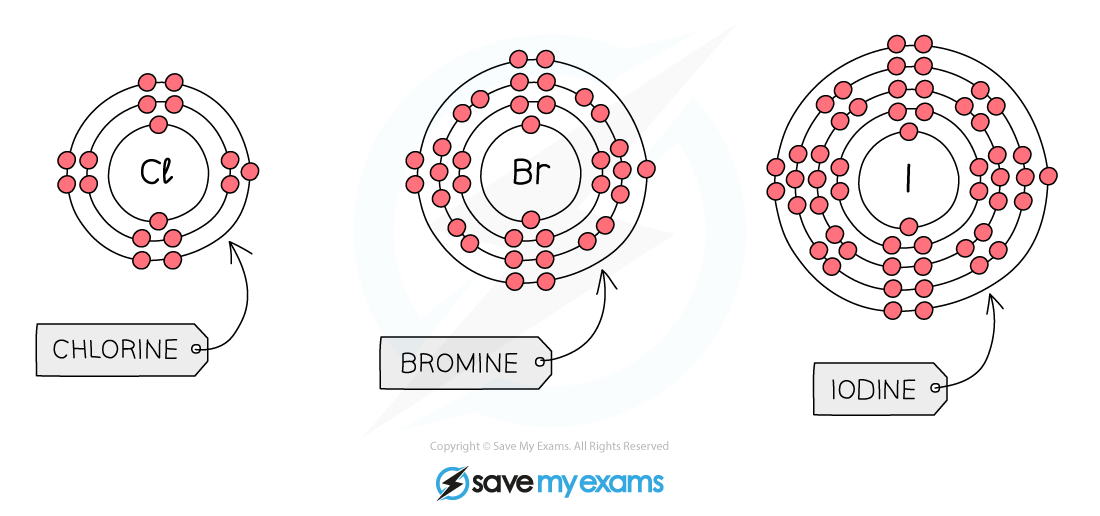
Diagram showing the electronic configuration of the first three elements in Group 7
-
The increasing number of electron shells has two main effects:
- The atomic radius increases, so the outer shell is further from the nucleus
- There is more electron shielding from the inner shells
-
These factors reduce the force of attraction between the nucleus and an incoming electron
-
Therefore, it becomes harder to attract an electron
-
This means that the reactivity of the halogens decreases down the group
Predicting group VII properties
Spec point — Predict the properties of other elements in Group VII, given information about the elements
Extended only
- You may be given information about some elements and asked to predict the properties of other elements in the group
- The information you might be given could be in relation to melting/boiling point or physical state/density so it is useful to know the trends in properties going down the group
Predicting melting and boiling point
-
The melting and boiling point of the halogens increases as you go down the group
-
Fluorine is at the top of Group 7
- It has the lowest melting and boiling point
-
Astatine is at the bottom of Group 7
- It has the highest melting and boiling point
Predicting physical states and density
-
The halogens become denser as you go down the group
-
Fluorine is at the top of Group 7
- It is a gas
-
Astatine is at the bottom of Group 7
- It is a solid
Predicting colour
-
The colour of the halogens becomes darker as you go down the group
-
Fluorine is at the top of Group 7 so the colour will be lighter
- Fluorine is yellow
-
Astatine is at the bottom of Group 7 so the colour will be darker
- Astatine is black
Exam Hint You can be asked to identify trends in chemical or physical properties of the Group 7 elements, given appropriate data.
- Place the elements and associated data in either ascending or descending order according to their position in Group 7
- Look for any general patterns in the data
Was this revision note helpful?
Build on this topic