States of Matter (Cambridge International IGCSE Science)
Exam board Cambridge International · IGCSEUpdated 2026-01-16
State changes
-
State changes occur when:
- Solids become liquids
- Liquids become gases
- Gases become liquids
- Liquids become solids
-
Each state change requires a change in the energy, arrangement and movement of the particles
The state changes
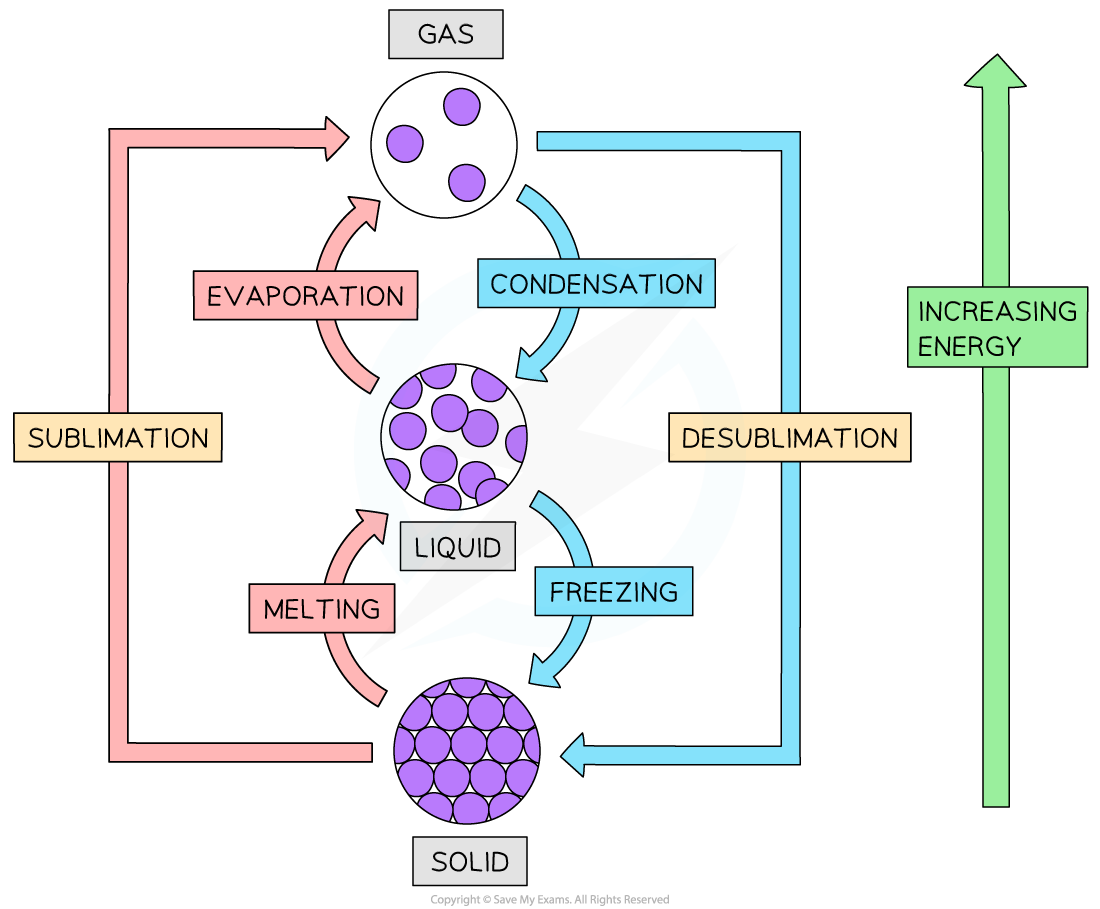
The inter-conversions / state changes are shown in relation to energy
Melting
- Melting is when a solid changes into a liquid
- Requires heat energy which transforms into kinetic energy, allowing the particles to move
- Occurs at a specific temperature known as the melting point (m.p.)
Freezing
- Freezing is when a liquid changes into a solid
- This is the reverse of melting and occurs at exactly the same temperature as melting, hence the melting point and freezing point of a pure substance are the same. Water, for example, freezes and melts at 0 ºC
- Requires a significant decrease in temperature (or loss of thermal energy) and occurs at a specific temperature
Boiling
- Boiling is when a liquid changes into a gas
- Requires heat which causes bubbles of gas to form below the surface of a liquid, allowing for liquid particles to escape from the surface and within the liquid
- Occurs at a specific temperature known as the boiling point (b.p.)
Evaporation
- Evaporation occurs when a liquid changes into a gas and occurs over a range of temperatures
- Evaporation occurs only at the surface of liquids where high energy particles can escape from the liquid's surface at low temperatures, below the b.p. of the liquid
- The larger the surface area and the warmer the liquid surface, the more quickly a liquid can evaporate
Condensation
- Condensation occurs when a gas changes into a liquid on cooling and it takes place over a range of temperatures
- When a gas is cooled its particles lose energy and when they bump into each other they lack the energy to bounce away again, instead they group together to form a liquid
Exam Hint Questions on the particle theory of matter show interconversion of states with a reversible arrow: ⇌, which means that the process can go forwards and backwards.
Read the question carefully and pick the direction of the change in state that the question refers to.
State Changes & Kinetic Theory
Extended Tier Only
-
When substances are heated, the particles absorb thermal energy which is converted into kinetic energy
- This is the basis of the kinetic theory of matter
-
Heating a solid causes its particles to vibrate more
- As the temperature increases, the particles vibrate so much that the solid expands until the structure breaks
- This is when the solid melts into a liquid
-
Heating a liquid causes its particles to move more and spread out
- Some particles at the surface gain sufficient energy to overcome the intermolecular forces
- This is when a liquid starts to evaporate
- When the boiling point is reached, all of the particles gain enough energy to escape and the liquids boils into a gas
Was this revision note helpful?
Build on this topic